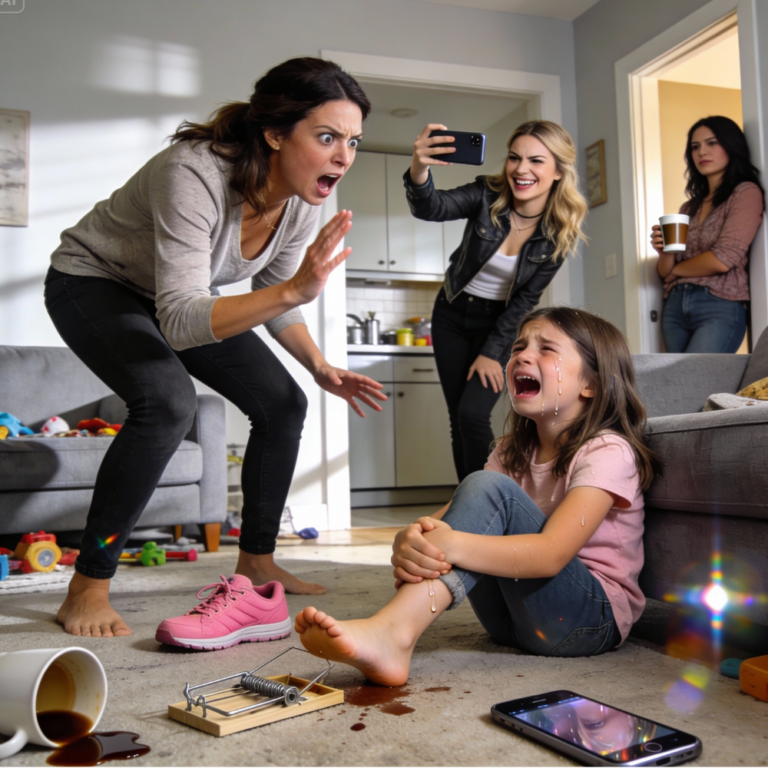
The sound that trap made when it snapped shut still echoes in my head. It was small—metal on rubber—but in that instant, it swallowed the world. My sister put mousetraps in my eight-year-old daughter’s shoes and filmed on her phone while my child screamed and cried. And my mother, coffee in hand, barely looked up before waving it off with a scoffed, “It’s nothing.” That was the last straw.
It had been raining that morning, Seattle’s usual gray mist turning the windows dull and streaked. The apartment smelled like instant coffee and body spray—my sister Carolina’s scent always lingered like static in the air. I’d woken up before sunrise to pack Sophia’s lunch and iron her uniform. I was running on four hours of sleep, same as every day. Work, school, dishes, repeat. No time for drama. At least, that’s what I told myself.
“Mom,” Sophia called from the hallway, her small voice bright and practiced. “Where are my sneakers?”
“By the door,” I answered, buttoning my blouse. “Next to my umbrella.”
She nodded, her dark hair pulled into a ponytail that made her look older than eight. I watched her cross the hall toward the shoes, humming under her breath. She was the kind of kid who liked things neat, shoes lined up perfectly, pencils sharpened to the same length. It was one of the few things I felt I’d done right as a mother. Teaching her order in a world that loved chaos.
From the next room came Carolina’s voice—too cheerful, too performative. “Hey, guys! Watch this. Best morning prank ever. Family edition.”
I froze mid-step.
In our house, “prank” was never funny. It was Carolina’s word for cruelty.
Before I could move, Sophia slipped her foot into the first sneaker. The snap was sharp. Metal biting rubber. Then came her scream—a sound so high it cracked at the end.
I dropped my coffee.
The mug shattered as I ran to her. Sophia was on the floor, both shoes kicked off, a thin red welt rising across her bare foot. A real mousetrap—metal bar, spring and all—lay open beside her sneaker.
“Got her!” Carolina crowed, phone up, camera rolling. Her laugh was shrill, manic. “Oh my god, look at her face! She totally fell for it!”
I lunged forward and snatched the phone from her hand before I even thought about it. “You filmed this?” I demanded.
She blinked, startled but unbothered. “Relax. It’s content. People love family pranks. It’ll get like ten thousand views, easy.”
“You put a trap in a child’s shoe,” I hissed.
“It’s not a big deal,” she said, rolling her eyes. “It didn’t even break the skin. You’re being dramatic.”
From behind her, our mother shuffled into the room, hair in curlers, robe half-tied. She held her mug like a prop in a bad sitcom. “What’s all the screaming about?”
I pointed to Sophia, still crying softly into her hands. “She stepped on a mousetrap.”
Mom took one look and shrugged. “It’s nothing. She’ll live.”
“Nothing?” I stared at her. “She’s bleeding.”
“Oh, come on, Morgan,” she said. “Don’t start one of your scenes. Kids need to toughen up. My dad used to snap traps on his fingers all the time. Builds character.”
I couldn’t believe what I was hearing.
Sophia was trembling, the tears on her cheeks cutting pale streaks through the dust on her face. I knelt beside her and touched her foot gently. The skin was red and swollen.
“Let me see, sweetheart,” I said softly.
She looked up at me, her lashes clumped with tears. “It hurts, Mom.”
“I know,” I whispered, wrapping her in my arms. “I know it does.”
Behind me, Carolina was still talking to her phone, oblivious. “Anyway, guys, don’t forget to like and follow. Family content every day!”
“Turn that off,” I said without looking at her.
Carolina laughed. “You seriously need to lighten up. No one got hurt.”
“No one got hurt?” I stood up, shaking. “You trapped my kid for views. You filmed her pain. What is wrong with you?”
“God, you’re so dramatic.” She flipped her hair over her shoulder. “You’re always the victim. Maybe if you had a sense of humor, people wouldn’t find you so boring.”
Mom snorted into her coffee. “At least your sister’s trying to make something of herself. You’re thirty-seven, working part-time at a café, and still living under my roof. Maybe you could learn a thing or two from her about ambition.”
Ambition. That word felt like poison in my mouth.
I looked at Sophia—my small, kind, bookish daughter—now afraid to even touch her own shoes. And I realized I couldn’t let her grow up thinking this was normal. That pain was content. That cruelty was love.
“Put on your rain boots,” I told her quietly.
Carolina frowned. “Excuse me?”
“Boots,” I repeated, not looking at her. “Now, Sophia.”
Sophia stood, wobbly but determined, and slipped her feet into her rubber boots. The pink ones with little clouds on the sides. She wiped her tears with her sleeve, her face set in that too-adult way she had when she was scared.
“Mom,” she said, barely above a whisper. “I don’t want to live here anymore.”
It wasn’t a tantrum. It wasn’t even a plea. It was a fact.
Something inside me went very still.
I walked to the counter, grabbed my phone, and scrolled through my contacts until I found the number I hadn’t called in years.
“Mrs. Brooks?” I said when she picked up. “It’s Morgan Wells. You mentioned once that you had a spare room.”
There was a pause on the other end. Then her voice, calm and firm. “I remember. You can have it. Bring your daughter. And don’t look back.”
I hung up.
Carolina laughed. “What, you’re running away now? You’ll be back. You always come crawling back.”
Mom looked up from her coffee. “You’re not taking that child out of this house.”
“I’m not leaving you,” I said evenly. “I’m taking care of us.”
“Where do you think you’ll go?” Carolina sneered. “No one wants you. Not even Dad did.”
I turned to face her. “You’re right,” I said. “No one did. Until now.”
We packed in silence. Sophia grabbed her backpack, a sweater, her favorite stuffed bear. I took my purse, her birth certificate, and one photo from the fridge—her laughing on a swing, the sun behind her.
Mom blocked the door, one hand on her hip. “You walk out that door, you don’t come back.”
“Then this is goodbye,” I said, brushing past her.
The rain had picked up outside, steady and silver. The pavement glistened beneath the streetlights. Sophia held my hand tightly as we walked down the stairs, her little fingers cold in mine.
“Are we really not coming back?” she asked.
I looked at her, at her red eyes and trembling lip, and said the only thing I could. “We’ll come back when we want to, not when they let us.”
At the corner, the bus to Portland hissed to a stop, doors folding open with a sigh.
We climbed aboard, damp hair clinging to our faces, and as the bus pulled away, I stared out the window at the house growing smaller behind us—the ring light still glowing faintly in Carolina’s window, chasing attention into the dark.
That was the morning everything changed.
My sister put mouse traps in my eight-year-old daughter’s shoes, then filmed on her phone while my child cried. My mother waved it off. It’s nothing. That was the last straw. I didn’t forgive them, even when they came crawling back, begging me. My alarm chirped twice and went quiet. I got up right away, not because I felt great, because mornings in our place didn’t wait for anyone.
In the hallway, my 8-year-old Sophia was already standing with her backpack, thin, focused, the kind of kid who hates to be late. “Mom, where are my sneakers?” “By the door,” I said, tying my scarf and helping her into her jacket. The coat rack clattered in our narrow hallway. Three women, one small apartment outside Seattle.
Me, my mom, Gloria, and my younger sister, Cararolina, the one who always had a live stream going. From the next room, Karolina’s voice popped like a bubble. Hey guys. Best morning prank for families. Watch this. I froze. In our home, prank always meant one thing. Someone would cry. Usually me or my kid. Found them.
Sophia bent by the bench, pulled out her sneakers, and slid her foot into the left one. Click. The world shrank to that sound. She shrieked high and small and yanked her foot back. A real metal mousetrap snapped around the insole. The right sneaker had one, too. It smacked shut when she touched it. Laughter burst from the doorway. Karolina stood there with her phone up recording.
Did you guys see that? She jumped. It’s a prank. . I flew forward, ripped the trap off, checked my kid’s toe. A red welt rose across the nail. Her jaw clenched so hard her cheeks shook. Don’t start. Gloria sighed, stepping out with her coffee. It’s a joke. She’s not made of glass. A joke. I pulled Sophia behind me, blocking the camera.
You put a mouse trap in a child’s shoe. Carolina tilted her phone. Relax. It’s content. People love family pranks. People love laughing at pain, I said. That doesn’t make it okay. Someone here needs to chill. She singonged. I’m making us go viral. Gloria snorted. At least your sister earns you. A cafe job and a kid. Be grateful she’s popular.
That old cold rose up in me. The kind that lives under your ribs. I looked at Sophia’s tear bright eyes at her red finger where she’d poked the trap. Something inside me clicked shut the same way that metal bar had. “Put on your rain boots,” I told Sophia. “We’re late.” Karolina panned the phone like a cat tracking a laser.
“Mom, tell her not to ruin the stream. Subscribers hate toxic energy.” “Toxic?” I stared at her. Toxic is putting traps in a kid’s shoes. It’s a trend, she said. Do you even know how the internet works? Sophia pulled on a boot and looked up at me. Mom, she said calm and even. I don’t want to live here anymore. Not a tantrum. A truth. It shook my hands more than any scream.
I got my phone, found the number, and hit call. Mrs. Helen Brooks, it’s Morgan Wells. I remember, said a dry, steady voice. I’ve got a spare room. Don’t bring whining. We’re coming today. My daughter and I come, she said. And bring the keys to your resolve. I hung up and looked around our hallway.
Ring light, tripods, a box of gags, fake roaches, a plastic poop, two more mouse traps, an altar to cheap attention. We’re leaving, I said. Gloria raised her brows. To that old witch in Oregon, she won’t take you in. She just did. Carolina smirked. You’ll hate it. No action, no content, no life.
Who’s going to subscribe to your soba story? I looked at my sister and saw nothing living. Only the cold ring light glow bouncing off a screen. Let silence subscribe to us, I said. I’ve been waiting for it. We packed in 20 minutes. Sophia’s backpack, a folder of papers, a couple of shirts, a jacket. I took one photo.
Sophia on a swing laughing. Karolina behind her, no phone in her hand, real eyes, real smile. There was a time when laughter didn’t hurt. Gloria blocked the door. “Don’t you dare take that child.” “I’m not leaving you,” I said. I’m going toward us. Karolina shouted from the doorway. No one opened that door for you. This is my house.
The door? I said, I opened it myself. Outside drizzle, pavement shining like glass. Mom, Sophia asked. Are we really not coming back? We’ll come back when we want to, I said. But we’re going to live where no one films our pain. We walked to the bus stop and for the first time in years, I didn’t look back. The bus to Portland came fast, like it had been waiting for my yes.
I bought two tickets, sat Sophia by the window. Mom, she said, forehead against the glass. Can we get a dog? If we want one, I said smiling. Tomorrow we start over. We arrived near sunset. wet leaves, an old swing, a porch light. On the steps stood Mrs. Helen Brooks, tall silver hair, a coat thrown over a house, keys in hand.
Inside, she said, “Soup’s cooling. Talk after dinner.” The house met us with quiet and the smell of bread, old pictures on the wall, a simple table, no ring lights, no tricks, just warmth. Sophia sat on a high stool, legs swinging. “Bed at 9:00,” Helen said. “School tomorrow. The teacher is strict but fair.” I nodded.
Her words didn’t feel like orders. They felt like beams, like the bones of a place where life holds. Next morning, Helen walked Sophia to the local elementary school and mapped my new world with me. Grocery, clinic, bus, post office. On the corner, a tiny cafe. Sign on the door. help wanted. “You’ll go in?” Helen asked. “I’ll go in,” I said, and breathed in freshly ground coffee.
The owner, Katie, looked me over with quick, kind eyes. Got experience a little. Can you smile? I can. Then you’ll learn the rest. Hours are tight. Tips are honest. Deal. Deal. By noon, I was wiping tables and messing up orders. No foam isn’t the same as no milk. Apologizing, trying again, and not giving up.
By close, my legs hummed and my pocket held 25 bucks in cash and a lunch voucher. For the first time in a long time, I felt tired without shame. At home, Helen drilled homework. “There, there, there,” she said, gentle but firm. “Kick mistakes out before they move in.” I set a small pie on the table, bought with my change. Dessert after grammar, Helen said.
Sophia saw the soften in her eye. She smiled. Tonight was an exception. Our rhythm found us. Days in the cafe, learning the difference between sweet but no syrup and no sweet but vanilla. Apologizing in a way that people believe. Smiling when I wanted to drop. Evenings at home, dinner, homework, the washer humming, sticky notes on the fridge, nights, tomorrow’s list.
Mornings, deep breath, three steps to the door. Go. A week later, I took a second job downstairs with Mrs. Patterson, the neighbor with sharp eyes and weak knees. I do it myself, she said. But the joints won’t let me. Dust, floors, milk. The cat will complain. He runs this place. I cleaned, made soup, changed sheets. I tried to refuse money.
She tucked a 20 into my palm. That’s not for cleaning, she said. That’s for my peace. Peace is expensive. The line stuck in my head like a good song. Peace is expensive. School stuck to Sophia the way the new coat stuck to her shoulders. On week two, she came home with puffy eyes. “What happened?” I asked. “Some girls said I live with a witch,” she said.
I told them, “It’s better to live with a smart old lady than with foolish adults.” I laughed and held her tight. Helen stayed strict, but under her coat there was a softer lining. One day she came back from the market with a yellow hood full of light. “A rain jacket,” she said. “On sale.” your color. Sophia pulled it on, her spine lifted.
Rubber boots later, Helen added. Autumn’s long. Saturdays turned into our thing. Helen set a big bowl on the table. Wash hands. We’re making cookies. Sophia dusted herself in flour and pinched the edges like grandma. I caught myself thinking, “This is family. Not the hugs for the camera. The same crease on a cookie.
” In the cafe, I learned names and drinks. Mr. Lamb, black coffee, nothing else. Miss Ortiz, latte with oatmeal. Nurse Rachel, double shot. She just got off nights. Katie said, “You don’t just bring coffee. You hand people their normal back. That’s rare.” She was right. We were building a place folks wanted to return to.
Sometimes my phone buzzed. Carolina, how’s Boringville? I deleted it. Gloria, ungrateful child. Your sister misses you. Come back. I didn’t answer. Silence was kinder than their words. Evenings I sat with Mrs. Patterson. Pills by the clock, warm compresses, quiet talk. She passed me a box of old papers one night.
Church resell, she said. And the key top shelf tag says attic. Air the place out come spring. I slipped the key into my pocket. Some things don’t need words right away. Sophia kept blooming. In school they were learning dough and she ran home dusted head to toe. How do I make it fluffy? She asked. Strain the flower. Don’t rush.
Helen said loves warm hands and a quiet house. She said it and looked at me like she finally saw not a girl with mistakes, but a woman who knows what she’s doing. On our fridge, a new life grew. Work shifts, reading logs, bus route, a tiny paper lightning bolt Sophia cut out that said truth. At night, I opened my notebook. One more early shift equals money for school clothes.
Next month equals a bookshelf. Dreams stopped being luxuries. They turned into a plan. Helen started bringing things that matter. A pack of notebooks, a marker set, another hook for the hallway. It’s easier to keep order when each person has their hook, she said. She was right. Three coats, three bags, three pairs in a row.
Mornings got smoother. Katie gave me more to do. Close a shift, count inventory, then open the shop at 6. Keys felt like proof in my pocket. I stepped out into the dark and breathed the cold. Nothing big happened. Maybe that was the big thing. Texts from Gloria stopped. Karolina’s pranks kept popping up in my feed. Someone crying. Lots of likes.
I scrolled past. Other people’s loud lives don’t have to be mine. Sophia had old fears, of course. What if they come? And slept with a nightlight. Helen didn’t comment. She just placed a small salt lamp on the nightstand. Makes the sleep warmer. She said it did. By winter, our days clicked into place. I could hear no onions versus a little onion, almond milk versus dairy without missing a beat.
In her yellow jacket, Sophia looked like a highlighter in the gray yard, easy to spot from the window. Helen stopped saying bed by 9. At 9, the house just closed the book. At semester’s end, Sophia brought home a card, student of the month. Caring and honesty. On the back, the teacher wrote, “Thank you for always telling the truth and protecting others.
” I stuck it to the fridge with a dog-shaped magnet. An advance, I win. For a future dog. The only notifications on my phone now came from the school app and a reminder to visit Mrs. Patterson. An empty DM box didn’t feel like a hole anymore. It felt like a window you could open for air. Saturday cookies, Sunday pep talk into my week. You can do this.
And then I did. Helen set out soup and poured tea. Well, she said dry as ever, but warmer somehow. We live. We do. I smiled. Not for likes, for us. Sophia got used to the new school. She made a close friend, Lindsay, the girl who folded paper planes and knew the bus map better than adults. The two of them spread out Helen’s old road atlas on the floor and drew roots, argued about transfers.
I listened from the kitchen doorway and smiled. They were planning their future like pros. My tired changed. No longer the dull kind that comes from being ground down. The sharp, honest kind you earn after a good shift. My back achd. My hands stung from cleaner. No one laughed when something hurt. That meant more than medicine.
We even got a real snow thick for our area. Sophia ran across the yard in the yellow jacket, easy to spot, like a bright marker on white paper. She came in red cheicked and asked Helen, “In class, we made dough.” “How do I make it fluffy?” “Strain the flour.” “Don’t rush,” Helen said. “And remember, Do likes warm hands and a quiet house.
” That look she gave me, like she finally believed I was the woman I’d been fighting to be, stuck to my ribs. By spring, sun showed up early again. We repainted the scuffed walls. Helen grumbled and helped. Anyway, essent peeled, she said, hiding a smile in her cup. Sophia turned 11. Fifth grade. Strong grades, little debates with teachers, polite and true.
I realized I wasn’t afraid of my alarm anymore. It didn’t start panic. It started a day where no one tried to make me small. The cafe got a new owner. Stephanie Park, a young entrepreneur, wanted to breathe life into the place. She posted a sign. Manager wanted. “You know everything here, Morgan,” said Carla, our cook.
“Apply before strangers squeeze in.” “I’m a server, not a boss.” I said, “Old beliefs are stubborn.” That night, Sophia overheard and said, “Mom, if you ran the cafe, I’d be proud.” The words went deeper than any reference letter. A week later, Stephanie handed me keys. “Yours,” she said. “You’re responsible now. Pay is higher.
Monthly bonus if we hit goals.” I walked home under blooming lilacs with a warm chest and cold hands. I didn’t feel like a failure anymore. Mrs. Patterson, though, was fading. Her body was tired, eyes still sharp. She didn’t get up much, but said, “Sit. Be with me. Tell me things I told her about dough and yellow jackets and kids who get caring and honesty awards.
She soaked it in. You’re a good woman, she said. You don’t wait for gifts. But I’ve got one anyway. For the photos, I asked. I’ll put them in a box. For the apartment, she said. Calm. Final papers are with my lawyer. I’m tired of living alone. You brought life here. Let it serve you. No, you can’t. I started.
I can, she said gently. Homes die with their owners if no one walks in them. I want to know there will be tea and laughter and the smell of something baking. A month later, she was gone. The funeral was small. Me, Sophia, a neighbor. Back in her apartment, an envelope sat on the table. keys inside a note.
Thank you for your help and kindness. Live like it’s yours. I cried long and quiet, not from grief, though there was grief. From being seen, from not being a shadow anymore. Moving in became a marker in our story. Helen helped, complaining and hauling, bringing trays of seedlings. At least grow tomatoes if you keep buying flowers, she said, sliding a box of soil our way.
Sophia had her own room now, drawings on the wall, a class photo taped above the desk. Mom, she said, I’m not embarrassed to have friends over anymore. Let it only be crowded because there’s love, I told her and wrapped my arms around her shoulders. Five more years ran past like a dog off leash. Sophia turned 16, tall, calm, sure. Her eyes said she had a spine.
The cafe turned into a small chain. Six cozy spots around Portland and the nearby BBS. In each one, it smelled like home. Vanilla, coffee, fresh baking. On each wall hung a framed photo of Helen. That firm gaze, knit shawl, and a line underneath. A warm home starts with clean hands and honest words. Helen went out less. Sight wasn’t great.
Knees were worse. Mind was iron. I cared for her as gently as she had held us. No fuss, just love. Main thing is Sophia grew into a person, Helen would say. The rest is dust. The rest is just road. I smiled. Then the past knocked. Not a storm, more like a draft under the door. My phone rang at dawn. Unknown number.
I was tying my shoes for a meeting with investors. Morgan Wells. The man’s voice was rough, like he hadn’t used it kindly in years. I’m sorry to call this way. My name is Ian. I’m Sophia’s father. The cup shook in my hands. I sat on the bottom stair. What did you say? I was in prison, he said.
Not for what I did, but for what I didn’t do. I kept my mouth shut when I shouldn’t have. I wrote letters. Many. Your mother, Gloria, didn’t pass them on. Said you didn’t want them. She didn’t pass anything. I said I left stupidly thinking I’d make money, get clean, do it right, put it on paper. Then I messed up and everything spun. It’s over now.
Can I come? I don’t want pity. I just want to see my daughter. I was quiet a long time. Come, I said. When he showed up at the door, I didn’t recognize him for a breath. Once Ian wore a leather jacket and an easy grin. Now he stood hunched, gray at the temples, tired corners to his eyes. But the eyes themselves, still kind, still sorry. “Hey, Morgan,” he said softly.
“Didn’t think I’d ever see you again.” “Me neither,” I said. “Come in.” We sat at the kitchen table like we had as kids, except time had piled between us. “I thought about you both.” “So much,” he said. I wrote letters. I wanted to hear her voice at least once. She’s grown, I said, studying, working. She knows truth and lies from the inside.
The door clicked. Sophia walked in from campus, shrugged off her coat, and froze. Mom, who’s this? I stood. This is your father. Silence stretched, heavy, real. Ian stood too, ready to leave without a word. Sophia, he said, I’m not asking for forgiveness. I ran when I should have stayed. Then it felt too late to fix.
I wanted to say this. I’m proud of you. You grew into someone better than I ever imagined being. She stepped closer, her face tightened, but there wasn’t anger in her eyes. Mom, did you know where he was? No, he called today. Sophia breathed out. So, you found the door after all? She said, if you came, it wasn’t for nothing. She held out her hand.
I don’t know what to call you yet. Let’s start with a handshake. Ian took her hand in both of his like it might break. Thank you, he whispered. I don’t deserve it, but thank you. Then he sank to his knees. I’ll give the rest of my life to your happiness. I don’t want to waste any more time. If you’ll let me, I’ll be near quietly.
Help sometimes. See, you know, you’re okay. I stood at the window and then walked over, touched his shoulder. Stand, I said. If you want to help, put up a shelf under Helen’s photo. She’d say, “Enough fuss. Put the kettle on.” He laughed once, short, like learning to live again. And just like that, a new chapter started.
The part of life where you don’t always know what you’ll find or lose. But you do know this. In this house, no one laughs when it hurts. A while before Ian’s call, another ghost had shown up. The kind with mascara and a shaky smile. One morning, my phone lit up with a name I hadn’t seen in years. Karolina, we’re in town, she said, syrup around the edges. Things are hard.
Can we meet? Where are you? I asked. The train station, she said. We heard your cafes are doing great. An hour later, the doorbell rang. Two women stood outside. Life having carved both of them thin. Gloria, salow, trembling hands. Karolina in a cheap jacket, smudged eyeliner, tired grin. Hi sis, she said. Can we come in? I stepped back. Come in.
Helen came out with her knitting, eyes steady. Didn’t plan for visitors, she said. Tease on. Sugars counted. Gloria tried to hold herself upright. We’re not asking for handouts, she said. It’s just a rough patch. The channel’s dead. Sponsors left. Carolina stared at the floor. People got used to noise. She said, “I’m tired.” I tried.
It isn’t working. Money’s gone. Mom’s sick. The apartment’s bad. We thought, “What did you think?” I asked. “That you’d help?” she said, barely above a whisper. Gloria folded her arms. “We’re family,” she said. “We’re not strangers.” “Family is not mousetraps in a kid’s shoes for views,” I said. “I was stupid,” Gloria muttered.
Felt like I was protecting her. “Protecting her from what?” I asked. “From her conscience.” Sophia came out of her room, tall, calm, more woman than girl now. “Hello,” she said. I remember you. You laughed. Carolina turned pale. Sophia, it was all so dumb. I want to say I’m sorry. I want to ask you something.
Sophia said steady. Did you ever feel ashamed? Even once? When you set the traps, when you laughed, Karolina stared at her shoes. Yes, she whispered. But later. Later isn’t never, Sophia said. But forgiveness doesn’t come when money does. She looked at me. Mom, I’m going to finish homework. The door clicked. Gloria began to cry, small and brittle.
She’s grown, she whispered. I didn’t know who she is. Of course not, Helen said, eyes on her yarn. While you were chasing likes, someone was growing up in here. I don’t want money, Karolina said standing. I’m so tired. Everything fell apart. No one listens. Everyone forgot. I hoped you’d forgive me.
I stared at her a long time. The phone in her hand looked like a lost part of her, not a tool. Forgiveness is possible, I said. Trust is a different thing. So, you won’t help? Gloria asked. I’ll help. I said, I’ll pray you find some conscience. But there’s no money. I have a daughter, a job, and a life I built without you.
Karolina pressed her lips. You changed. No, I said. I just stopped waiting for love from people who laugh at pain. They left. The hallway stayed quiet for a while like they couldn’t make themselves move. then steps, then nothing. Helen nodded at the door. That’s it, she said. The trap shut. Not on you this time.
For the first time that day, I smiled from somewhere real. I’ve been afraid of pain for so long, I said. Let the people who brought it be afraid now. Helen clicked her needles. Strong women don’t get revenge, she said. They live. That’s scarier. I went to the window. Snow fell easy. No wind.
Right below that window years ago, Sophia in a yellow jacket built her first snowman. Now she was grown. The house was strong. No shadow could knock it down. Time does what it does. It moves. Sophia headed to college journalism, working in the student media center. Steady, honest. Write it clean. The cafes grew into a small family. Six spots, vanilla, coffee, fresh bread.
Helen’s photo on every wall. A warm home starts with clean hands and honest words. Helen spent more days in her chair by the window. Less seeing, more knitting, mind still iron. Main thing is she’s a person, Helen said one night. The rest is dust. The rest is road. I told her. “Then drive well,” she said, half a smile.
That April morning, the phone rang. Ian’s voice cracked the air. By lunch, he stood in our kitchen. By dinner, he’d held our daughter’s hand. By night, he’d hung a shelf under Helen’s picture. We didn’t erase anything. We didn’t pretend it never hurt. We just agreed on this. We build forward.
THE END!

Leave a Reply