At 4:47 a.m., the world decided to remind me what it could take.
Ruby had been restless for hours—small whimpers, half-sleep kicks, the soft protest of a kid who couldn’t tell you where it hurt, only that something did. Teething, I told myself. Growing pains. The normal kind of hard. I had finally gotten her back down in her fox pajamas, her cheek warm against my collarbone, her pacifier tucked in like a guilty secret I promised myself I’d take away soon, once life stopped being sharp.
Then the walls started moving.
It wasn’t a movie moment. There were no dramatic pauses. It was a brutal, sudden shaking that turned my bedroom into something unfamiliar. The dresser rattled like it wanted to walk away. The windows chattered. Somewhere in the building, someone screamed a single, raw note and then went silent.
Ruby’s eyes snapped open.
I scooped her without thinking and stumbled toward the door frame. The floor bucked under my feet. The ceiling made a sickening cracking sound, like ice splitting on a pond. Ruby didn’t cry.
She pressed her face into my neck and held on so tight it hurt.
I remember the weight of her arms. The shape of her fear, quiet and trusting. Like if she held on hard enough, I could hold the whole world together.
Nineteen seconds.
Later, people would say, Only nineteen seconds. Like that was a comfort. Like you could measure terror with a stopwatch.
Nineteen seconds was long enough for the bookshelf in the living room to tip sideways, for one of the kitchen cabinets to fling itself open and throw plates like it was angry. Long enough for the upstairs neighbor’s heavy footsteps to turn into a thud and a crash. Long enough for my heart to convince itself that this is it, this is the part where everything falls apart.
And when the shaking stopped, the silence that followed was almost worse. A thick, stunned quiet, broken only by car alarms and a distant dog barking like it was trying to warn the sky.
Ruby’s breath was fast against my skin.
“It’s okay,” I whispered, and I hated myself for lying because I had no idea if it was.
I carried her outside in my bare feet. The hallway smelled like dust and something sharp, like snapped wires. People poured out of doors in pajamas and hoodies and tangled hair. Someone held a cat pressed to their chest like a newborn. Someone else clutched a laptop—an instinct, not logic. We all stood in the parking lot under a sky that was still night-dark, lit by the cold yellow of street lamps.
My building looked the same as it always had—plain, two stories, stucco painted a tired beige. But the air around it felt different, charged and watchful.
Then I saw the crack.
It ran from the second floor down to the foundation, jagged as a lightning strike frozen in place. Like the building had been split open and stitched back together wrong.
Ruby’s head lifted from my neck. She looked at the other kids huddled by their parents.
“Are we having a sleepover outside?” she asked, like it was a game.
I almost laughed. Almost.
“Just for a minute, baby,” I told her. “We’re just gonna be safe.”
A man in a property manager polo shirt—Greg, I remembered, always too cheerful—showed up twenty minutes later, breathing hard like he’d run from somewhere far away. He took one look at the crack, then at us, and his face did that thing adults’ faces do when they’re trying to keep from panicking.
He lifted a hand.
“Okay,” he called out. “Listen up—everyone. We’ve got structural damage. We’re calling inspectors, but—”
He hesitated. That hesitation landed like a stone in my stomach.
“But right now,” Greg continued, voice louder, “the building is uninhabitable. I’m sorry. You can’t go back inside.”
The word hit me harder than the earthquake.
Uninhabitable.
It wasn’t just damaged. It was done. And so, in the span of nineteen seconds, my home turned into a thing I wasn’t allowed to touch anymore.
Ruby shifted on my hip, her pajama legs dangling, the little fox faces staring out at the world like they didn’t know this was a crisis.
I looked down at my phone. 5:00 a.m.
My fingers were shaking as I opened the emergency alert list and called the shelter number.
A woman answered, her voice already tired like she’d been awake all night.
“We have space,” she said. “But it’s first come, first served. It’s crowded. Bring blankets if you have them.”
Crowded. Loud. No guarantee of privacy.
Ruby had just gotten over an ear infection. She’d finally stopped waking up crying at night. Her body still felt fragile to me, like if I made one wrong choice, she’d fall apart again.
I stared at the crack in my building and tried to think like someone who had options.
My parents lived twenty minutes away.
A four-bedroom house. The kind of house you imagine when you imagine stable. Shaded porch. A yard that had once been mine—where I’d played hopscotch and built snowmen back when winter still brought snow.
My sister lived there with her two kids. My brother visited on weekends.
There were always people coming and going.
But there was space.
There was always space when they wanted there to be.
I called my mother at 5:15 a.m.
She answered on the third ring.
“What?” she snapped, voice thick with sleep and annoyance, like I’d called to ask her to pick up milk.
“Mom,” I said, and my voice came out thin. “Our building—there was an earthquake. The foundation’s cracked. We can’t go back inside. Ruby and I need somewhere to stay. Just a few days. I’ll figure it out, but—”
Silence.
Not the quiet of someone listening.
The quiet of someone deciding.
Ruby’s fingers played with the strap of my tank top. She yawned like it was any other morning.
“Mom?” I said again, my stomach tightening.
My mother made a sound. Not quite a sigh. Not quite a word.
“I don’t know, Sarah,” she said. “It’s… it’s early.”
I swallowed hard. “I know it’s early. It’s an emergency. I have Ruby. We’re in the parking lot.”
Another pause.
Then: “Your sister’s kids are already here.”
I blinked, like that was supposed to mean something. “Okay. And you have four bedrooms.”
“It’s crowded,” she said, the word flat.
“We can sleep on the couch,” I said quickly, because my mind was already bargaining. “We don’t need space. We just need somewhere safe. Ruby’s—she’s in her pajamas, Mom. We couldn’t even—”
My voice broke. I hated that it did.
My mother didn’t soften.
“I just don’t think we have room,” she said, and the calmness of it made me feel like I’d stepped into cold water.
For a second, I couldn’t breathe.
I looked down at Ruby’s fox pajamas. Her pacifier. The way her hair stuck up in the back, a little halo of sleep.
I made my voice very quiet because I didn’t want Ruby to hear the edge of it.
“Okay,” I said.
And I hung up.
Ruby tilted her head.
“Where are we going, Mama?”
I forced my mouth into a smile that felt like paper.
“We’re going to figure it out,” I said. “Like we always do.”
The motel three blocks from my office had a vacancy. Eighty dollars a night. I did the math in my head like it was a prayer.
I had enough for four nights.
After that, I’d need a miracle.
The motel room smelled like old carpet and stale air conditioner. There was a brown comforter folded with the kind of precision that makes you suspicious. Ruby climbed onto the bed like it was a trampoline and clicked on the TV. Cartoons flooded the room with bright voices, too cheerful, too loud.
I sat on the edge of the bathroom tub with the door half closed and cried until my chest hurt.
Not because of the building.
Not because of the crack.
Because my mother had said there was no room.
Because my sister’s kids were there and my brother visited on weekends and somehow that mattered more than my kid and me standing in a parking lot at five in the morning.
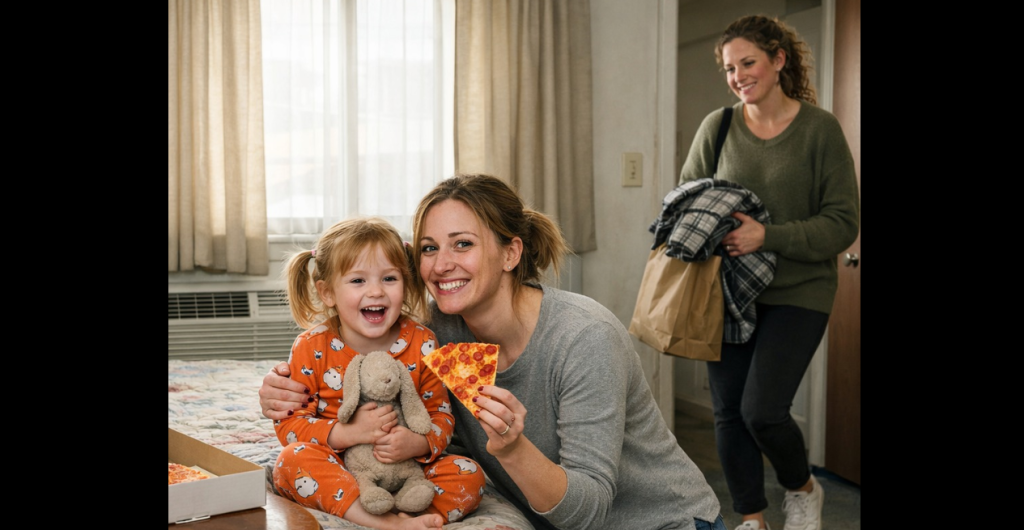
I washed my face. Practiced a smile in the mirror. Came out and ordered pizza and told Ruby this was a “special adventure sleepover.”
She believed me.
Because she was five and she trusted me.
And I loved her so much it felt like a wound.
We stayed at the motel for four nights.
Every morning, I brushed Ruby’s hair with the little plastic comb from the front desk. Every night, I counted my money and pretended the numbers didn’t scare me.
I went to work during the day because I had to. My office—a small insurance company with cheap coffee and fluorescent lights—wasn’t built for personal catastrophes. My boss, Jim, did that thing where he looked at me with sympathy but also with the silent expectation that I would still meet deadlines.
“You okay?” he asked the first morning I showed up, my blouse wrinkled, my eyes puffy.
“I’m fine,” I lied, because “fine” was the only word that didn’t come with paperwork.
I dropped Ruby off at Dana’s house before work, the way people drop off their dignity, gently and with apologies.
Dana had been my friend since community college. She’d been the kind of friend who noticed things without making you say them out loud. When I texted her, I’m in a motel, can you watch Ruby while I work? she replied, Bring her. Bring you too if you need to.
Dana’s apartment smelled like cinnamon and dog fur. Her dog, Captain, was a golden retriever mix with a crooked grin and too much enthusiasm. Ruby fell in love instantly.
“His name is Captain,” Dana told Ruby, crouching down to Ruby’s level. “And he’s very important.”
Ruby’s eyes widened.
Dana leaned in like she was sharing a secret. “He needs a co-pilot.”
Ruby’s face lit up. “Like in an airplane?”
“Exactly,” Dana said solemnly. “Co-pilots are responsible. They help keep everyone safe.”
Ruby nodded like she’d been training for this her whole life.
Captain licked her hand like he agreed.
At the end of the fourth night in the motel, my mother called.
Not to ask if we were okay.
Not to ask where we were.
To tell me my brother was visiting that weekend and she’d made up the guest room for him.
She said it casually, like she was discussing weather.
“Oh,” I said, because my throat had turned into stone. “Okay.”
“Just letting you know,” she continued, voice brisk. “So don’t stop by.”
I didn’t correct her. I didn’t say, Stop by from where, Mom? The motel? The curb? The parking lot you refused to rescue us from?
I just said, “Sure.”
After I hung up, I stood in the motel bathroom staring at the sink until my vision blurred.
The next week, my sister posted photos on social media.
Family dinner at my parents’ house.
My niece and nephew grinning. My brother holding a beer. My father carving something at the table like a man who’d never had to choose between his kids. My mother smiling with her head tilted just so, like she was the portrait of a woman whose life made sense.
The table looked full and warm and happy.
Nobody tagged me.
Nobody called.
Nobody texted: How’s Ruby? Do you need anything?
I sat on Dana’s pullout couch at 11 p.m., Ruby curled into my side, Captain’s warm weight pressed against my feet, and felt something shift inside me.
It wasn’t sadness exactly.
It wasn’t even anger.
It was clarity.
A quiet, clean understanding that I had spent years doing this—waiting on the edge of my own family, hoping they’d make room, hoping they’d notice, hoping if I was good enough, quiet enough, helpful enough, they’d finally treat me like I belonged.
And in nineteen seconds, the world shook and showed me the truth:
Belonging doesn’t turn you away at five in the morning.
The next day, after I dropped Ruby off at preschool—Dana had helped me get her temporarily enrolled in a little program near Dana’s place, because Dana was the kind of person who moved mountains like they were furniture—I sat in my car with my hands on the steering wheel and made a call I’d never imagined making.
A real estate lawyer.
Her name was Patricia Webb. Her office was downtown in a building with clean windows and a lobby that smelled like money.
Patricia’s voice on the phone was calm, precise. Like she lived in a world where things could be handled.
“I own a twenty-five percent share of a property,” I told her, my mouth dry. “A house. My parents’ house.”
There was a pause, not uncomfortable—professional.
“Okay,” Patricia said. “Tell me how your name got on the deed.”
“My grandfather,” I said. “When he died, he wanted equal shares for all the children. My parents’ names, my brother’s, my sister’s, and mine. We each got twenty-five percent. I… I didn’t think about it much.”
“Do you have a copy of the deed?” she asked.
“I can get it.”
“All right,” Patricia said. “And what is it you want to do?”
I stared at the steering wheel like it might answer.
“I want to know what my options are,” I said. “Because… because I need to take care of my daughter.”
Patricia didn’t ask for my family history. She didn’t ask why. She didn’t say, Have you tried talking to them?
She said, “In most states, as a co-owner, you can sell your interest. If the other owners don’t want to buy you out, you can sell to a third party.”
My stomach flipped.
“A third party?” I repeated.
“Yes,” she said, still calm. “But that can trigger something called partition. In a partition action, a co-owner—like the new purchaser—can ask a court to order the property sold, and the proceeds divided based on ownership.”
“So,” I said slowly, understanding forming like ice. “If I sold my share to someone outside the family, they could force a sale of the whole house.”
“They could,” Patricia confirmed. “Or your family could buy out your share to avoid that risk.”
I swallowed.
“They’d have to engage,” Patricia said gently. “One way or another.”
My hands started shaking again, but this time it wasn’t fear.
It was the weird adrenaline of someone finally realizing there was a door.
“Can you send a formal letter?” I asked.
Patricia didn’t hesitate. “Yes. I’ll draft it and send it after you provide proof of ownership.”
I got the deed copy from county records online. It was strange seeing my name there in plain black type, like it had always been obvious.
SARAH ELLIS — 25% INTEREST.
My mother had never talked about it like that. She’d always said, “Grandpa wanted it kept in the family.”
As if “family” meant them.
Not me.
Not Ruby.
Patricia sent the letter two days later. Certified delivery. Formal language. Clean edges.
My mother called two hours after it arrived.
“What is this?” she demanded, voice sharp enough to cut.
“I’m exploring my legal options,” I said, and I was proud of how steady my voice sounded. “Regarding my share.”
“What does that mean?” she snapped.
“It means I own part of that house,” I said. “And I’d like to be fairly compensated for it.”
“You can’t sell your share,” my mother said, like she was scolding a child who’d touched something fragile. “It’s the family home.”
“Then buy me out,” I said. “At fair market value.”
Silence.
And in that silence, I could hear the old power dynamic trying to wake up. The part where she would push and I would fold. The part where she decided what “reasonable” looked like.
“Sarah,” she said finally, voice shifting into that familiar tone—half disbelief, half disdain. “You’re being ridiculous.”
“This is because we couldn’t take you in during the earthquake,” she added quickly, like naming it would make it petty.
I stared at the wall of Dana’s living room. Ruby was on the floor coloring, her tongue stuck out in concentration. Captain lay beside her like a loyal guard.
“It’s because I realized something,” I said softly. “I’ve spent years trying to earn a place in this family. And I think I should stop trying. I think I should start being practical.”
“You’re doing this to hurt us,” my mother hissed.
“I’m doing this to take care of my daughter,” I said. “The way you chose not to.”
My mother made a sound—angry, wounded.
“Don’t be dramatic,” she said.
I almost laughed. Dramatic. As if I hadn’t been carrying my life in a duffel bag for two weeks.
My father called next.
“Sarah,” he started, voice heavy. “What is going on?”
I could hear the TV in the background. Some sports game. The normal world, continuing.
“I’m selling my share unless you buy me out,” I said.
“We’re your parents,” he said, like that was supposed to mean something.
“You didn’t act like it,” I replied.
A pause.
Then: “Your mother said you called at five in the morning.”
“Yes,” I said, and it tasted bitter. “Because my home was uninhabitable.”
“We were asleep,” he said, almost defensive.
“I know,” I said. “But you woke up. You answered. And you still said no.”
He sighed.
“It’s complicated,” he said.
“It’s not,” I said quietly. “It’s simple. There was room. You just didn’t want me in it.”
That was the first time my father went silent in a way that felt like it meant he heard me.
Then he said, “We’ll talk about this.”
“I already did,” I said. “With a lawyer.”
My brother texted me:
This is insane. Mom is upset. Drop it.
My sister didn’t call at first. She waited until two days later and then showed up at Dana’s apartment unannounced, like she was delivering judgment.
I opened the door and saw her standing there in leggings and a sweatshirt with the logo of the gym she never stopped talking about. Her hair was in a perfect ponytail. She looked like someone whose life hadn’t been cracked open.
“Hi,” she said, like we were meeting for coffee.
Dana appeared behind me, cautious.
I stepped outside and closed the door gently behind me.
“What are you doing here?” I asked.
My sister crossed her arms. “Mom says you’re trying to sell the house.”
“I’m trying to get bought out,” I corrected.
“Same thing,” she snapped. “Sarah, what the hell? That house is—”
“The family home,” I finished for her, my voice flat.
“Yes,” she said, eyes flashing. “It’s where the kids have holidays. Where we—”
“Where you had dinner while Ruby and I were in a motel,” I said, and that finally wiped the rehearsed outrage off her face for a second.
Her jaw tightened.
“You didn’t tell me you were in a motel,” she said.
I stared at her. “You didn’t ask.”
“I thought you went to Mom and Dad’s,” she said, and now she sounded more uncertain than angry.
I let out a slow breath. “I asked. They said no. Because you and your kids were already there.”
My sister’s eyes flickered, and for a moment I saw something like discomfort. Like she was doing the math and realizing her comfort had been bought with my exclusion.
“Well,” she said, voice smaller. “We needed help. You know that. After Jason left—”
“I’m not saying you didn’t need help,” I said. “I’m saying there was room. There could have been room for all of us.”
She shook her head, like she couldn’t accept that the story might have more than one victim.
“So you’re punishing us,” she said.
“No,” I said, and my voice was steady in a way that surprised me. “I’m choosing Ruby. I’m choosing stability.”
My sister’s eyes hardened again. “You always make everything about you.”
I laughed then, short and sharp. “I’m literally making it about my kid having a bed.”
“Mom says you’re being vindictive,” she said, like it was evidence.
“Mom says a lot of things,” I replied.
My sister’s lips pressed together.
“She’s scared,” my sister said quietly. “Of losing the house.”
I thought about my mother’s voice—sharp, offended. Not worried about me. Worried about control.
“Then she should buy me out,” I said simply.
“And where’s she supposed to get that money?” my sister demanded.
I almost said, Not my problem. But the truth was more complicated. My parents weren’t rich. Comfortable, yes. Retired, yes. But a buyout wasn’t pocket change.
Still—if my name was on that deed, then my needs mattered too.
“I’m not asking for charity,” I said. “I’m asking for what’s mine.”
My sister looked at the door behind me, like she could sense Ruby inside.
“She’s okay?” she asked, and it sounded like the question had surprised her on its way out.
I softened just a fraction. “She’s okay. Dana’s been helping.”
My sister nodded once, quick. “Mom could’ve helped,” she muttered, more to herself than to me.
Then she snapped back into her armor.
“You’re tearing the family apart,” she said, voice louder.
I leaned in a little. “No,” I said. “The family broke long before this. I’m just finally refusing to pretend it didn’t.”
She left after that, walking to her car like she was angry at the ground.
When I went back inside, Dana was in the kitchen making coffee like she always did when she didn’t know what else to do with her hands.
“You okay?” she asked softly.
I nodded, but my throat was tight. “I don’t know.”
Dana set down the mug and looked at me like she could see the pieces of me shifting into a new shape.
“You’re doing what you have to,” she said.
Ruby ran over then, holding up her drawing.
It was a house. A simple square with a triangle roof. Two stick figures holding hands in front.
“This is us,” Ruby announced. “In our new house.”
My chest ached.
“Is that Captain?” Dana asked, smiling.
Ruby grinned. “He’s visiting.”
Captain thumped his tail, as if he approved of being included in Ruby’s future.
That night, after Ruby fell asleep, Dana and I sat on the pullout couch with the TV muted.
“You ever think about how families have rules you don’t learn until you break them?” Dana asked quietly.
I stared at Ruby’s small shape under the blanket. “Yeah.”
Dana took a sip of her drink. “Your mom wants you to stay small.”
I didn’t respond because the truth of it hit too hard.
When I was a kid, I used to follow my mother around like she was the sun. I wanted her approval the way plants want light. I cleaned the kitchen without being asked. I got straight A’s. I offered to babysit my siblings. I learned early that love came with conditions, even if no one called them that.
My brother, Mark, had always been the easy one. The golden boy. The one my father called “a good kid” even when he crashed the car at seventeen. My sister, Emily, had always been the fragile one, the one who could cry her way out of consequences.
I was the responsible one.
Responsible meant you don’t need anything.
So when I needed something—when the earth cracked my home open—I was suddenly inconvenient.
Patricia called me the next day with an update.
“They’re responding,” she said.
“Angrily?” I guessed.
Patricia let out a tiny, amused breath. “Emotionally. But yes, they’re responding. They asked if you’d accept less than fair market value.”
“No,” I said quickly. “No, I won’t.”
“Good,” Patricia said. “Then we proceed.”
Proceed. Like this was a process, not a heartbreak.
She explained the steps again: appraisal, valuation, negotiation. If they refused, she could help me list my share to a third party. Partition would loom like a storm cloud.
“They’re unlikely to let it get that far,” Patricia said. “Most families don’t.”
I thought of my mother’s fear of losing the house. Of control. Of image.
“They’ll do it,” I said, more sure than I felt.
A week later, we met at Patricia’s office.
My parents came together, like a united front. My mother wore a crisp blouse, the kind she wore to church. My father looked tired, older than I remembered.
Mark wasn’t there, but his disapproval sat in my pocket like a rock. Emily wasn’t there either. It was just me facing the people who had raised me to believe love was something you earned.
We sat in a conference room with a long table that felt like it belonged to people with better lives.
Patricia sat at the head, papers neatly arranged.
My mother’s eyes swept over me like she was inspecting damage.
“You look… thin,” she said, like she’d noticed the consequences without acknowledging the cause.
“I’ve been under stress,” I replied.
My mother sniffed softly. “We all have.”
Patricia cleared her throat. “We’re here to discuss the buyout terms for Ms. Ellis’s twenty-five percent interest.”
Ms. Ellis.
Not Sarah.
That small distancing felt like oxygen.
My father leaned forward. “Sarah,” he began, voice low, “there’s no need for this to be—”
“Legal?” I finished, my voice calm. “It’s already legal. My name is on the deed.”
My mother’s mouth tightened. “Your grandfather didn’t mean—”
“Yes, he did,” I said. “He meant equal shares.”
Patricia’s pen hovered. “We have an appraisal based on current market value. The buyout number reflects that.”
My mother’s face flushed. “That’s outrageous.”
“It’s math,” Patricia said evenly.
My father rubbed his forehead. “We can’t just pull that kind of money out of nowhere.”
“You have options,” Patricia said. “Refinancing. A home equity loan. Payment plan agreements—though those are less common and require strong guarantees.”
My mother turned to me, eyes sharp. “So you’re going to take money from us, after everything we’ve done for you.”
There it was.
The ledger.
The unspoken invoice for being raised.
I sat back in my chair. “You didn’t do me a favor by being my parents.”
My mother’s breath caught, scandalized.
My father’s eyes flickered down, as if ashamed.
“You’re acting like we abandoned you,” my mother said, voice rising.
“You did,” I said.
“We said we didn’t have room,” she snapped.
“And then you made up the guest room for Mark,” I said, and the words came out quiet but steady. “You had room. Just not for me.”
My father’s shoulders slumped. “It wasn’t… it wasn’t like that.”
“Then what was it like?” I asked, and now my throat was burning. “Explain it to me. Explain how you couldn’t fit a five-year-old on your couch for a few nights but you could host family dinners and weekend visits.”
My mother looked at Patricia, as if seeking backup.
Patricia’s face remained politely blank, the face of someone who had seen this story in a hundred different costumes.
My mother leaned toward me, voice dropping into something poisonous. “You’ve always been dramatic, Sarah.”
A laugh tried to rise in me and turned into something else.
I pictured Ruby in fox pajamas. Ruby asking, Where are we going, Mama? Ruby believing in adventure sleepovers.
I pictured myself crying in a motel bathroom, biting back sobs because I didn’t want my kid to see my heart break.
“I’m done being the one who makes it easy,” I said.
My mother blinked.
My father said softly, “What do you want from us?”
I held his gaze.
“I want what’s mine,” I said. “And I want you to stop pretending I’m wrong for asking.”
My mother opened her mouth, but Patricia cut in smoothly, “We can take a ten-minute break.”
My parents stepped into the hallway.
Patricia looked at me. “You’re doing well,” she said quietly, not in a cheering way, in a factual way.
“I feel like I’m twelve again,” I admitted.
Patricia nodded once. “That’s common. But you’re not twelve. You’re an adult with a child. And you’re making a rational decision.”
Outside the conference room, through the glass, I saw my mother talking with her hands, sharp, clipped. My father stood beside her like a tired soldier.
When they came back in, my mother’s face was controlled again.
“We’ll buy you out,” she said stiffly. “But we’re not happy about it.”
“I don’t need you to be happy,” I replied. “I need Ruby to be safe.”
My father flinched at Ruby’s name, like it finally made him remember this wasn’t abstract.
Patricia slid paperwork forward, explaining timelines. Appraisal verification. Funds. Closing.
As the meeting ended, my mother stood and gathered her purse with quick, tight movements.
“This will change things,” she said to me.
I met her eyes.
“It already has,” I said.
My father paused at the door. He looked back at me like he wanted to say something—something human, something true—but my mother’s hand on his arm pulled him along.
And just like that, they were gone.
Two weeks later, the buyout was signed.
It wasn’t dramatic in the way I’d imagined. No screaming, no sobbing. Just papers, signatures, wires moving through invisible systems.
The number was fair. Patricia had insisted on that.
When the money hit my account, I stared at the balance and felt a strange mix of grief and relief—like I’d sold a piece of my childhood to buy my future.
Dana hugged me in her kitchen when I told her.
“I’m proud of you,” she said simply.
Ruby ran around Captain, laughing, yelling, “We’re getting a house! We’re getting a house!”
I crouched down and pulled her into my arms.
“We’re getting a home,” I corrected softly into her hair. “A real home.”
Six weeks after the earthquake, we closed on a small house in a neighborhood with quiet streets and a school with a big playground and good ratings on websites parents trusted like scripture.
It wasn’t a dream house.
It was better.
It was ours.
Ruby and I drove there the evening we got the keys. Dana came too, because she insisted, because she said, “You don’t do firsts alone.”
The house smelled like fresh paint and emptiness. Sunlight spilled across bare floors like a promise.
Ruby burst through the front door like she’d been released from a cage.
She ran into the living room, then down the hallway, then back again.
“This one’s mine!” she shouted, flinging open the door to the small bedroom overlooking the backyard.
She raced to the window and pressed her face against the glass.
“I can see three birds!” she announced, voice full of wonder.
Dana leaned against the hallway wall, smiling softly. Captain—who Dana had brought because Ruby begged—padded around sniffing corners like he was inspecting the place for safety.
Ruby turned to me, eyes shining.
“This is our house,” she said, like she was making a vow.
I knelt down and cupped her face in my hands.
“Yes,” I said. “This is ours.”
“Forever?” she asked.
The word forever landed in my chest like something heavy and sacred.
“Yes,” I said. “Forever.”
That night, after Ruby fell asleep on a mattress on the floor because we didn’t have furniture yet, I sat alone in the empty living room.
The quiet here was different from the motel quiet. This quiet wasn’t despair. It was peace waiting to be filled.
I thought about the parking lot at five in the morning. Ruby’s fox pajamas. The crack in the building. The word uninhabitable.
I thought about Dana’s pullout couch and pancakes on Saturdays and Captain needing a co-pilot.
I thought about Patricia’s calm voice explaining partition like it was a door I had permission to walk through.
And I thought about my parents’ house—the one I grew up in, the one I had clung to as proof I belonged.
Home doesn’t turn you away.
It doesn’t make you beg.
It doesn’t say, I don’t think we have room, when you’re holding your child in the dark and the earth has just tried to swallow you.
The next morning, Ruby woke up and ran into the backyard in her socks, squealing when she found a dandelion.
“Mama!” she yelled, holding it up like treasure. “Look!”
I stepped out onto the back porch and watched her spin in circles, laughing, the sun bright in her hair.
And I realized something that made my throat burn in a different way than grief.
Sometimes the thing that breaks you open is the thing that shows you exactly where the door is.
My parents still called occasionally after that. Holidays mostly.
The conversations were short and careful, like walking on a floor you weren’t sure would hold.
“How’s work?” my mother would ask, as if small talk could build a bridge.
“Fine,” I’d say.
“How’s Ruby?” my father would ask, and his voice would always sound like he was reaching.
“She’s good,” I’d say, and I’d mean it.
Ruby never asked about them.
She asked about Dana.
About Captain.
About whether we could get a dog someday.
“Someday,” I’d tell her, because I wasn’t ready yet for another responsibility, another love that would need protecting.
But someday felt possible here.
In this home.
In this life I had chosen, built out of necessity and stubbornness and the kind of love that doesn’t require permission.
On the anniversary of the earthquake, Ruby came home from school with a paper crown on her head and glitter on her cheeks.
“What’s that?” I asked, laughing.
“We learned about earthquakes,” she announced, as if it was a science project and not the thing that changed our lives.
My smile faltered just a second.
Ruby didn’t notice. She twirled. “My teacher said we should have a plan. Like where to go.”
My chest tightened, but I crouched down anyway. “That’s smart. What did you decide?”
Ruby pointed to the doorway between the kitchen and the living room.
“That’s a strong spot,” she said seriously. “And then we go outside. And then…” She thought hard. “And then we go back inside because it’s our house.”
I reached for her and pulled her into my arms.
“Yes,” I whispered into her hair. “We go back inside.”
Because no one could tell us there wasn’t room anymore.
Because I had stopped waiting to be chosen.
Because I had chosen us.
And if that made me the villain in their story, then so be it.
In mine, I was finally the mother my daughter deserved.
The first time Ruby called the new house safe, it wasn’t even in a dramatic moment.
It was a Tuesday. I was trying to wrestle a fitted sheet onto a mattress like it was a wild animal, and Ruby was sitting cross-legged on the floor in her pajamas—different pajamas now, not foxes, but pink with little moons—coloring a picture of Captain wearing a pilot hat. She looked up, watched me fight the sheet for a few seconds, and said matter-of-factly, “This house doesn’t shake, Mama.”
I froze with the corner of the sheet in my hands.
It wasn’t true, of course. Any house could shake. The earth didn’t care about mortgages or fresh paint. But Ruby’s voice carried the kind of certainty kids have when they decide something is real. I wanted to step inside that certainty and lock the door.
“Yeah,” I said, forcing a lightness I didn’t feel. “This house is strong.”
Ruby nodded, satisfied, then went back to coloring like she’d just solved a major problem.
I got the sheet on the mattress and sat on the edge of the bed, my pulse still too loud. My body hadn’t forgotten the quake. It remembered it the way it remembered childbirth—something you survived, but the memory lived in your nerves like a ghost that refused to move out.
We’d been in the new house three weeks, and I still woke up at odd hours. Still listened for sounds. Still checked the walls for cracks when a truck rumbled past on the street.
And every time I caught myself doing it, I thought about my mother’s voice at 5:15 a.m.
I just don’t think we have room.
Like it was the most natural thing in the world to say to your daughter.
Like turning someone away was just a logistics problem.
The buyout money had bought us this house, yes. It had bought Ruby her own bedroom and me the fragile luxury of not having to smile at motel clerks while counting bills. It had bought us stability.
But it had also bought me a new reality: there was no going back.
Not to the version of my family where I believed love meant endurance. Not to the version of myself who waited for permission to belong.
That clarity was good.
It was also lonely.
Dana came over most weekends, partly because she liked us, partly because she worried I’d collapse under the weight of being “fine.” She’d show up with grocery bags and a too-bright smile.
“I brought you house-warming essentials,” she’d announce, as if she hadn’t already given us the most essential thing: somewhere to land when the world tilted.
“Dana,” I’d protest, taking the bags anyway.
“Shush,” she’d say. “I’m practicing being a rich aunt. Let me spoil you.”
Ruby loved Dana in a way that was pure and uncomplicated. Dana was pancakes and silly voices and Captain’s warm body pressed against Ruby’s legs while she watched cartoons. Dana was the adult Ruby trusted besides me—maybe even more than me sometimes, because Dana didn’t carry the heaviness I did.
One Saturday morning, Ruby and Dana were at the kitchen table making pancake batter. I was leaning against the counter with a mug of coffee, watching them with that tight ache that came when you realized you were lucky and sad at the same time.
Dana flicked a little flour at Ruby’s nose.
Ruby giggled. “Captain’s gonna eat the pancakes!”
Captain’s ears perked up at his name.
Dana smiled. “Captain is on a strict diet of admiration.”
Ruby leaned down and whispered in Captain’s ear like it was a sacred secret.
Dana looked up at me, her expression turning quiet. “How are you sleeping?”
I shrugged. “Fine.”
Dana’s eyebrow raised.
I sighed. “Not great.”
“Thought so,” she said, flipping a pancake with unnecessary intensity. “Any nightmares?”
I hesitated. The truth was embarrassing in a way I couldn’t explain. Not because nightmares were shameful, but because they were proof I wasn’t as steady as I wanted to be.
“Sometimes,” I admitted.
“About the quake?”
“About… being outside,” I said, and my voice lowered automatically, even though Ruby was busy stirring batter. “About calling my mom. About—” I swallowed. “About her saying no. Like… I wake up and I’m still in that parking lot.”
Dana’s face softened, and she set the spatula down like she suddenly needed both hands available in case I fell apart.
“That’s not something your brain forgets fast,” she said.
“I feel stupid,” I whispered. “Like, I solved it. We’re okay. Why can’t my body catch up?”
“You’re not stupid,” Dana said firmly. “You were rejected in a crisis. That’s a primal thing.”
I stared at my coffee.
Dana went back to flipping pancakes, but her voice stayed gentle. “Have you talked to a therapist?”
I let out a humorless laugh. “With what time? With what money?”
Dana shot me a look. “Don’t do that thing where you act like you have to bleed quietly.”
I flinched, because she wasn’t wrong.
“I’m okay,” I insisted.
Dana reached across the counter and squeezed my wrist. “You’re strong. That’s not the same as okay.”
Ruby looked up then, batter on her chin. “Mama, do you want a heart-shaped pancake?”
My throat tightened.
“Yes, baby,” I said. “I want a heart-shaped pancake.”
Ruby beamed, like she could fix anything with breakfast.
I turned away so she wouldn’t see my eyes shine.
The first time my mother came to see the house, it was not because she wanted to.
It was because Emily forced it.
I found out later, through Dana, who had a talent for hearing things through mutual friends like she had invisible radio antennas.
Apparently, my sister had gone home one evening, kids in tow, and found my mother folding laundry with her jaw set the way it got when she was trying to maintain control.
Emily had thrown her purse on the couch and said, “I saw Sarah today.”
My mother hadn’t looked up. “Why?”
“Because she’s my sister,” Emily snapped, and even imagining that conversation felt like stepping into an alternate universe.
My mother’s hands had kept moving. “How is she?”
“She’s fine,” Emily had said, then—after a pause—“She has a house.”
My mother’s hands had stopped then. Just for a second. Like her body betrayed her.
“A house,” she’d repeated, as if she’d said a dirty word.
“Yes,” Emily had said. “A small one. But nice. Ruby has her own room.”
My mother’s shoulders had tightened. “Well. That’s what she wanted.”
Emily had stood there with the posture of someone who was tired of carrying a family’s denial. “Mom, did you ever think about what it looked like? Saying there was no room? When you literally have a guest room?”
My mother’s voice had turned icy. “You don’t understand.”
Emily had scoffed. “No, you don’t understand. You made it clear who matters. And now Sarah’s done playing.”
Dana told me all this while I was standing in my backyard watering new plants I couldn’t afford but bought anyway because I wanted something to root itself here.
I stood frozen with the hose in my hand.
“What?” I said, because my brain couldn’t process the idea of Emily confronting our mother.
Dana shrugged. “Maybe she’s having a conscience.”
I snorted. “Emily doesn’t do conscience. She does survival.”
Dana gave me a look. “Maybe she’s realizing survival is easier when you’re not stepping on someone else.”
I didn’t reply, because my throat was suddenly too tight.
Two days later, my mother called.
Her name flashed on my phone like a warning.
I stared at it until it stopped ringing.
Then it rang again immediately, because my mother didn’t believe in unanswered calls.
I exhaled and picked up.
“Hello?”
There was a pause. I could hear her breathing, like she was preparing for battle.
“Your sister says you have a house,” she said finally.
Not How are you? Not I’m glad you’re safe.
A statement. A claim. A way to mark territory.
“Yes,” I said. “We do.”
Another pause. “Where?”
I almost laughed. “In town.”
“Don’t be smart,” she snapped.
I looked at Ruby, who was on the living room floor lining up stuffed animals like they were waiting for a bus.
“I’m not,” I said. “What do you want, Mom?”
She made that not-sigh sound again. “Your father thinks we should see it.”
The words were so carefully arranged that I could hear the negotiation behind them—Dad saying we should, Mom resisting, Emily pushing, Mark sulking.
“You want to come over,” I repeated slowly.
“It’s… strange,” she said, as if the strangeness was mine. “You buying a house without… discussing it.”
I gripped the phone tighter. “We didn’t buy it without discussing it. I told you exactly why I needed the money.”
“That money was for the family,” she snapped.
I felt something harden in my chest. “No,” I said, voice steady. “That share was mine. Grandpa made sure of that.”
Silence.
Then my mother said, in a voice that made my skin prickle, “We’ll come by Sunday. After lunch.”
Not a question.
A command.
I closed my eyes. Ruby was humming to herself, oblivious.
“No,” I said.
“What?” my mother snapped.
“I said no,” I repeated. “You don’t get to show up here like you’re inspecting something you own.”
My mother’s breath sharpened. “Sarah—”
“If you want to see it,” I continued, heart pounding, “you can ask. Like a guest.”
There was a long silence, thick and angry.
Then, through clenched teeth, my mother said, “May we come by Sunday?”
The words sounded like they hurt her.
I swallowed. Part of me wanted to say no just to feel the power of it. To mirror the moment she’d taken power from me in a parking lot at dawn.
But another part of me—the part that wanted closure, or at least a clearer picture—said this might be necessary.
“Yes,” I said. “But not after lunch. Ruby naps. Come at ten.”
My mother hesitated, as if nap schedules were beneath her.
Then she said, “Fine.”
And hung up.
Dana, of course, found out because I called her ten seconds later, voice shaking.
“They’re coming,” I told her.
“Do you want me there?” Dana asked immediately.
I hesitated. Pride wanted to say no. Pride wanted to handle my family alone, like I always had.
But then I remembered the bathroom in the motel. The way I cried with the door half closed. The way I did everything alone because I had been trained to.
“Yes,” I admitted. “Please.”
Dana didn’t make me feel weak for needing her. She just said, “I’ll bring muffins and emotional support.”
Sunday morning arrived like a storm you can see forming on the horizon.
I cleaned the house even though it was already clean. Wiped counters that didn’t need wiping. Fluffed pillows that were already fluffed. Rearranged Ruby’s toys like order could protect us.
Ruby wore leggings and a unicorn shirt and kept asking, “Grandma’s coming?”
“Yes,” I said carefully.
“Is Grandpa coming too?”
“Yes,” I said, and my stomach twisted.
Ruby considered this. “Are they gonna bring me a present?”
I blinked. The question was so innocent it hurt.
“I don’t know, honey,” I said softly.
Ruby shrugged like it didn’t matter. “Dana brings me presents.”
Dana had shown up at nine-thirty with muffins, Captain on a leash, and the calm energy of someone who was ready to bodyguard my heart.
“You good?” she asked, standing in my kitchen.
“No,” I said.
Dana nodded. “Perfect. That means you’re awake.”
At ten on the dot, a car pulled up.
My mother always arrived exactly on time when she wanted to assert control. As if punctuality was a weapon.
My father got out first, moving slower than I remembered. He looked around at the neighborhood like he was trying to make sense of a world where his daughter lived without his approval.
My mother stepped out next, face set, sunglasses on even though the sun was mild. Emily’s minivan was behind them. Emily got out with my niece and nephew in tow.
So they’d brought reinforcements.
Dana leaned close to me. “Cute,” she murmured.
I opened the door before they could knock, because I refused to let them stand on my porch and claim the role of “welcomed.”
My mother’s gaze swept over me, then the doorway, then Dana behind me.
She stiffened. “Hello.”
“Hi,” I said. “Come in.”
My father stepped inside and looked around, his eyes softening at the sight of Ruby’s drawings taped to the wall. He noticed Captain and smiled faintly.
“Hey, buddy,” he said to Captain, who wagged politely.
Ruby darted into the hallway like a comet.
“Grandma!” she yelled, and barreled toward my mother.
My mother stiffened—just for a second, but I saw it. Saw the instinct to protect herself from affection. Then she forced her arms open and let Ruby collide into her.
“There you are,” my mother said, voice weirdly bright.
Ruby pulled back and looked up. “Did you bring me a present?”
My cheeks burned.
My mother blinked, caught off guard. “A present?”
Ruby nodded solemnly. “Because you’re visiting our new house.”
My mother’s lips pressed together. My father cleared his throat.
Emily stepped forward quickly. “We brought cookies,” she said, holding up a container like it was an offering.
Ruby’s eyes lit up. “COOKIES!”
And just like that, Emily saved my mother from having to be generous.
Of course.
Dana’s hand brushed my arm, grounding me.
My mother looked around the living room with that critical, assessing gaze she used in department stores and other people’s homes.
“It’s… small,” she said.
My jaw tightened. “It’s perfect for us.”
My father walked toward the hallway, peeking into Ruby’s room where the bed was made with mismatched sheets because Ruby liked the chaos of it.
“She has her own room,” he said softly, almost to himself.
Ruby followed him and pointed proudly. “This is my bird window!”
My father smiled, and I saw something in his face I hadn’t seen in a long time.
Regret.
My mother sniffed. “It’s nice,” she said, but the tone was flat, like she was complimenting a casserole she didn’t like.
Emily hovered near the kitchen, watching me the way people watch a dog they’re not sure will bite.
Dana, bless her, acted like she belonged there. She offered coffee. She handed out muffins. She asked my nephew about school. She made the room feel less like a tribunal and more like a gathering.
My mother didn’t like that.
I could see it in the way she kept glancing at Dana like Dana was an intruder.
Finally, when Ruby was distracted by cookies and Captain, my mother cornered me near the sink.
“So,” she said, voice low. “You’re doing all right.”
It wasn’t a question.
It wasn’t warmth.
It was an evaluation.
“Yes,” I said.
My mother’s eyes flicked over my face, as if searching for evidence I was still suffering enough to prove I’d been wrong.
“And work?” she asked.
“Fine,” I said.
She nodded, like checking boxes.
Then her gaze sharpened. “You know this didn’t have to happen,” she said quietly.
My stomach dropped. “What didn’t have to happen?”
She leaned closer, her perfume sharp and familiar. “All this… legal drama. The stress. The money.”
I stared at her. “Mom, we were homeless.”
“We didn’t say you were homeless,” she hissed.
I felt my pulse spike. “We had nowhere to go.”
“We told you the shelter—”
“The shelter,” I interrupted, voice shaking now. “With my five-year-old who had just been sick. While you were sleeping in your bed.”
My mother’s eyes flashed. “Don’t start.”
I laughed, bitter. “Don’t start? You came into my house and said this didn’t have to happen. Like you didn’t make a choice.”
My mother’s jaw tightened. “We were dealing with your sister’s situation.”
I stared at her. “Emily’s divorce isn’t an emergency shelter.”
My mother’s eyes narrowed. “You always make Emily the villain.”
Emily, as if summoned, appeared in the doorway, her expression tight. “What’s my name doing in your mouth?” she asked, attempting humor but failing.
I looked at my sister. “Did you know Mom told me there was no room because your kids were there?”
Emily’s face flickered. “Sarah—”
“Did you know?” I pressed.
Emily exhaled, frustrated. “I didn’t know you were in the parking lot, okay? Mom didn’t tell me the details.”
My mother snapped, “Because it wasn’t necessary.”
My throat burned. “Not necessary. Right. My kid and I needing a place to sleep wasn’t necessary information.”
My father’s voice came from behind us, cautious. “Sarah…”
I turned and saw him standing by the kitchen table, holding a coffee cup he hadn’t drunk. His face looked tired. Worried.
Dana was in the living room with Ruby, reading a picture book aloud, deliberately not listening but close enough to intervene if needed.
My father stepped closer, lowering his voice. “We didn’t think it would be for long,” he said.
I stared at him. “That makes it better?”
He winced. “No. I’m just—”
My mother cut in sharply. “We did what we thought was best.”
I looked at her. “For who?”
She stared back, and in her eyes I saw the truth she would never say out loud: for herself. For peace in her house. For not disrupting the hierarchy she’d built. For not having to accommodate the daughter who had always been “fine.”
Emily’s voice cracked through the tension. “Mom, just stop. You’re not helping.”
My mother’s head whipped toward Emily. “Excuse me?”
Emily’s cheeks flushed. “You’re acting like Sarah did something to you. She didn’t. She protected her kid.”
My mother’s eyes widened, shocked by the betrayal.
I watched my sister, stunned. Emily—who had always played along with Mom—was actually standing up.
My mother’s voice turned cold. “So now you’re taking her side.”
Emily’s laugh was sharp. “It’s not a side, Mom. It’s reality.”
My father rubbed his forehead, looking like he wanted to disappear.
My mother’s gaze snapped back to me. “You humiliated us,” she said, voice trembling now—not with sadness, with rage. “You threatened the family home.”
I felt something settle inside me, heavy and steady.
“I didn’t threaten it,” I said. “I reminded you I exist.”
My mother’s mouth opened, then closed.
For a moment, nobody spoke. The house felt too quiet, like it was holding its breath.
Then Ruby’s voice floated in from the living room, bright and oblivious. “Captain, you’re the best co-pilot!”
Captain barked once, as if agreeing.
The normal sound of my child’s joy cut through the tension like sunlight through clouds.
I looked at my mother and realized she was a stranger in this house. In this life.
And that was okay.
“I’m not doing this again,” I said, voice calm. “Not the guilt. Not the rewriting. You said you didn’t have room. That happened. You don’t get to erase it because it makes you uncomfortable.”
My mother’s eyes glistened—whether with anger or something else, I couldn’t tell.
My father’s shoulders sagged. “Sarah,” he said quietly, “we should’ve let you come.”
The words landed like a stone in water—small ripple, deep impact.
My mother turned toward him like he’d slapped her. “Don’t,” she hissed.
But he didn’t back down. His eyes stayed on me. “We should have,” he repeated, and this time his voice carried something like shame. “I’m sorry.”
My chest tightened. Part of me wanted to crumble into that apology like it was a blanket. Another part of me—stronger now—knew it was late.
Still, it mattered that he said it.
I swallowed. “Okay,” I said, and my voice was rough. “Thank you.”
My mother stared at me, as if my acceptance was another insult.
Then she set her coffee cup down with a sharp clink. “We’re leaving,” she said.
Emily blinked. “Mom—”
“No,” my mother snapped. “I’m not staying here to be attacked.”
Attacked. Like my truth was violence.
She marched to the front door. My father hesitated, looking torn. He glanced at Ruby, who was now hugging Captain around the neck.
“Bye, Grandpa!” Ruby called cheerfully.
My father’s face softened. “Bye, sweetheart,” he said, voice thick. “Be good.”
Ruby nodded solemnly, like she’d been given an important assignment.
My father looked at me one last time. His eyes said something his mouth didn’t.
Then he followed my mother out.
Emily lingered awkwardly, her kids already heading toward the door, confused.
She looked at me, her face tight with something complicated.
“I didn’t know,” she said quietly. “I swear I didn’t.”
I studied her. Emily had always been good at saying what she needed to say to survive. But there was a crack in her armor now.
“I believe you,” I said, and it surprised both of us.
Emily exhaled. “Mom’s… she’s not going to let this go.”
I shrugged, tired. “Neither am I.”
Emily nodded slowly, like she understood. “Ruby’s happy,” she said, glancing toward the living room.
“Yes,” I said. “She is.”
Emily’s mouth twisted into a half-smile. “Good.”
Then she left, and the house fell quiet again except for Ruby’s laughter and Captain’s happy panting.
Dana appeared in the kitchen doorway, watching me carefully.
“You okay?” she asked.
I stared at the spot where my mother had stood and felt the strange emptiness of it.
“I don’t know,” I admitted.
Dana crossed the room and hugged me without asking. It was the kind of hug that didn’t demand you be grateful or strong or anything at all.
Ruby ran into the kitchen then, cookie crumbs on her face.
“Why did Grandma leave?” she asked bluntly.
My throat tightened. I crouched down so I was eye-level with her.
“Grandma has big feelings sometimes,” I said carefully.
Ruby frowned. “Did I do something?”
“No,” I said quickly, touching her cheek. “No, baby. You didn’t do anything wrong. You were perfect.”
Ruby considered this, then shrugged like it was solved. “Okay. Can we get a dog now?”
Dana laughed.
I laughed too, because sometimes kids save you by being exactly who they are.
“Not yet,” I said, wiping cookie crumbs from Ruby’s chin. “But someday.”
Ruby grinned. “Someday soon?”
“Someday soon,” I lied, and this lie didn’t hurt, because it was hopeful.
That night, after Ruby fell asleep, I sat alone in the living room and let the quiet wash over me.
My mother had come into my home and tried to rewrite the past. Tried to make herself the victim.
But my father had said, I’m sorry.
And that mattered, even if it didn’t fix everything.
I stared at the bare wall where I planned to hang pictures, memories, proof of our life.
My phone buzzed.
A text from Mark.
Mom’s crying. You happy now?
I stared at the message until the words blurred.
The old version of me would have replied immediately, apologizing, smoothing, making things okay.
The new version of me set the phone facedown on the table and didn’t answer.
Because Ruby was asleep in her room.
Because this house was ours.
Because for the first time in my life, I wasn’t going to set myself on fire to keep them warm.
I turned off the living room light and walked down the hallway to Ruby’s room. I stood in her doorway for a moment, watching her breathe, her small hand curled around the edge of her stuffed bunny.
The street outside was quiet. The walls were still. The floor didn’t shake.
I whispered into the darkness, mostly to myself:
“We’re safe.”
And this time, I almost believed it.
Mark didn’t let it stay quiet.
Two days after my parents’ visit, my phone rang in the middle of the afternoon while Ruby was at preschool and I was on a work call pretending to care about deductible rates. I let it go to voicemail. When I checked it ten minutes later, it was my mother—voice trembling, theatrical, familiar.
“Sarah… your grandfather would be heartbroken. I hope you can live with yourself.”
I stared at the screen until my vision sharpened into something cold.
By evening, the pressure had spread like smoke. An aunt I hadn’t spoken to in years texted, Family is family. My cousin left a comment on one of Dana’s posts—because of course—about “entitlement.” Emily sent a single message that just said, Ignore them. Mark sent three in a row, escalating:
You blew up everything.
Mom can’t sleep.
You always do this.
Always.
Like I’d always demanded what I was owed. Like I’d always dared to be inconvenient.
I turned my phone off and ate dinner with Ruby at our little kitchen table. She told me about finger painting and how a boy named Tyler cried because his dinosaur broke and how she gave him her sticker because “that’s what co-pilots do.”
My throat tightened.
After she went to bed, I sat on the living room floor with the lights off and let the anger come—not the explosive kind, but the steady heat of truth.
I wasn’t the one who broke the family.
I was the one who stopped pretending it was whole.
The next Saturday, I got the call I’d been bracing for.
My father.
His voice was quieter than usual. “Your mom wants us all to meet.”
“No,” I said immediately.
He exhaled. “Sarah…”
“I’m not coming over to be ganged up on,” I said. My hands were steady this time. “If you want to talk, you can come here. One at a time.”
Silence.
Then, softly, “I’d like to come.”
So he came alone the next afternoon.
Ruby was in the backyard blowing bubbles when his car pulled up. I watched him get out slowly, like he wasn’t sure if this was allowed. He stood on my porch holding a paper bag in one hand, his shoulders rounded in a way I didn’t remember from childhood.
I opened the door before he could knock.
“Hi,” I said.
“Hi,” he echoed.
He looked past me and saw Ruby through the window, sunlight on her hair. His face shifted—something tender, something painful.
“I brought her something,” he said, and held out the bag. “It’s… small.”
I took it. Inside was a little stuffed dog wearing a pilot hat.
I blinked hard.
Ruby spotted him then and ran toward the porch, bubbles forgotten. “Grandpa!”
My father knelt awkwardly, like his knees weren’t used to humility. Ruby slammed into him with full-body joy. He held her too carefully at first, then tighter, like he remembered how.
“I have a present!” he said, pulling back to show her the dog.
Ruby gasped, hands to her mouth. “HE’S A CO-PILOT DOG!”
My father smiled, real this time. “I figured Captain shouldn’t be the only one.”
Ruby hugged the toy like it was priceless. “Thank you, Grandpa!”
She darted off to show Dana—who had stopped by with groceries—because Ruby believed every good moment should be shared.
My father and I stood in the doorway watching her go.
“She’s happy,” he said softly.
“Yes,” I said. “She is.”
He swallowed. “I’m… glad.”
We sat at my kitchen table. The same table where Ruby ate her cereal. The same table my mother had judged silently like it wasn’t enough.
My father held his coffee cup with both hands like it anchored him.
“I need you to hear this,” he said, eyes fixed on the wood grain. “Your mother… she’s angry. But she’s also scared. Losing that house felt like losing—” He stopped, searching.
“Control,” I supplied.
He flinched, but didn’t argue.
He cleared his throat. “What happened that morning… when you called… I should’ve told her to let you come. I should’ve gotten up, gotten in the car, picked you up myself.”
My chest tightened. “Why didn’t you?”
He looked up then, and his eyes were tired, honest. “Because it was easier not to fight. And I’ve done that too long.”
The truth of it landed heavy. Not cruel—just real.
“I can’t fix what we did,” he said. “But I’m sorry. Truly.”
I let the silence stretch. In it, I felt grief—old and deep—but also something like relief. Not forgiveness, not yet. But confirmation I hadn’t imagined the harm.
“I believe you,” I said finally. “But I need things to be different.”
He nodded quickly. “Tell me.”
I took a breath. “Ruby and I are not available for guilt. Or blame. If Mom wants a relationship with us, she needs to stop rewriting what happened. She needs to acknowledge it.”
My father’s jaw tightened. “She won’t want to.”
“Then she won’t have access,” I said, voice steady. “Not to Ruby. Not to me.”
He stared at me like he was seeing me clearly for the first time—an adult, not a daughter he could manage.
Then he nodded once. “Okay.”
Outside, Ruby squealed with laughter. Dana’s voice floated in, bright and teasing. Captain barked like he had an opinion.
My father turned his head toward the sound, and his eyes glistened.
“You did the right thing,” he said quietly. “Even if your mother can’t admit it.”
My throat burned. “I didn’t want to do it like this.”
“I know,” he said. “But you did it.”
When he left, Ruby ran to the window and waved until his car disappeared.
That night, after Ruby was asleep, my phone lit up again. A message from my mother.
Your father says you’ve set “boundaries.” Don’t punish Ruby because you’re angry at me.
I read it once. Twice.
Then I typed back, slow and careful:
Ruby is not being punished. Ruby is being protected. If you want to be in her life, you can start by acknowledging what you did.
I didn’t add anything else. No apology. No softness to cushion her from the consequences of her own choices.
For a long time, there was no reply.
Weeks passed. Holidays approached. The air got colder. Life, stubborn and ordinary, filled the spaces where chaos had been. Ruby learned the bus route to her new school. I learned the names of neighbors. I planted tulips in the backyard because I wanted proof that things could come back.
On Christmas Eve, my father called.
“Your mom wants to talk,” he said quietly. “Not… to fight. Just to talk.”
I stared at Ruby through the doorway, asleep with her co-pilot dog tucked under her chin.
“Put her on,” I said.
There was a pause, then my mother’s voice came through, small in a way I’d never heard.
“Sarah,” she said.
I didn’t answer right away.
“I… shouldn’t have said there was no room,” she said, words strained like they cost her. “We had room.”
My heart thudded hard.
“I was overwhelmed,” she continued. “And… I made the wrong choice.”
It wasn’t a perfect apology. It didn’t include the full weight of what she’d done. But it was the first crack in the wall.
I exhaled slowly. “Okay,” I said.
She swallowed audibly. “Can I… can I talk to Ruby sometime?”
I looked at my daughter, safe in her bed, in our house.
“Yes,” I said. “But we’re going to do this differently now.”
My mother didn’t argue. She just whispered, “Okay.”
After I hung up, I stood in the hallway for a long moment, hand on the wall like I needed to feel the solidity of it.
Ruby shifted in her sleep and murmured something about Captain.
I went into her room and sat on the edge of her bed, smoothing her hair back.
“This is forever,” I whispered, the promise settling into my bones.
Not the forever of pretending.
The forever of building something that doesn’t shake apart when the world does.
In the morning, Ruby woke up and ran into the kitchen, hair wild, eyes bright.
“Mama,” she said, climbing into my lap like she still fit there. “Is today a special day?”
I kissed her forehead. “Yeah, baby,” I said. “It is.”
“Because we’re home?” she asked.
I held her tighter, breathing in the warm, sleepy scent of her.
“Because we’re home,” I said. “And this time, nobody gets to tell us there isn’t room.”
THE END

Leave a Reply