From the moment Emma Carrington was born, the word never hovered over her like a shadow.
Never walk. Never run. Never chase a dog across a yard or stomp through puddles in rain boots. Never spin until she fell laughing onto the grass. Doctors didn’t say it with cruelty, but they said it with the calm confidence of people who’d learned to protect themselves by predicting the worst.
“It’s a miracle she survived at all,” one neonatologist had said to Alexander Carrington in a quiet hospital corridor, his voice low as if volume could soften the truth. “But her spinal trauma is severe. She’s paralyzed from the waist down.”
Alexander had stood there in his tailored suit, hands clenched at his sides, hearing those words like they were being spoken to someone else. The wealthy tech investor who could buy entire companies with a signature suddenly couldn’t buy a single nerve to reconnect.
At first he did what he’d always done when faced with impossible odds.
He attacked it.
He spent money like a man trying to punch through fate. Specialists, private clinics, equipment that looked like it belonged in a sci-fi film. He funded research programs that promised “breakthroughs” and “new pathways.” He flew in doctors from Zurich, from Tokyo, from Boston—people who spoke in careful, clinical sentences and wore expressionless faces that never gave him what he wanted most.
Hope.
Year after year, the results stayed the same.
Emma’s legs remained still.
Lifeless.
As if they belonged to someone else entirely.
By the time Emma turned four, Alexander had stopped letting himself imagine miracles.
He loved his daughter fiercely, but he buried the dream like you bury a painful treasure you can’t afford to look at anymore.
His life became a careful balance: build an empire by day, protect his child from heartbreak by night. He made sure the Carrington estate never lacked anything—ramps, specialized chairs, physical therapy rooms with padded floors, adaptive toys. He hired the best nannies, the best tutors, the best drivers. He made Emma’s world as safe and polished as he could.
But safety can become a cage when it’s built out of fear.
The mansion was beautiful—marble floors, vaulted ceilings, endless windows that looked out onto manicured gardens.
It was also quiet in a way that sometimes felt too heavy.
Emma didn’t complain. She didn’t rage. She didn’t ask why.
She simply existed with a calm that both comforted and haunted Alexander.
He’d sit in board meetings approving acquisitions worth hundreds of millions, then come home and watch his daughter move through the halls in her small wheelchair, her face thoughtful, her eyes always observing.
Sometimes he’d catch her watching other children—neighbors’ kids—running on the sidewalk outside the gate. Her gaze would follow them the way someone follows a bird they can’t catch.
Alexander tried to act normal.
He told jokes. He bought gifts. He read bedtime stories with animated voices, trying to make her laugh.
She did laugh. Emma was joyful in her own way.
But Alexander could feel the grief underneath his own love—the ache of seeing a child who deserved everything and still couldn’t have what most people took for granted.
Then Sophie arrived.
No one really knew much about Sophie except that she came with glowing recommendations and an unconventional résumé. Alexander’s previous nanny had quit abruptly—no warning, no explanation—leaving the household scrambling. Sophie was the only one available on such short notice, which alone should have made Alexander suspicious.
But desperation makes you accept gaps in logic.
Sophie didn’t wear the usual starched uniform. She arrived in soft cotton and sneakers, hair loosely tied back, eyes warm in a way that made the cold marble of the Carrington mansion feel less intimidating.
She shook Alexander’s hand, looked him in the eye, and said, “Thank you for trusting me.”
Alexander didn’t know why, but that sentence landed differently than the rehearsed professionalism he was used to.
From day one, Sophie ignored the rigid rules the previous nannies had followed.
The old nannies had treated Emma like porcelain—lift here, cushion there, “Careful, careful,” until Emma’s life felt like a constant warning.
Sophie treated Emma like a child.
She sat on the floor with her. Painted with her. Sang silly songs. Made up stories where Emma was a pirate captain commanding a ship of stuffed animals.
And Emma responded.
Not in a dramatic miracle way—at least not at first.
But in small shifts that Alexander noticed even when he tried not to.
Emma smiled more.
She asked for Sophie when she woke up.
She began to say “again” after games instead of simply letting them end.
It was a different kind of energy—less resigned, more alive.
A week into Sophie’s job, Alexander returned early from a business trip. He expected to find Emma in the playroom with a tablet and a nanny hovering nearby.
Instead, he stepped into the sunlit room and froze.
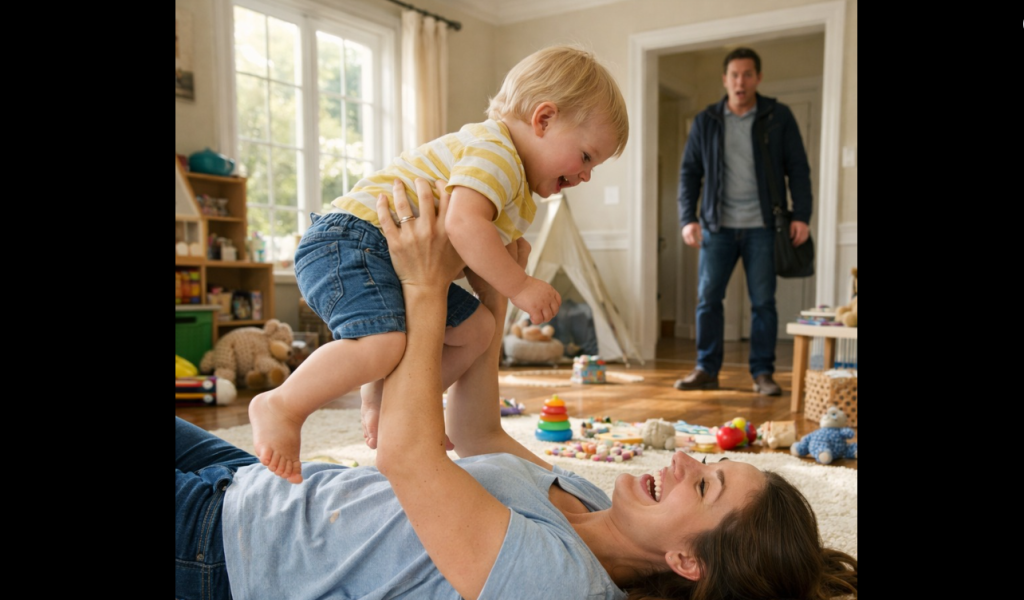
Sophie was lying on her back on the padded floor, holding Emma above her, the little girl squealing with laughter.
But it wasn’t just that.
Sophie’s hands weren’t under Emma’s arms.
They were supporting her legs.
And Emma—Emma was kicking.
Not full, coordinated kicks.
Not the kind you see in toddlers chasing bubbles.
But movement.
Small, real movement, like her body had remembered something it had been told to forget.
Alexander’s breath caught so sharply it hurt.
“What are you doing?” he demanded, stepping forward before he could stop himself.
Sophie glanced up, calm but firm. “Helping her feel her legs,” she said, as if this was the most obvious thing in the world. “She needs to trust them.”
“That’s dangerous,” Alexander snapped, moving closer, the protective father in him screaming. “Her condition—”
“She’s not glass,” Sophie interrupted softly, still holding Emma securely. “She’s a child. If we treat her like she can’t, she never will.”
Alexander opened his mouth to argue.
Then Emma laughed again—bright, pure, unaffected by the tension.
That laugh hit Alexander harder than any medical report ever had.
Because it wasn’t just joy.
It was freedom.
Over the next few days, Alexander watched Sophie like a hawk.
He told himself it was caution. He told himself it was responsibility.
But underneath it was fear.
Fear of hope.
He had heard too many doctors say “no chance” to allow himself to believe anything else.
Sophie didn’t do anything reckless, but she was relentless.
She had Emma stand at the kitchen counter while supporting her torso, letting her feel weight through her arms. She’d place toys just far enough away that Emma had to reach, forcing her to balance with Sophie’s gentle hands at her sides.
She turned therapy into play.
She made the lawn into “lava” and the stepping stones into “safe islands.” She called Emma’s crutches “magic wands” and every careful shift of weight a “spell.”
Emma’s joy was undeniable.
She giggled more. Asked more questions. Began waking up each morning asking to “practice” with Sophie.
Alexander watched all of it with a knot in his chest.
The rational part of him fought against it. The rational part had been trained by years of specialists. The rational part said, You’ve seen false hope before. Don’t do this to her.
But the father part—the part that wanted to see his daughter run in the hallway—couldn’t stop watching.
Two weeks later, everything changed.
It was a warm Saturday morning when Alexander came home early from a meeting. He expected to find Emma in her wheelchair, maybe drawing, maybe watching cartoons.
Instead, he stepped into the living room and stopped cold.
Sophie was standing a few feet away from Emma, arms outstretched like a safety net. And Emma—Emma was standing too.
Not in her wheelchair.
Not being held up.
She was holding onto the edge of the couch with one hand, her face scrunched in fierce concentration.
“Come on, sweetheart,” Sophie coaxed. “One step. Just one.”
Alexander’s breath caught so hard he felt dizzy.
Emma looked at Sophie. Then she looked at Alexander.
There was fear in her eyes.
But there was something else too.
Determination.
She let go of the couch.
Her knees trembled.
Her body wobbled.
And then—with a small movement so subtle it would have meant nothing to a stranger—she shifted her left foot forward.
It wasn’t even a full step.
But for Alexander, it was an earthquake.
Sophie beamed. “That’s it!” she cried. “You did it!”
Emma’s face lit up like the sun.
Alexander felt something deep in his chest crack open.
Hope.
Not the fragile kind.
The kind that hurts when you’ve buried it for years.
For days afterward, Sophie kept working with Emma the same way—games, stories, laughter disguised as therapy.
Obstacle courses out of pillows.
Treasure hunts that required “one more step.”
Pirate adventures where Emma’s “ship” could only move if she moved too.
Emma changed before Alexander’s eyes.
Her confidence grew.
She began to trust her legs the way she trusted Sophie.
Alexander wanted to believe.
But he was still terrified.
He set a rule: Sophie could continue, but only under strict supervision. No exercises without him or another adult present. No pushing too far.
Sophie didn’t argue. She only said, “Alright, Mr. Carrington. But trust me. She’s stronger than you think.”
Then came the day Sophie proposed something bigger.
“There’s a small children’s fair in town,” she said one morning. “Games, music… and a tiny petting zoo.”
Alexander frowned instantly. “You want to take her there? In her condition? Crowds, noise—”
“She needs to see the world,” Sophie replied, “not just the walls of this house. Besides, you’ll be with us. I think she’s ready for something big.”
Alexander’s instinct was to say no.
But when he looked at Emma, her eyes bright with curiosity, he couldn’t.
Against his better judgment, he agreed.
The fair smelled like popcorn and sun-warmed hay.
It wasn’t a fancy event—no velvet ropes, no donor plaques with last names carved into brass. It was the kind of local children’s fair that looked a little crooked and joyful on purpose. Folding tables lined the grass, volunteers in bright T-shirts handed out paper wristbands, and a small band played on a wooden stage that seemed built for exactly one thing: noise.
Kids ran everywhere, sticky fingers clutching cotton candy. Parents balanced strollers and iced coffees. Someone’s dog barked excitedly at a balloon shaped like a giraffe.
Alexander Carrington didn’t belong here, not the way he belonged in boardrooms and penthouse fundraisers. Even dressed casually—dark jeans, plain sweater—he moved like a man who was used to controlling spaces rather than being part of them.
He kept scanning for hazards.
Uneven ground.
Running children.
People not watching where they were going.
He stayed close enough to Emma that his shadow covered her like armor.
Emma, meanwhile, looked like she’d stepped into a storybook.
Her wheelchair was parked back in the car the way Sophie had insisted. Today wasn’t about what Emma couldn’t do. It was about what she might.
Emma clung to Sophie’s hand, small fingers tight, her eyes darting everywhere—bright, curious, overloaded. She had never been in a place like this without her chair. Without that familiar boundary between her body and the world.
Alexander watched her carefully, waiting for fear to take over, waiting for her to collapse into tears the way she had during so many failed therapies in sterile clinics.
Instead, Emma kept looking.
Kept breathing.
Kept going.
Sophie walked at Emma’s pace, never dragging her forward, never forcing. She paused when Emma paused. She crouched beside her when Emma got overwhelmed, whispering, “You’re doing great. You’re safe. We can stop anytime.”
That alone made Alexander’s throat tighten. Because for years, the experts had treated Emma’s fear as something to overcome.
Sophie treated it as something to respect.
They stopped first at a row of carnival games. A ring toss with plastic bottles, a little fishing pond where kids pulled rubber ducks from water. Emma watched the other children, a smile tugging at her mouth as a boy missed three throws in a row and then celebrated like he’d won a trophy when one ring finally landed.
“I want to try,” Emma whispered.
Alexander tensed.
Sophie looked up at him gently. “She can try,” she said.
Emma reached out and took a ring, her hands steady. She leaned forward slightly—balancing with Sophie’s hand at her side—and tossed.
It missed. Completely.
Emma blinked, then laughed.
A real laugh, not the polite one she used when adults praised her for simply “trying.”
She tossed again.
Miss.
Again.
Miss.
And then, the fourth ring landed.
The tiny victory made Emma gasp like it was magic.
Alexander found himself smiling without meaning to. He caught Sophie’s eye for a moment.
Sophie smiled back like she’d known this would happen all along.
The petting zoo was near the far end of the fair, fenced off with hay bales and cheerful banners. A small pony stood inside, gentle and sleepy, munching hay like it had all the time in the world.
When Emma saw it, her whole face changed.
It was as if something lit up behind her eyes.
“Can I touch it?” she asked softly, voice full of wonder.
Sophie crouched beside her. “You can,” she said. Then, with a playful seriousness, she added, “But I’m going to make you a deal.”
Emma’s eyes widened. “A deal?”
Sophie nodded. “You take three steps toward that pony,” she said, “and you can feed him yourself.”
Alexander froze.
His instincts screamed.
Three steps was a lot. Uneven ground, excitement, crowd noise—if Emma fell, the physical injury wouldn’t be the worst part. The worst part would be the crushing disappointment.
“Sophie—” he began.
But Emma nodded eagerly, cutting him off.
“I can,” she whispered, almost to herself.
Sophie positioned herself behind Emma, hands hovering near her sides, ready to catch but not holding. She leaned in close and said quietly, “Remember: slow is strong.”
Emma took a deep breath. The air smelled like hay and sugar and grass.
She lifted one foot, knees trembling.
Step one.
It was shaky. Her body wobbled, but Sophie’s hand was there, steadying her just enough.
Emma exhaled, eyes wide with shock at her own movement.
Step two.
Her foot landed more confidently this time. She tightened her grip on Sophie’s hand, not in fear, but in focus.
Alexander’s chest tightened. He didn’t realize he was holding his breath until it hurt.
Step three.
Emma shifted weight, moved forward, and landed the third step.
It wasn’t graceful.
It wasn’t perfect.
But it was hers.
The pony lifted its head, ears twitching, and leaned toward her gently. Sophie handed Emma a small handful of feed.
Emma giggled as the pony’s soft nose brushed her palm.
Alexander blinked hard.
He didn’t care who saw his tears.
He didn’t care about the image he’d built for years—the untouchable investor, the composed billionaire. That identity felt cheap compared to what he was watching now.
A child touching a pony.
Three steps.
A miracle.
Later that afternoon, the fair grew louder near the stage. The band had started playing a faster tune—something cheerful, almost silly. Children danced in front of the stage, spinning and skipping like the world was theirs to claim.
Sophie knelt beside Emma again.
“Do you want to dance?” she asked.
Emma’s smile faded. Her eyes flicked to the dancing kids.
“I…” she hesitated. “I can’t.”
Sophie tilted her head. “Yes, you can,” she said gently. “Just follow me.”
Alexander’s father instincts flared again. “Sophie,” he warned, voice tight.
Sophie looked up at him. Her expression was calm, but there was something firm behind it.
“Mr. Carrington,” she said quietly, “she’s already doing it. She just doesn’t know she is.”
Before Alexander could stop her, Sophie took Emma’s hands and guided her toward the open space in front of the stage.
The band struck up an even faster tune. A fiddle danced over the rhythm. Drums tapped like a heartbeat.
Sophie began swaying, exaggerated her steps so Emma could see them. At first, Emma barely shuffled, leaning heavily on Sophie, her face tense with concentration.
But Sophie kept smiling, kept moving like this was fun, like the dance was a game, not therapy.
Emma took a small step.
Then another.
And another.
Alexander stood frozen, watching his daughter—his daughter who had been told she would never walk—take step after step in time with the music.
The crowd began to notice.
People paused mid-conversation. Parents turned. Kids stopped running.
A ripple of attention spread.
Emma’s eyes were locked on Sophie’s face, as if Sophie was the only anchor she needed. Her feet moved again, tiny determined steps stamping to the rhythm.
Then Sophie did something that made Alexander’s breath stop entirely.
She slowly let go.
Not abruptly. Not as a trick.
Slowly. Carefully.
One hand released, then the other.
Emma wobbled.
Alexander’s whole body tensed, ready to sprint forward and catch her.
But Emma didn’t fall.
She swayed, knees trembling, arms lifting instinctively for balance.
And then… she took another step.
Alone.
The crowd gasped.
Emma’s face shifted from fear to shock to pure, blazing pride.
She kept moving.
Not fast. Not smooth.
But she moved, her feet finding the rhythm, her body believing itself.
The applause started softly, hesitant, like people weren’t sure if it was okay to clap in case it scared her.
But when Emma took five more steps without falling, the applause grew louder.
Cheers erupted.
Someone shouted, “Go, sweetheart!”
Another voice yelled, “You’re doing it!”
By the time the song ended, Emma had walked more than twenty feet without support.
Twenty feet.
Alexander felt his knees weaken.
Emma stood there, breathing hard, cheeks flushed, eyes wide—like she couldn’t believe her own body had obeyed her.
Then she did something that shattered Alexander completely.
She laughed.
A loud, bright laugh that rang out over the crowd.
And she ran—ran in her own uneven way—into Sophie’s arms.
Sophie caught her, holding her tight, and whispered something into Emma’s hair that Alexander couldn’t hear.
But he didn’t need to.
Because he could see it.
Belief.
Sophie hadn’t just been a nanny.
She had been the spark that lit a fire inside his daughter, the one thing all the doctors and money in the world hadn’t been able to give her.
Not treatment.
Not technology.
Belief.
On the drive home, Emma was exhausted. She fell asleep in her car seat, head tilted against the cushion, her hands still clutching Sophie’s scrunchie like a prize.
Alexander drove in silence at first, his mind replaying every step, every wobble, every laugh.
When they pulled into the estate driveway, he finally spoke.
“How?” his voice cracked. “How did you do that?”
Sophie unbuckled her seat belt and turned toward him.
“I didn’t do it,” she said softly. “Emma did.”
“But the doctors—” Alexander began, frustration rising. “They told me—”
“They told you what they could measure,” Sophie interrupted gently. “They didn’t measure her spirit.”
Alexander swallowed hard.
Sophie continued, “I don’t think she was ever broken. I think she was scared. And everyone treated her like fear was proof she couldn’t.”
Alexander’s throat tightened again.
“She’s been scared for years,” he whispered.
“And she’s been brave for years,” Sophie said. “Those two things can exist together.”
In the weeks that followed, Emma’s progress accelerated.
Not like a miracle movie where she suddenly runs across a field.
But real progress.
She walked short distances with support.
Then longer.
She fell sometimes—because walking means falling sometimes—but she got back up more often than she cried.
Specialists were baffled. They watched Emma walk down clinic hallways and shook their heads.
“We underestimated her potential,” one neurologist admitted reluctantly. “And… perhaps the motivational component.”
Alexander wanted to scream, Perhaps?
But he didn’t.
He was too busy learning something he should have learned years ago: that love isn’t just paying for treatment.
Love is being present.
He rearranged his entire schedule.
Board meetings were moved. Calls were rescheduled. Deals were delegated.
Every morning, Alexander made sure he was there for Emma’s “practice walks.”
Not because he feared she would fall.
But because he never wanted to miss another step again.
One evening, sitting in the garden as the sun dipped behind the trees, Alexander asked Sophie quietly, “Why were you so sure?”
Sophie smiled faintly.
“I wasn’t sure,” she admitted. “I just believed she deserved the chance to try.”
Alexander looked at his daughter, who was laughing softly while balancing a toy on her walker like it was a crown.
He felt tears sting again.
For Alexander, that was the most shocking truth of all:
That the miracle he had prayed for all those years hadn’t come from medicine.
It had come from courage.
From a young woman who refused to see his daughter as broken.
And from a little girl who finally believed she wasn’t glass.


Leave a Reply