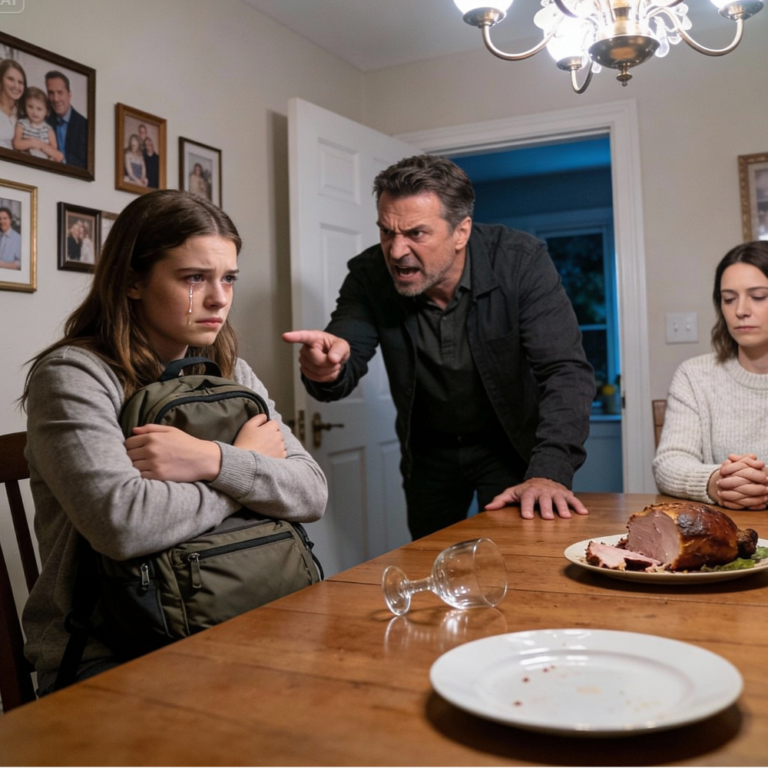
My father’s voice didn’t shake when he said it. That was what made it worse. There was no anger, no shouting, no hint of emotion at all—just a calm, measured tone that made every word cut deeper.
“You’re just a stupid mistake of my past,” he said, pushing his plate away like the sight of me spoiled his appetite. “Take that pregnancy and get out of my house.”
The clink of his fork against the plate was the only sound in the room after that. My mother didn’t speak. She just stared down at her mashed potatoes as though she could hide inside them if she didn’t move.
My name is Phoenix Hall, and I was eighteen when my father decided I was no longer his daughter.
The night started like any other Sunday dinner—roast chicken, overcooked green beans, my father talking about contracts and deadlines, and my mother nodding at the right times, pretending she cared. I’d been dreading it all week. The secret inside me had grown heavier every day, sitting like a stone in my chest. I’d planned to tell them together, calmly, with Tyler by my side. He was supposed to come for dinner, but twenty minutes before, he texted: Work emergency. Rain check?
So I went alone.
My father was still wearing his work clothes—gray slacks, rolled sleeves, and a watch that gleamed under the dining room light. Everything about him was sharp and deliberate. My mother sat across from him in her usual pale sweater set, pearls around her neck, posture perfect. I remember watching the way her hand trembled slightly as she poured water into my glass. Maybe she already sensed what was coming. Maybe she’d known before I did.
I tried to eat, but the food turned to sand in my mouth. Halfway through the meal, I set my fork down and said, quietly, “I need to tell you something.”
They both looked up. My father’s expression didn’t change, but my mother’s did—just a flicker of worry, gone as quickly as it appeared.
“I’m pregnant,” I said.
The words hung there, almost visible, like steam rising from the plate.
My father blinked once, twice, then leaned back in his chair, folding his arms across his chest. “You’re what?”
“I’m pregnant,” I repeated, my voice barely holding. “Tyler and I—”
“Tyler,” he interrupted, his lip curling. “That boy who sells vitamins for a living? You let him do this to you?”
I felt my throat tighten. “He’s not like that, Dad. He loves me.”
“Loves you,” he said, almost to himself, as if testing how the words sounded. Then he laughed once—short, humorless. “Do you have any idea what this does to me? To our name?”
“I’m not asking for anything,” I said quickly. “I’m just telling you the truth.”
He slammed his hand on the table, and the water glasses rattled. “You’re throwing your life away! I built everything for you—college, a career, a future—and you destroy it because you can’t keep your legs closed?”
“Gerald,” my mother murmured softly, eyes still on her plate.
He ignored her. “Do you have any idea how this looks? My only daughter, knocked up at eighteen, no husband, no plan. You’re a disgrace.”
“I’m not a disgrace,” I said, my voice shaking. “I made a mistake, but I’m going to handle it.”
He stood up, the chair scraping violently against the floor. “No, you won’t. You’ve been nothing but a disappointment from the day you were born. I should’ve known better than to expect anything different.”
“Dad—”
“Don’t call me that.” His voice was low and sharp now, dangerous in its calm. “You’re not my daughter anymore. You’re just a stupid mistake from my past. You want to play house? Take that pregnancy and get out.”
For a moment, I couldn’t breathe.
I turned to my mother, desperate for her to say something—to tell him to stop, to tell me to stay. But she just sat there, hands folded neatly in her lap, eyes fixed on her plate. When she finally spoke, her voice was so quiet I almost missed it. “Maybe it’s best if you go,” she said.
That was it. No hug. No tears. No I’m sorry. Just dismissal.
He gave me one hour.
I packed my things in silence. My room looked smaller somehow, the posters faded, the trophies meaningless. I threw clothes into a duffel bag, my hands shaking so badly I could barely zip it. The baby books I’d bought—the ones Tyler and I had picked out in secret—stared back at me from the shelf. I left them there.
Downstairs, the TV was on. Some game show laughter filled the air, so cheerful it made me sick. I paused in the doorway, hoping for a miracle, hoping he’d tell me to stop, to stay, to fix it. He didn’t even look up. My mother was beside him on the couch, her hands folded in her lap, her face blank.
When I stepped outside, the air hit me like a slap—cold, sharp, final.
I sat in my car for a long time before I turned the key. My phone buzzed once: a text from Tyler. Can we talk tomorrow? Busy tonight.
Busy.
I called him anyway. Straight to voicemail. I called again. Nothing. I sent a message—just one line: He kicked me out.
I waited three hours in that parking lot outside the grocery store, watching headlights blur into the rain, watching my phone screen stay dark. Every time it lit up, my heart jumped, only to sink again when it wasn’t him.
My father looked me dead in the eyes and said I was the stupidest mistake he ever made. He said I should take my pregnancy and get out of his house. He gave me one hour to pack 21 years of my life into whatever I could carry. And my mother, she just sat there at the dinner table staring at her mashed potatoes like they held the secrets of the universe.
My name is Phoenix Hall. I was 18 years old when my world collapsed. And I need to tell you how I built a new one from the wreckage. Growing up in Ridgewood, I was never the daughter my father wanted. Gerald Hall owned a midsized construction company. And from the moment I was born, he made his disappointment clear.
He wanted a son. He got me instead. So, he decided to pretend the difference didn’t exist. While other girls my age were learning to braid hair and pick out prom dresses, I was learning to change tires in our garage, spending summers hauling materials at his construction sites, and playing softball.
Even though I secretly wanted to take dance classes, my father had a plan for me. You see, I was going to be the son he never had. I was going to take over Hall Construction and continue his legacy. The fact that I was a girl was just an inconvenience he chose to ignore. I got pretty good at ignoring it, too.
I learned to swallow my feelings, to perform, to achieve. I studied business at Rutgers because that’s what he expected. I got straight A’s because anything less meant a lecture about wasted potential. I became a perfectionist, always chasing approval that never quite came. Looking back, I realize I could rebuild a carburetor with my eyes closed, but I still can’t French braid to save my life.
Some education, right? My mother, Constance, was a different kind of problem. She wasn’t cruel. She was just absent in every way that mattered. She floated through our house like a ghost, never disagreeing with my father, never standing up for me, never making a single wave. I used to think she was weak.
Later, I realized she had simply made her choice a long time ago, and that choice was comfort over courage. If someone had told me back then that in just eight months, I would lose everything. My family, my future, and the man I thought loved me, all in the same 24 hours, I would have laughed. But life has a cruel sense of timing, and mine was about to run out.
Then I met Tyler Webb. Looking back now, I should have known that any man whose smile could convince you the sky was green was probably lying about the color of everything else, too. But I was 21 and desperate to be loved by someone who actually saw me as a woman. So when this handsome 24year-old pharmaceutical sales rep started talking about our future like it was already written in the stars, I believed every single word.
Marriage, kids, a house with a white picket fence. After 21 years of being told I wasn’t enough, here was someone who made me feel like I was everything. I fell hard. The kind of fall where you don’t even realize you’ve left the ground until you’re already plummeting toward concrete. Eight months into our relationship, I found out I was pregnant.
Terrified doesn’t begin to cover what I felt. But Tyler seemed happy. He talked about baby names, about nursery colors, about teaching our kid to ride a bike. I let myself believe him. I let myself hope. That was my first mistake. Tyler started getting distant, busy with work, he said. Traveling more, he said. I pushed down my worries because I needed the fairy tale to be real.
I needed something in my life to not be a disappointment. My second mistake was telling my parents. I planned to announce my pregnancy at Sunday dinner. Tyler was supposed to be there with me, but he canceled last minute. Work emergency, he claimed. So, I sat alone across from Gerald in Constance Hall, pushed my food around my plate, and finally said the words that would change everything.
My hands went ice cold under the table. I could feel my heartbeat in my throat, pounding so loud I was certain they could hear it across the dining room. My father’s face went through several stages. Confusion first, then disbelief, then something cold and hard settled into his features. Something I had never seen before in 21 years.
My mother just froze, her fork halfway to her mouth, a statue in pearls and silence. Gerald didn’t yell at first. That would have been easier. Instead, he spoke in this quiet, controlled voice that was somehow worse than any scream. He talked about his plans for me, about how I was supposed to take over the company, about how an unmarried pregnant daughter would destroy his reputation in the business community, about how he had spent 21 years trying to mold me into something useful. And this was how I repaid him.
Then the quiet broke. He stood up so fast his chair fell backward and crashed against the hardwood floor. The sound made me flinch like a gunshot. And then he said words that I will carry with me until the day I die. He said I was just a stupid mistake from his past. He said he should have tried again for a son instead of wasting his time on me.
He told me to take my pregnancy and get out of his house. I looked at my mother, begged her with my eyes to say something, anything, to defend me just this once. She stared at her mashed potatoes like they were the most fascinating thing she had ever seen. Gerald gave me one hour. I packed two suitcases with shaking hands.
21 years of existence crammed into whatever would fit. My mother didn’t come to my room. Didn’t offer help. Didn’t say goodbye. I could hear the television turn on downstairs. Some game show with cheerful music while I erased myself from my childhood home. I walked out the front door and I never looked back.
In my car, I called Tyler. No answer. I called again. Voicemail. I sent a text with trembling fingers telling him my father had kicked me out, telling him I needed him. Three hours I waited for a response. Three hours of sitting in a dark parking lot watching my phone screen like it held my entire future, praying for the fairy tale to survive just a little longer.
Then his message came through and whatever was left of my naive little heart shattered into pieces so small I wasn’t sure I’d ever find them all. Before we continue, if you’re enjoying this story, please hit that subscribe button and tell me in the comments where you’re watching from and what time it is there. I see every single comment and they mean the world to me.
Thank you so much for your support. Now, where were we? Right, Tyler’s message, six words. That’s all he gave me. After eight months, after all those promises, after talking about our future and our baby and forever, six words on a glowing screen in a dark parking lot, he said he couldn’t do this. He said he was sorry. He told me not to contact him again.
I didn’t listen. Of course, I didn’t. I called him probably 40 times that night. Every call went straight to voicemail until eventually the number just stopped connecting at all. He had blocked me. The man who talked about our children’s names had blocked me like I was a telemarketer. The next morning, I drove to his apartment. I needed answers.
I needed to look him in the eye and understand how someone could transform from Prince Charming into a ghost overnight. A woman answered the door. She was pretty, put together, wearing an engagement ring that caught the morning light like a tiny disco ball of betrayal. Her name was Lauren, and she had been engaged to Tyler Webb for two years. 2 years.
While Tyler was whispering promises in my ear, he was going home to a fiance who had no idea I existed. I was the other woman in a story I didn’t even know I was part of. The morning sickness I’d been fighting suddenly had nothing to do with pregnancy. Lauren and I just stared at each other for a moment. Two women realizing we’d been loving the same lie.
Then Tyler appeared behind her and the mask finally came off. There was no charm left, no warmth. He looked at me like I was an inconvenience, a mess he needed to clean up. He told me to handle my problem and shut the door in my face. I should have seen the signs. The man took work trips to supposedly exotic locations, but never came back with a tan or a single photograph.
I used to think he was just private. Turns out he was just a professional liar with a frequent flyer account. So there I was, 21 years old, pregnant, disowned, and dumped in the span of 24 hours. I had $847 in my savings account. My father had already called every relative we had, poisoning the well before I could even reach out.
My aunt tried to send me money secretly, but Gerald found out and threatened to cut her off completely. Even my mother managed to sneak $500 to me through a cousin, but when my father discovered it, he took away all her credit cards as punishment. I found a room in a boarding house in Newark. It smelled like mildew and broken dreams, but it was $60 a week, and that was all I could afford. I worked three jobs.
Mornings at a bakery starting at 4 in the morning, covered in flour and exhaustion. Afternoons at a dry cleaner, pressing other people’s clothes while my own fell apart. Evenings at a call center getting yelled at by strangers until 10 at night. I would fall into my tiny bed, sleep for 5 hours, and do it all again.
My body held on as long as it could. At 6 months pregnant, I collapsed during my shift at the call center. Just crumpled right there between the cubicles like a puppet whose strings got cut. I woke up in a hospital with a doctor telling me I was killing myself and my baby. He said I had to slow down or I would lose her.
I quit two of my jobs. I had no choice. I survived on one income, food stamps, and a level of anxiety that probably should have had its own zip code. My daughter was born in April. I named her Iris after the flower and the goddess of rainbows because she was the only color left in my gray world. She came into this life in a delivery room with no family waiting outside, no father pacing the halls, no grandparents eager to hold her, just me, exhausted and terrified and more in love than I had ever been in my entire life. The nurse asked if my
family was coming. I told her they were traveling. It was easier than explaining that my family had thrown me away like yesterday’s garbage. I held Iris in my arms, this tiny, perfect human who had done nothing wrong except exist. And I made her a promise. I swore she would never ever know what it felt like to be unwanted.
My father, meanwhile, was busy erasing me from existence. He told everyone in Ridgewood that I was troubled, making poor choices. He implied things without saying them directly, letting people’s imaginations fill in the worst details. Old family friends crossed the street to avoid me when I visited the area. Former college classmates stopped returning my texts.
I discovered through a cousin’s accidental social media post that I had been cropped out of every family photo. 21 years of birthdays, holidays, and graduations, and I no longer appeared in any of them. But here’s the thing about rock bottom. Once you’re there, there’s nowhere to go but up.
And I learned that year how to stretch $12 across seven days of groceries. I learned 47 different recipes involving rice and beans. To this day, I’m worth millions. And I still can’t look at a kidney bean without my eye twitching a little. Some traumas stay with you. The wound that cut deepest wasn’t my father’s rage, though. It was my mother’s silence.
Constance Hall had watched her only daughter get thrown out into the world, pregnant and alone. And she had said nothing, done nothing, chosen nothing except the path of least resistance. A few months after Iris was born, I wrote my mother a letter. I poured my heart onto that paper. I told her about her granddaughter.
I begged her to meet Iris, to be part of her life, to choose love over fear just this once. Her response came two weeks later. One paragraph. She said, “My father thought it was best if they moved on.” She said she was sorry. Sorry. That single word so small and weak and useless. It was worse than silence. At least silence didn’t pretend to care.
On Iris’s first birthday, I threw her a party in our tiny apartment. Just the two of us. A cake from the discount rack at the grocery store with a dent in the frosting and a single balloon I found on sale. I was exhausted, broke, eating cake that tasted like survival and pretending it was sweet. But my daughter smiled at me.
This huge, gummy, joyful smile that didn’t know anything about absent fathers or cruel grandfathers or mothers who chose comfort over their children. And something shifted in my chest. I realized I had two choices. I could spend the rest of my life drowning in resentment, replaying my father’s words, letting Gerald Hall live rentree in my head forever.
Or I could build something so big, so successful, so undeniably mine that his opinion would become irrelevant. I’ve never been good at drowning. The turning point came from an unexpected source. A tough, widowed 68-year-old woman named Miriam Castayanos who ran a struggling property management company and had zero patience for excuses.
I got an entry-level job at her firm when Iris was about 18 months old, filing paperwork, answering phones, making coffee that Miriam always complained was too weak. But Miriam noticed things. She noticed I stayed late without being asked. She noticed I caught errors in contracts that had slipped past everyone else. She noticed I had the kind of hunger that comes from having nothing and everything to prove.
One day, she called me into her office and asked me what I wanted to do with my life. I told her I wanted to never be powerless again. She nodded like that was the only acceptable answer and started teaching me everything she knew. Miriam had built her company from nothing after her husband died and left her with three kids and a mountain of debt. She understood survival.
She understood what it meant to be underestimated. And she saw something in me that I couldn’t see in myself yet. I discovered I had a gift for real estate. Not the flashy sales pitch kind, but something more valuable. I could look at a neglected property, a building everyone else saw as a lost cause, and see exactly what it could become.
I saw potential where others saw decay. It was like my superpower, except instead of a cape, I wore sensible flats and determination. My first successful negotiation, if you can call it that, was convincing my landlord not to evict me by offering to personally fix the building’s broken mailboxes. I spent an entire weekend with a screwdriver, a YouTube tutorial, and more curse words than I’m proud of.
But when I finished, I realized something important. I could sell anything to anyone if I believed in the value I was offering. That busted mailbox situation was my business school. I got my real estate license while working full-time and raising iris alone. I studied at 2 in the morning. Textbooks spread across my kitchen table.
My daughter sleeping in the next room. I drank enough coffee to fuel a small spacecraft. I failed my first practice exam and cried in the bathroom for 20 minutes. Then I dried my eyes and studied harder. When I passed that licensing exam, I held the certificate in my hands and sobbed. Not sad tears, survivor tears, the kind that come when you realize you might actually make it after all.
My first sale was a tiny condo that had been sitting on the market for 8 months. Nobody wanted it. The location was weird. The layout was awkward and it smelled vaguely of cats and regret. I staged it myself with furniture from thrift stores and tricks I learned from home improvement shows. I baked cookies before every showing because I read somewhere that the smell makes people feel at home.
It was probably manipulation, but it was also delicious manipulation. That condo sold in 3 weeks. My commission was $3,200. more money than I had seen in two years of struggling. I remember depositing that check and just staring at my bank balance, watching the numbers change, feeling something I hadn’t felt since before my father’s words destroyed everything. I felt hope.
Miriam promoted me, gave me more listings, started treating me less like an employee and more like a protege. I learned the business inside and out, absorbing everything she taught me like a sponge that had been thirsty for decades. When Iris was 3 years old, she asked me why we didn’t have a backyard. She had seen one on a television show, and she wanted to know why our apartment building only had a parking lot.
I knelt down to her level and made her a promise. I told her someday we would have the biggest backyard in all of New Jersey. She drew me a picture that night, a house, way too big, with a yard that took up most of the page and two stick figures holding hands, me and her. I put that drawing in my wallet and I have carried it every single day since.
But success doesn’t come without setbacks. I struggled constantly with a voice in my head that sounded exactly like my father. Every time I reached for something bigger, that voice told me I was just a stupid mistake. Every time I doubted myself, Gerald Hall’s words echoed through my thoughts like a curse I couldn’t break. Miriam noticed.
She sat me down one afternoon and shared her own story of being dismissed and doubted. Her husband’s family had told her she would fail. Business associates had laughed at her. Banks had refused to give her loans because she was a woman alone. She looked me dead in the eyes and said something I have never forgotten.
She told me, “The best revenge isn’t proving them wrong. The best revenge is forgetting they exist while you build your kingdom.” Around this time, Tyler decided to resurface because of course he did. He found me on social media when Iris was four years old. His message was all false concern and carefully worded questions.
He had heard I was doing better. He wanted to reconnect. He thought maybe they should discuss Iris’s future. What he meant was he had heard I wasn’t destitute anymore and wanted to either ease his guilt or see if there was money to be had. I screenshot every message, save them in a folder, and never responded.
Let him wonder. Let him wait forever. Here’s something funny, though. Lauren, his ex- fiance, reached out to me separately around the same time. Apparently, Tyler had eventually cheated on her, too, because leopards don’t change their spots. They just find new gazels. She was now happily remarried to a decent man and wanted to apologize for how everything went down, even though none of it was her fault.
We ended up becoming friends, united by the shared experience of loving a professional con artist. Life is strange that way. Sometimes the people you should hate become the people who understand you best. Through industry connections, I started hearing whispers about hall construction. My father had overextended during a building boom, taken bad loans with worse terms, and his company was slowly bleeding out.
His pride wouldn’t let him admit it. Constants had to let go of their housekeeper. They stopped going on their annual vacation. Small cracks in the facade that only someone watching closely would notice. I noticed. I didn’t feel satisfaction. Not yet. I was too busy building my own empire to waste energy on his crumbling one.
By the time Iris started first grade, I had saved $180,000. I had a plan, a reputation, and a future that had nothing to do with Gerald or Constance Hall. I wasn’t planning revenge. I was simply too busy for revenge. But if my success happened to shine a light on exactly what they threw away, well, that was just good positioning.
By the time I was 28 years old, I had learned something important about myself. I wasn’t just a survivor. I was a builder. Miriam Castanos decided to retire. 68 years of working, fighting, and proving everyone wrong had earned her a beach somewhere warm where nobody knew her name, and nobody needed her expertise.
Before she left, she sat me down and offered me her entire client list at a price so low it was practically a gift. I tried to argue, tried to pay her what it was actually worth. She just looked at me with those sharp eyes that had seen everything and said this was her investment in the future. She said she wanted to watch what I would build and she couldn’t do that if I was broke from overpaying her.
Then she handed me a bottle of champagne, told me not to open it until I made my first million and walked out the door. I still have that bottle. I’m saving it for something even bigger now. I launched Phoenix Rise Properties from a tiny office in Hoboken with one desk, one chair, and more ambition than square footage.
The name wasn’t subtle, but subtlety had never gotten me anywhere. I was a phoenix. I had burned and I had risen. Anyone who had a problem with that could take it up with my profit margins. My specialty became finding neglected properties in neighborhoods that were about to transform, buildings everyone else dismissed as lost causes. I would buy them, restore them with care and intelligence, and sell them for considerably more than I paid.
My first major project was a condemned apartment building in Jersey City that the city was about to demolish. I saw potential where everyone else saw rubble. 18 months and a lot of sleepless nights later, I had converted it into luxury condos that sold out in 6 weeks. That project made me $1.2 million in profit. I remember sitting in my new office staring at the numbers, trying to make them feel real.
Eight years earlier, I’d been eating dented birthday cake in a boarding house, wondering if I could afford diapers. Now I was a millionaire. Not inherited wealth, not family money, mine. Every dollar earned through work and will. And refusing to quit when quitting would have been so much easier. I deliberately kept a low profile during those years.
Used my business name on everything, rarely my personal name. No social media presence, no photographs in industry publications, no flashy displays of success. My office was in Hoboken, far from Rididgewood and the people who used to know me. Anyone from my old life wouldn’t have recognized the confident business woman in tailored suits who closed deals worth more than their houses.
The transformation from struggling single mother to real estate developer still surprises me sometimes. I went from owning two pairs of work pants to having a closet organized by season and occasion. I still keep those original two pants, though. They’re framed in my closet like art. Some people hang diplomas. I hang polyester blend reminders of where I started.
Through it all, Iris remained my center, my reason, my north star. When she was seven, she started asking about grandparents. Her friends at school talked about visiting grandma’s house, getting spoiled with cookies and presents, having that special relationship that grandparents and grandchildren share.
Iris wanted to know why she didn’t have that. I told her a simplified version of the truth. I explained that sometimes adults make choices that hurt people they should love, and my parents had made that choice. I didn’t poison her against them. I didn’t use her as a weapon for my own pain. I just told her the facts in words a seven-year-old could understand.
She thought about it for a moment. This beautiful girl with my eyes and her own fierce spirit. Then she shrugged and said it was their loss because I was the best mom ever. I cried in the shower that night. Happy tears and sad tears all mixed together, washing down the drain along with the last remnants of hope that my parents might somehow change.
Speaking of change, I should tell you about Russell. Russell Okonquo was an architect, 34 years old, divorced with a young son, brilliant at his work, and patient in a way that felt foreign to me. We met at an industry conference when I was 29. He was presenting on sustainable building design.
I was pretending to take notes while actually judging everyone’s business cards. He asked me to coffee afterward. I said no. He asked again a month later. I said no again. The third time, 6 months after that, I finally said yes. mostly because his persistence had become impressive enough to reward. Here’s the thing about Tyler Webb. He didn’t just break my heart.
He broke my ability to trust. For years after him, I couldn’t look at a man’s kindness without searching for the hidden agenda. Every compliment felt like the opening move in a con. Every promise sounded like a lie waiting to reveal itself. I had built walls so high around my heart that I wasn’t sure anyone could scale them. Russell didn’t try to scale them.
He just showed up consistently, respected my boundaries, and proved through actions instead of words that he was exactly who he appeared to be. It took years, literal years of friendship, of slow trust building, of him never once pushing for more than I was ready to give. By the time Iris was eight, Russell and I were officially together.
He had earned that place in my life the hard way, which is the only way that matters. Meanwhile, I kept tabs on Hall Construction through public records and industry gossip. Not obsessively, just occasionally enough to know that my father’s empire was crumbling while mine grew. Gerald had lost two major contracts to competitors who were younger, hungrier, and more adaptable.
He had taken a second mortgage on my childhood home, the house he had kicked me out of, with such righteous fury. My mother’s sister mentioned at a community event that Gerald’s pride wouldn’t let him admit they were struggling. He was still pretending everything was fine while the foundation rotted beneath him.
I felt nothing when I heard these things. No satisfaction, no pity, just a kind of distant acknowledgement, like reading about a stranger’s misfortune in the newspaper. Then I saw the listing, Thornfield Estate, six bedrooms, 4 acres, a historic property in Rididgewood that had been on the market for 2 years because the asking price was ambitious and the renovation needs were significant.
It was 3 miles from my parents’ house. It was also in one of the best school districts in New Jersey, perfect for Iris. As she approached high school years, the property had incredible bones, and I could already see exactly what it could become. I told myself I was buying it because it was a good investment, because Iris deserved that backyard I had promised her when she was three, because Ridgewood schools would give her opportunities that mattered.
All of that was true, but I would be lying if I said I didn’t smile when I signed those papers. Some purchases are practical. Some purchases are poetic. This one was both. We moved into Thornfield Estate 2 weeks before Iris’s 9th birthday. I was 30 years old, self-made, successful, beyond anything my 21-year-old self could have imagined.
I had a daughter who knew she was loved, a partner who had earned my trust, and a home that belonged entirely to me. I didn’t think about my parents. I didn’t need to. But Ridgewood is a small town and secrets have a very short lifespan. The whispers started within days of my moving in. Ridgewood isn’t a big place.
People talk. People notice. And when the disowned daughter of Gerald Hall suddenly appears in a historic estate worth more than most people’s lifetime earnings, people definitely talk. I heard the rumors secondhand through Russell, who heard them from a colleague who heard them from a neighbor. Did you hear Gerald Hall’s daughter is back? The one he kicked out years ago.
She’s living in Thornfield Estate, the $8 million property. Can you believe it? Before we continue, I need to take just a second to say thank you. If this story is hitting home for you, please take a moment to like this video and subscribe to the channel. It truly means everything to me. and tell me in the comments where you’re watching from right now and what time it is.
I read every single one. Thank you from the bottom of my heart. Now, back to those whispers. The rumors spread through Ridgewood like wildfire through dry grass. Everyone knew except apparently Gerald and Constance Hall. They existed in their own bubble of denial, still pretending their reputation was intact, still believing no one knew about their financial troubles or their discarded daughter.
Constants found out first, her bridge club of all things. Some well-meaning friend asked if she was excited about having Phoenix back in town, about having access to her granddaughter. Constance apparently went pale as paper and excused herself early. she told Gerald that night. I can only imagine how that conversation went. His face when he realized his stupid mistake, the daughter he had thrown away like garbage was now living in a house he could never afford.
The daughter he had erased from photographs was worth more than he would ever be again. Gerald didn’t believe it at first. Couldn’t believe it. He researched Phoenix Rise properties obsessively, according to what I heard later. found the portfolio, the awards, the industry recognition, found photographs of me at conferences, shaking hands with mayors and developers looking nothing like the crying girl he had given one hour to pack her life.
I imagine his face went through several stages during that research. Confusion, denial, recognition, and finally something he probably hadn’t felt in years, desperation. It was a Saturday morning when the call came. I was in my home office reviewing plans for a new development project, drinking coffee and enjoying the quiet.
Iris was playing in the garden with Russell’s son, their laughter floating through the open window like music. My security team called, very professional, very neutral. They informed me there was an older couple at the main gate. The couple claimed to be my parents and requested entry to the property. My heart stopped. Then it started again, faster than before.
I looked out the window at Iris, my daughter, happy and innocent, unaware that the people who had rejected her before she was even born, were currently standing at our gate, waiting to be led in. I told security to inform them I would be there shortly. Then I made them wait 47 minutes. I would love to tell you it wasn’t pettiness, that I genuinely needed that time to compose myself, to prepare what I would say, to settle my nerves.
And that was partly true, but I would be lying if I said there wasn’t some satisfaction in knowing Gerald Hall was standing outside a gate waiting for permission to enter while his daughter took her time deciding if he was worth the effort. Some things you earn through patience. Other things you earn through making people wait.
When I finally walked down to the gate, I saw them clearly for the first time in 9 years. Gerald had aged badly. The stress of financial ruin was written across his face in deep lines and gray skin. He had lost weight, but not in a healthy way. In the way that comes from worry eating you alive from the inside.
Constant stood slightly behind him, smaller and frailer than I remembered. Her eyes red like she had been crying recently. Gerald tried to smile when he saw me. It was the most pathetic thing I have ever witnessed in my life. This man who had screamed at me, who had called me a stupid mistake, who had given me 60 minutes to erase myself from his existence, was now attempting to look warm and fatherly.
The performance was so bad it would have been funny if it wasn’t so tragic. He started talking immediately, didn’t even wait for me to speak. Words tumbled out of his mouth about family and misunderstandings and water under bridges and moving forward. He talked about how proud he was of what I had built. Proud.
The man who told me I was worthless was now claiming pride in my success. Constant said nothing. She just stared at the estate behind me, at the gardens, at the evidence of the life her daughter had built. Without any help from her, I wondered what she was thinking. I wondered if she felt regret or just envy.
I let Gerald finish his speech. It took a while. He had clearly rehearsed it, though not well enough to make it convincing. When he finally stopped talking, I spoke for the first time. I didn’t yell. I had imagined this moment for years. And in my imagination, I always yelled, screamed all the pain and anger and hurt that had been festering inside me.
But standing there looking at this diminished man who used to terrify me, I felt something unexpected, calm. I told him that he had called me a stupid mistake, that he had told me I was nothing, that he had erased me from family photographs like I had never existed. I reminded Constance that she had written me a letter choosing his comfort over her own grandchild, that her sorry was not enough then, and would never be enough now. Gerald’s facade cracked.
He admitted the company was bankrupt. They were about to lose the house. Everything he had built was gone, and he needed help. He actually said those words to me. He said I had to help them because they were my parents. I almost laughed almost because here was the man who had refused to be my father when I needed him, demanding that I be his daughter now that he needed me.
He finally saw me as capable, but only because he needed my checkbook. Better late than never, some people might say number. Some things are simply too late. I looked at my father for a long moment. Really looked at him. This man who had shaped my entire childhood with his disappointment and demands. Who had made me feel like a failure simply for being born the wrong gender, who had thrown me away when I needed him most and expected me to crawl back when he needed me.
Then I looked at my mother, the woman who had chosen silence over love, who had watched her only daughter get discarded and done nothing, who had written sorry in a letter like that single word could bandage a wound that went bone deep. And I smiled. Not with cruelty, not with vengeance, not with the satisfaction of watching them suffer.
I smiled because I realized standing there in front of my beautiful home with my daughter’s laughter in the background that I didn’t need anything from them anymore. Not their approval, not their regret, not even their acknowledgement of how wrong they had been. I was free. I told Gerald I wasn’t going to help him.
Not because I wanted him to suffer, but because I didn’t owe him anything. He had made that clear 9 years ago when he gave me 1 hour to pack my life into suitcases. The debt between us was settled the moment I walked out his door. I told him I had a daughter who had never known what it felt like to be unwanted.
That was my legacy. Not saving people who threw me away when I was at my lowest. Then I turned to Constance specifically. I told her she could have left him. She could have chosen me. She could have been a mother when it mattered. She didn’t. That was her right, her choice to make, and this was mine.
Gerald tried anger first, raised his voice, talked about everything he had done for me growing up. Tried to make me feel guilty. It bounced off me like rain off glass. His anger had no power anymore. Then he tried guilt, reminded me they were old, that they had nowhere to go, that I was their only child. I felt nothing. The guilt he was trying to summon had been burned out of me years ago.
Finally, he tried something that looked almost like genuine remorse. His voice cracked. His eyes got wet. He said he was sorry, that he had been wrong, that he had made the biggest mistake of his life. Too little, 9 years too late. I told him I hoped he found peace, but he wouldn’t find it here.
Not at my gate, not in my home, not in my life. Constant spoke for the first time since they had arrived. Her voice was small, barely above a whisper. She asked if she could at least see Iris just once, just to see her granddaughter. For one moment, my heart wavered. This was my mother. The woman who had braided my hair when I was little before Gerald decided that was too feminine.
The woman who had snuck me $500 through a cousin when I had nothing. Then I remembered the letter. I remembered sorry. I remembered the years of silence. The years of choosing him over me. the years of letting me struggle alone while she preserved her comfortable life. I told her Iris didn’t know she existed, and I said keeping it that way was the kindest thing I could give my daughter.
Constance’s face crumpled. Gerald put his arm around her, still trying to maintain some dignity, still playing the role of protective husband, even though he had protected nothing. They left slowly, like they were hoping I would change my mind. I watched them walk back to their car, a vehicle that was older than it should have been, showing the kind of wear that comes from deferred maintenance and stretched budgets. They drove away.
I stood at my gate until their car disappeared around the corner, and I felt lighter with every inch of distance between us. Iris came running up a few minutes later, Russell’s son chasing behind her. She asked who those people were. I looked at my daughter, this beautiful, happy, confident girl who knew she was loved every single day of her life, who had never been called a mistake, who had never been made to feel like she wasn’t enough.
I told her they were nobody important. And I meant it. That evening, Russell came over for dinner. We sat in the garden watching the kids play, eating food that I had actually paid someone else to cook because I could afford that now. because I had built something from nothing and I was allowed to enjoy it. Iris showed Russell her latest drawing.
Our family, our house, our big backyard with trees and flowers and a swing set. Three figures holding hands, plus Russell’s son beside them. A family that had nothing to do with blood and everything to do with choice. I looked at my life at the daughter I had raised alone through the hardest years. At the man who had earned my trust through patience and consistency.
At the home that belonged entirely to me, paid for with money I had made through my own intelligence and effort. Not a single piece of it came from Gerald or Constance Hall. And that’s exactly the way it should be. Those who throw away their children don’t get to claim their success. I rose from the ashes because I had to.
My parents never even tried to strike the match.



Leave a Reply