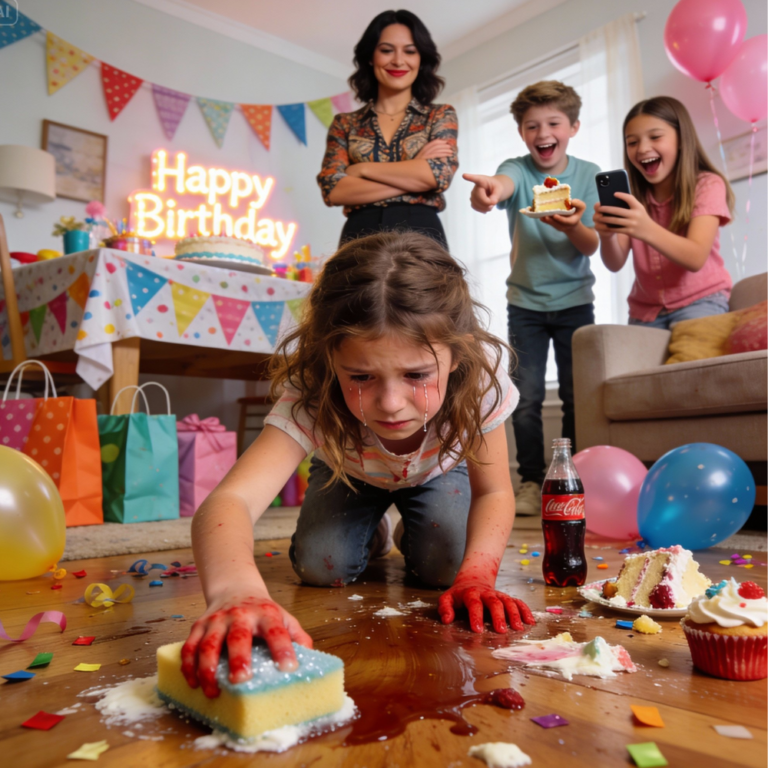
The kind of fury that doesn’t roar—it hums. It lives under your skin, in the space between every heartbeat, sharp and deliberate. That’s what I felt as my daughter sat beside me, her small hands raw and trembling, her hair tangled from a night she should have spent laughing with friends, not scrubbing floors.
My 9-year-old daughter went to a sleepover at my sister’s house. They left her behind to clean while everyone else went out for ice cream and a movie. When she told me what happened, I didn’t shout. I didn’t cry. I didn’t even speak. I just watched her reflection in the car window, a quiet child holding her stuffed rabbit like it was a lifeline, and felt something inside me go still.
Three days later, I made sure my sister’s perfect little world began to crumble. But it started right here—in this car, on that rainy Sunday morning, with my daughter’s voice breaking as she told me everything.
The wipers dragged across the windshield, smearing the drizzle into watery streaks. The neighborhood looked too calm, too polished. The kind of place where people left baskets of flowers on porches and smiled at block parties. The kind of place where, if you didn’t look too closely, you’d think everything was beautiful. But I had looked closely. I knew better.
“Tell me again,” I said quietly, because I needed to hear it straight, word for word.
Annie’s eyes darted to the floor. “They said I couldn’t come with them until I finished the chores.”
“What chores?”
“The list.” She reached into her jacket pocket again, slower this time, pulling out the same crumpled sheet. It was spotted with soap stains and fingerprints, the pencil smudged from where she’d rubbed at it with the side of her palm. I smoothed it open on the steering wheel.
At the top, written in glitter pen: “EARNING YOUR PLACE.” Hearts and stars framed the title. Below it, each task was numbered.
- Scrub the kitchen floor.
- Wash the dishes.
- Vacuum the hall.
- Clean the bathroom sink and mirror.
- Wipe baseboards.
- Tidy the playroom.
There were little checkboxes next to each one. Only the first three were ticked off.
“Who wrote this?” I asked.
“Briella and Kenzie,” Annie whispered. “Aunt Mara said it was good for me. That I’d learn how to be useful.”
“Useful,” I repeated softly, the word tasting like rust.
“She said it builds character,” Annie continued. “She said the other girls earned their fun last year, too.”
“And the fun?” I asked, though I already knew.
“They went for ice cream. And the movies.”
I could hear the tiny crack in her voice when she said it, like the words themselves were sharp enough to hurt.
“Did they even tell you goodbye?”
Annie shook her head. “They just left.”
My grip tightened on the steering wheel until my knuckles went white. “And you stayed alone?”
“I tried to clean fast,” she said. “I didn’t want to be bad. I wanted them to like me.”
That did it.
All the quiet patience I’d carried for years—the kind you build growing up in a family where appearances matter more than people—started to splinter.
I’d watched Mara for decades craft this perfect image: smiling mom, flawless house, Instagram-ready kids who wore matching bows and called her “the best mom ever.” She threw brunches that made neighbors jealous, volunteered at school fundraisers just long enough for photos, and bragged about her “family values” while barely hiding her disdain for mine.
I had never truly hated her until that moment.
“Did you tell anyone you were hurt?” I asked, trying to keep my voice even.
“I told Grandma,” Annie said, voice small. “She said it was good practice for when I’m older.”
For a second, I thought I might be sick.
I pulled over on the side of the road. The engine hummed softly, the sound of rain muffled on the roof. I turned toward Annie, forcing my face calm, because the last thing she needed was to see me unravel.
“Sweetheart,” I said, reaching out to touch her cheek. “You didn’t do anything wrong. Not one thing.”
“But they said I wasn’t part of the group,” she whispered. “They said I had to earn it.”
“You never have to earn being treated with kindness.” My voice cracked, but I didn’t care. “Not from anyone. Ever.”
Annie nodded, though I wasn’t sure she believed me yet.
I looked at her small hands again—red, swollen, raw around the knuckles—and something inside me hardened. My whole life, I’d been told to let things go. To be polite. To forgive. I’d spent years being the quiet sister, the understanding daughter, the one who swallowed every insult and smiled through it.
Not this time.
When I pulled back onto the road, I didn’t head home. I just drove, needing the motion to think. My sister’s house had always been a monument to perfection—gleaming floors, lavender candles, marble countertops. But now, every inch of that house felt contaminated by the image of my daughter on her knees, scrubbing someone else’s filth while the rest of them laughed over ice cream cones.
I remembered dropping Annie off just twenty-four hours earlier. She’d been buzzing with excitement, clutching her overnight bag and the little bracelet she’d made for Kenzie. I’d watched her skip up the walkway, hair bouncing, face bright. And Mara—standing in the doorway, phone in hand—had smiled her politician’s smile and said, “Don’t worry, we’ll take great care of her.”
I almost laughed now thinking about it.
“Mom?” Annie said softly beside me.
“Yes, honey.”
“Am I still allowed to see them?”
The question sliced through me.
I looked at her, this small, brave kid who still asked for permission to forgive people who didn’t deserve her kindness. Her face was blotchy from crying, her lip trembling, her voice barely above a whisper.
I wanted to tell her no. To tell her she’d never set foot in that house again. To promise her that nobody would ever treat her like that while I was alive.
But instead, I said quietly, “You don’t have to decide that right now.”
She nodded and looked back out the window.
Outside, the rain had stopped. The sky was pale, washed out, the kind of light that makes everything look too clean, too exposed. Annie traced a finger along the fogged glass, writing invisible letters only she understood.
As we turned the corner, Mara’s neighborhood disappeared in the rearview mirror, but her words—She should be useful—kept replaying in my head, like a tune I couldn’t shake.
The list sat in my lap, still damp from Annie’s hands. I folded it neatly and tucked it into my purse. It felt less like a piece of paper and more like evidence—something solid, undeniable.
And as I glanced at my daughter again, her head resting against the seat, I knew this wasn’t over. Not by a long shot.

My 9-year-old daughter went to a sleepover at my sister’s house. They left her behind to scrub the floors and wash their dishes while everyone else went out for ice cream and a movie. I didn’t shout. I took action. 3 days later, my sister’s perfect life started crumbling. If you’d told me that Saturday morning that my daughter’s dream sleepover would end with her crying herself to sleep, I probably would have laughed dryly.
The kind of laugh you give right before the world tilts. But that morning started with hope. My daughter Annie’s hope. And mine. Though I’d never admit it aloud. Annie had been talking about that sleepover for weeks. Months. Honestly, if you count the day she circled it on her paper calendar and covered the square with so many star stickers, it looked like a tiny explosion.
My sister Mara hosts these sleepovers every year. Though calling them sleepovers is generous. They’re more like miniature gallas for her daughters. Briella, who’s 11, and Kenzie, who’s nine and just a little older than Annie. Matching pajamas, themed snack bars, crafts so complicated they should come with instruction manuals.
Every kid gets a personalized gift bag with glitter and ribbons like it’s some exclusive event they’re lucky to attend. And for years, Annie wasn’t on that list. She was the kid watching from the sidelines, smiling like she didn’t mind. But she minded. God, she minded. So when Briella invited her this year, out of nowhere, without explanation, Annie treated it like she’d won a scholarship to the cool kids universe, she planned outfits.
She wrote little notes. She even bought tiny gifts for each girl using her savings. I bought one, too, pretending she didn’t see me wipe my eyes at the checkout. So yes, I was hopeful, quietly, carefully, like a parent who’s been burned before. When we pulled up to Mara’s house for drop off, it looked like something out of a magazine, signs with glittery arrows, pink balloons, laughter spilling out the door.
Annie stepped out of the car like she was stepping into sunlight. She didn’t even look back. I watched her run up the walkway, this hopeful, awkward kid in her favorite purple dress, and thought, “Maybe, just maybe, I should have known better. I really should have.” The next morning, the house looked different. Quiet. Too quiet.
The balloons were drooping like even they were exhausted. When I knocked, the door creaked open like I was interrupting a crime scene. And there was Annie. Pale, dirty, eyes red, dress wrinkled and stained with something I didn’t immediately recognize. Her hair stuck to her face like she’d been crying for hours. She held her stuffed rabbit under her arm like someone might take it from her.
Morning, she whispered. That’s when my heart cracked. Not dramatically, more like a hairline fracture you don’t notice until it’s too late. Mara didn’t appear. Neither did Bela or Kenzie. The whole place was strangely empty, except for Annie and the faint smell of bleach. “Ready to go?” I asked.
Annie nodded quick and stiff like she’d learned not to take up space overnight. Something in me went cold. We didn’t even make it out of the neighborhood before I asked softly. So, how was it? She didn’t answer at first, just stared straight ahead, lips trembling. Then she made a sound, small, strangled, and suddenly she was sobbing. Not the dramatic kind.
Not loud, just broken. They said I wasn’t part of the group. She choked out. They said I had to earn it. Earn what? My place. My grip on the steering wheel tightened. How? She reached into her pocket with shaking fingers and unfolded a crumpled piece of paper. A list. In handwriting, I recognized Bella’s with doodled hearts around the title like it was cute.
Scrub the floors, wash dishes, clean the bathroom sink, tidy the playroom, vacuum, the hallway wipe, baseboards, hours. That was hours of work for a child. A child who was supposed to be having a sleepover. I stared at the list. It trembled in my hand, though that might have been my own shaking. They said I had to finish it before I could do anything with them, Annie whispered.
But I couldn’t go fast enough, so they left. Left where? for ice cream and the movies. Of course, the outing Annie had been looking forward to since June. She wiped her nose on her sleeve. I tried to hurry. I wanted to go. I really did. But the floors were so dirty and the dishes had dried stuff on them.
And she folded in on herself, hugging the stuffed rabbit tight. And that’s when I noticed her hands red, raw, little patches where skin had peeled. Something inside me, something that had existed quietly all my life, flared awake. “Did your aunt know?” I asked. Annie nodded. She said it was fair, she said. She said I should be useful.
“Useful? I inhaled through my teeth. That word was going to haunt me.” “And Grandma and Grandpa were there.” Annie added, “They said cleaning would build character. They all left together with the girls. My vision went sharp, like the world had narrowed to a pinpoint, and you were here alone. She nodded again.
“I ate cereal for dinner. The milk smelled funny.” I pulled the car over. My hands shook as I reached for my phone. Not from shock, not from fear, from fury. The kind that’s quiet at first, the kind that starts low in the chest and rises slowly, steadily, until it’s something you could cut steel with. I dialed Mara. She answered on the second ring.
“Oh, hi,” she chirped. “Did she tell you? The kids thought she should clean. It was hilarious.” “Hilarious. The house needed it anyway,” she added. “Honestly, she did a good job.” In the background, my parents’ voices chimed in like they were offering commentary on a baking show. It was good for her. She’s too sensitive.
Karina, you baby her too much. I hung up quietly, deliberately, and I stared at my daughter, this little girl with swollen eyes and a crumpled list in her hands. And something in me clicked into place, something final, something cold. They thought they could treat my child like this and walk away, I whispered. I brushed a tear from Annie’s cheek.
They were wrong. A beat of silence passed. Very soon, they would regret everything. I didn’t sleep the night after the sleepover. Not a minute. I just lay there in the dark, listening to the refrigerator hum and trying not to picture Annie standing in that doorway with her dirty dress and swollen eyes. But the mind has a cruel talent for digging up old things when you least want them.
Because the more I replayed Annie’s night, the more familiar it felt, uncomfortably familiar, like I’d lived it once already. Mara and I grew up 3 years apart, which is the perfect age gap for the older child to declare full monarchy. She wasn’t a sister. She was a tiny dictator with pigtails. And the rules were simple. Mara gives orders. I follow them.
She’d call me into her room, point at whatever disaster she’d created, and say, “Mom wants you to clean this.” Mom had not said that. Mom didn’t even know the mess existed. But if I dared question it, Mara would raise her voice, and suddenly mom would appear, already annoyed, already assuming I was guilty. Karina, she’d sigh.
I don’t care who made the mess. You clean it. I must have heard those words a thousand times. They burrowed in deep, became part of the wiring floors, dishes, picking up toys, cleaning Mara’s room because you’re quicker, scrubbing scuffs off the hallway baseboards because you walk weird. Yes, she actually said that once if unfairness were a sport.
Marlo was destined for gold. And mom, bless her selective vision, always believed the older sibling. That’s life, she’d say. Older kids have more responsibilities, which was hilarious because Mara’s responsibilities were mostly pointing at things and telling me to fix them. Fairness wasn’t coming. I learned that early.
When we finally got old enough to move out, something shifted. Mara grew nicer or she grew better at pretending hard to tell. She’d send birthday texts, ask about my work, tag me in those generic sisters are forever posts that make you want to roll your eyes straight into another dimension. For a while, the relationship felt almost normal, polite, civil, like we were two adults with history, not one adult and her former unpaid childhood labor.
Did I trust it? Not entirely. But peace is a seductive thing when you’ve never had it. Then came adulthood in full force. nursing school, the clinic job, marriage, Annie, and eventually the divorce. Suddenly, I had a rhythm to my life. Steady work hours, predictable custody days, weekends that felt like either a marathon or an exhale.
And that’s when the karina is free, right? Era began. Hey, can you watch the girls? I have a work thing. Could you take them for a few hours? I’m overwhelmed. You’re not busy, are you? It started once a month, then bi-weekly, then suddenly it was our routine. Except no one asked me if I wanted a routine. I love my nieces, truly.
But there was a pattern I couldn’t ignore. They almost always showed up on the days Annie was with her dad. Not every single time. Life isn’t that neat, but enough that it felt intentional. Enough that I started wondering why Mara never suggested they come over when Annie was home. because Annie adored her cousins. She would have been thrilled to have them there.
And honestly, it would have been easier for me, too. Three kids playing together is a lot simpler than one lonely kid asking when the fun arrives. But convenience was never part of Mara’s calculations. Control was, and whether she meant to or not, she made sure Annie stayed on the outside of the cousin circle, watching, not joining, hoping not included.
It was a knife with a familiar shape. Then came the medical phase. If you’ve never been a nurse in a family like mine, imagine this. Your phone becomes a living, screaming creature. It rings for every rash, cough, headache, ankle twinge, mysterious itch, and emotional meltdown. My dad once called me because his ear felt strangely aware of itself.
I didn’t even know how to diagnose that Mara called constantly. The girls had sore throats. They had bumps. They had weird energy. Her husband had back pain and wanted me to just take a quick look at a barbecue while he nod on a rib. I became their free clinic. Not their sister, not their daughter, their convenience.
And I fell into the role like muscle memory because that’s what I’d always done. Fix it all, carry it all, be available. It didn’t occur to them that I might be exhausted or working or human. But nothing drained me like the money. My family treated my bank account the way raccoons treat a trash can, a resource they felt entitled to rumage through whenever the mood struck $80 until Friday. $150 because things are tight.
$300 because Mara’s business venture needed just one more push. These ventures had the lifespan of a housefly. money though gone permanently and somehow I divorced, raising a kid, working in healthcare became the family safety net. No one asked how I was doing financially. They just assumed I’d figure it out.
And for a long time, I did because I’d been trained that way, shaped that way, but everything snapped into focus the moment I saw Annie holding that chore list. The handwriting was different, but the message was the same. You’re here to serve us. You don’t get a place unless you earn it. Your feelings don’t matter.
Your pain doesn’t matter. Only our convenience matters. They did it to me for years, and now they were doing it to her. That was the line, the final one. Annie wasn’t going to be their new helper or their scapegoat or their built-in babysitter. She wasn’t going to learn the same lessons I did. The ones that carve into you until you stop noticing the carving.
They had taken enough from me. They would not take her next, and they had absolutely no idea what was coming. I didn’t expect Annie to say it first. We were sitting on the couch the morning after the sleepover. She was wrapped in her soft yellow blanket, hair still tangled, cheeks still blotchy. I made us hot chocolate because I didn’t know what else to do with my hands.
She took one sip, stared into the mug like it might give her answers, and whispered, “I don’t ever want to see them again.” There wasn’t anger in her voice, just a quiet finality, the kind you hear right before a door closes. And I felt something sharp in my chest. Not pain exactly, more like recognition, because I’d spent my whole life shoving down the urge to say those exact same words.
I understand, I said softly. What I didn’t say was, “Me neither. Not after this. Not anymore.” Something shifted in me right then. Clear as glass. No more babysitting. No more money. No more dropping everything to fix everybody’s everything. No more Karina will handle it. No more apologizing for wanting basic respect.
I didn’t feel guilty. Not even a little. What I felt was awake. The first thing I did was freeze the extra card Mara had borrowed during one of her financial emergencies. The bank app made a satisfying little click when it deactivated, like closing a lock on a door I should have shut years ago. Next, I canled the recurring transfers.
All those little automatic payments I’d convinced myself weren’t a big deal. Funny how not a big deal always turned into a few hundred a month. Then I sent Mara a message. I won’t be babysitting anymore. Please arrange alternatives. Short, direct, no wiggle room. Her response came 30 minutes later. A single letter K. Not okay. Not understood.
Just that one letter. The texting version of an eye roll. I stared at it and actually laughed. A dry laugh. Sharp around the edges. The kind you make when you realize someone has absolutely no idea what’s about to hit them. An hour later came the follow-ups. But you always do Wednesdays. I really need this one. We’ll talk later. I didn’t answer.
I didn’t even open them. I let them sit there like unanswered invitations to chaos. For the first time in my life, choosing myself felt almost peaceful. I should have known the peace wouldn’t last. Wednesday arrived bright and normal looking like the universe had no idea a bomb was about to go off.
I had the day off. Normally, I’d be driving to the school by 2:45, ready to pick up Briella and Kenzie and carry the afternoon on my back. Instead, I was at home eating leftover pasta and watching a baking show where someone cried over a collapsed sponge cake. It was glorious. Around 3:10, my phone buzzed once, twice, three times. I didn’t check it.
Not yet. But I had a guess. Somewhere across town, two kids were standing outside the school holding their backpacks, looking around for a car that wasn’t coming. And Mara, assuming I’d fold, assuming I’d show up anyway, hadn’t shown up either. It hit me then just how deeply she relied on me. Not in a grateful, appreciative way, in a Karina will fix it so I don’t have to way. My phone rang.
Mara, then mom, then Mara again. I let them ring through. Finally, I checked the messages. They were exactly what I expected. In exactly the order I expected them. Where are you? The school called me. I told them, “You always get them. I’m stuck in traffic. Answer me.” A part of me felt bad for the girls. Truly, none of this was their fault.
But I also knew this moment wasn’t actually about the kids. It was about responsibility landing exactly where it should have been all along. And Marlo wasn’t used to the wait. When she finally picked them up, she must have been a mess. The school doesn’t play around with late pickups, warnings, fines, stern lectures, the works.
It didn’t surprise me when my phone lit up again. This time I answered. Big mistake. Maybe necessary. Absolutely. She didn’t even say hello. What is wrong with you? She yelled. Her voice cracked so loudly I had to pull the phone slightly away. And then I heard it. The faint echo of my parents’ voices behind her. Of course, she’d put me on speaker.
Nothing says healthy family dynamic like an ambush conference call. You endangered the girls. Mara snapped. You knew I needed you. I took a slow breath and kept my voice level. Calm is a superpower when everyone around you is combusting. I told you I wouldn’t be there, I said. That is not an excuse. It’s not an excuse, I agreed. It’s information.
Your failure to plan isn’t my emergency. Dead silence. The kind that makes the air thicken. Then my mother jumped in. Karina, that’s enough. This isn’t who you are. Isn’t who I am? I almost laughed again, she continued. And about that sleepover, you’re seriously still upset. It was just a lesson. Children need responsibility.
A lesson, right? Scrubbing floors until her hands were raw. That kind of lesson. You’re overreacting, Mom added. You’re punishing children over nothing. Nothing. My jaw clenched so tight I heard something pop. “Mom,” I said slowly. “They used my daughter. She cleaned a little.” “A little,” my voice came out sharp.
“You left her alone in the house while you all went out for ice cream. She cleaned the entire place. Her hands were bleeding.” Another silence, a heavier one. “But I was done filling silences to keep the peace. You’ve exploited me since I was a kid, I continued. And now you’re doing the same thing to Annie that ends today. Mara scoffed. Oh, please.
No more babysitting, I said. No more money. No more medical favors. No more dropping everything because you snapped your fingers. “You’re having a tantrum,” Mom snapped. “We did so much for you,” Mara added. You always overreact, Dad muttered somewhere in the background. Every line they threw was the same script I’d grown up with.
Only now I wasn’t the same kid. If you want a relationship with me, I said quietly. It will be a real one, a respectful one. Otherwise, this is it. I’m done. There was a collective gasp like I’d sworn in church. Then mom delivered the final blow. Call us when you’re done with this tantrum. And the line went dead.
I sat there for a moment, phone still in my hand, feeling the tremble running through me. Not fear, not regret, just the weight of finally standing up. Really standing up. After a lifetime of bending, they thought I’d cave. They thought I’d panic. They thought they could guilt me back into place. They had no idea how serious I was and everything they depended on me for was about to fall apart.
I knew deep down that they weren’t going to let my silence stay silent. People like my family don’t hear the word no. They hear try harder. So the weeks that followed were loud, not outwardly, not in the screaming sense. Louder in the persistent tapping on glass sense. That kind of pressure that builds and builds until you either break or finally remember you have every right to walk away.
Every few days my phone lit up. You know I need you Wednesday. What else are you doing? The girls miss you. You’re being dramatic. I gave them the same answer every time. A simple, clean, beautifully uncompromising no typed just like that. Sometimes I didn’t even bother with the full word. Sometimes I just sent the single letter N, a petty masterpiece.
And honestly, keeping it that short made it easier not to get pulled into the undertoe. I didn’t owe them explanations. I’d spent my whole life explaining I was done giving them free essays. The financial requests stopped, too, mainly because the money pipeline dried up so fast it probably gave them whiplash.
The medical questions disappeared after I replied just once with, “Call your doctor. A sentence so radical in my family you’d think I’d suggested arson. Word trickled back to me through cousins, neighbors, and one overly enthusiastic hair stylist that Mara went through a series of disastrous babysitters. One lost track of the girls in a mall.
One fed them nothing but microwave noodles. One locked herself in the bathroom and cried for 20 minutes. Normally, I would have felt bad. Now, let’s just say I felt appropriately neutral. Some wounds teach numbness. About 3 weeks in, my parents called. I almost didn’t answer, but something told me this wouldn’t be a casual how’s the weather chat.
As soon as I picked up, Mom launched in. You’re skipping family dinner now. I blinked. No one invited me. Well, you always come, right? But no one invited me. A small tight pause stretched across the line. Then dad, who rarely speaks unless someone prompts him, cleared his throat. Well, he said, “If you want to join us tonight, your sister needs you to take the girls this afternoon.
” Ah, there it was. The entry fee, I actually laughed. A short dry sound. Seeing my family shouldn’t require unpaid labor, I said. So, no, I’m not coming. Mom gasped like I’d slapped the Pope. You’re abandoning your family. Funny, I said. I thought family abandoned me the moment they used my daughter.
There was a sharp inhale on the other end. Then mom said, “We’ll pray for clarity for you.” In the tone people use when they mean, “You’re hysterical and we’re tired of you.” We hung up politely. We were not polite. The real breaking point, though, the one that snapped the last thread they had left on me, came on a Saturday afternoon.
Annie and I had plans, real ones. Ice cream, then the park, then a movie night at home. I’d been promising her a day just for us without shadows creeping in. We pulled into the driveway and I froze because standing on my front step, backpacks on, pajamas stuffed into tote bags, were Briella and Kenzie alone. My stomach dropped.
“Mom said it’s an emergency,” Briella said as soon as she saw me. She said, “You have to watch us.” Kenzie nodded, eyes wide and apologetic in that way kids get when they don’t understand the situation, but feel the tension anyway. Annie stopped beside me. I felt her go tense, completely silent. My heart broke for her again.
I unlocked the door and gestured the girls inside. Not out of obligation, but because they were children standing alone on a sidewalk. Whatever war I was fighting with their mother. They weren’t combatants. But the moment the door closed, the temperature in the room shifted. Annie stood stiffly at the far end of the couch, clutching her stuffed rabbit, eyes flicking between me and the girls like she was bracing for another betrayal. I knelt down to her.
It’s okay, I whispered. They’re staying only until we figure out what’s going on. You and I still have our day. She nodded, but the hurt was there. That familiar shadow. I texted Mara, called her, called again. Nothing. I tried her husband straight to voicemail. How long ago did she drop you off? I asked the girls.
We walked, Briella said quietly. Walked. They’d walked to my house with full sleepover bags for an emergency. A cold, sharp realization slid through me. This wasn’t last minute. This wasn’t a crisis. This was planned. And if I’d been out running errands, if Annie and I hadn’t come straight home, they would have waited alone on the porch.
My hands shook so badly I almost dropped my phone. I opened social media, mostly to distract myself. And that’s when I saw at Mara in a sparkly dress, laughing, holding a drink at an adults only birthday party, smiling so wide you’d think she’d never had a care in the world. Caption: Much needed night out. Not a word about her daughters.
I felt something snap cleanly like a branch underfoot. I called my mother. Mom, the girls were dumped at my house without warning. Mara is unreachable. She needed a break. Mom said immediately. You’re making too much of this. She abandoned them. You’re exaggerating. She’s at a party. Another pause. Then she works hard.
Karina, that old familiar punch, the dismissal, the minimization, the suggestion that Mara’s exhaustion was valid and mine was imaginary. I hung up, not angrily, just done. Then I made the call I never thought I would. CPS listened carefully as I explained the situation. Two children left without permission.
No reachable parent, no emergency contact responding. And I had my own child to care for. They sent someone over immediately. It was surreal watching the girls pack up their backpacks quietly. They weren’t scared, just confused. Little whispers of, “Are we in trouble?” broke my heart. “No, sweethearts,” I said. “You’re not in trouble at all.
” The social worker took them gently, speaking softly, explaining everything. And when the door closed behind them, the silence felt heavy and hollow. I texted Mara, “Your kids are with CPS. You can pick them up there. Do not ever dump them on me again. I didn’t wait for her reply. I turned to Annie. Her face was drawn, worried.
Are we still getting ice cream? She whispered. My throat tightened. Yes, I said. We are absolutely getting ice cream, she smiled. We grabbed our jackets. We drove. We ordered the biggest sundaes on the menu. And Annie talked, actually talked about school, about books, about the little things she’d stopped sharing because she was too busy bracing for the next family explosion.
Somewhere between her giggle and the smear of chocolate on her lip, I felt it. A line had been crossed, and it would never uncross. Mara thought she could trap me in her emergency. She thought she could force my hand. She thought I would fold like always. She had no idea what she’d just started. Months later, I’m still no contact and everything is quieter.
Annie laughs more. I sleep better. My life finally feels like it belongs to me. Meanwhile, Mara’s world shrank the moment I stepped out of it. Without me patching every hole, she’s had to learn what responsibility actually feels like. Turns out some people only thrive when you let them use you. And I’m done being useful.
So tell me, did I go too far or not far enough?


Leave a Reply