I still remember the exact time because I looked at the clock on my dashboard just before pulling into the driveway. It had been a regular Tuesday—the kind where everything runs on autopilot. I left the Microsoft campus at 5:15, same as every other day, and spent most of the drive thinking about what Emily might be cooking for dinner. She’d texted me earlier, saying she was finally feeling better after her gallbladder surgery, that she might even make her favorite chicken soup.
But when I opened the front door, the smell of dinner wasn’t there. The house was too quiet. The kind of quiet that makes your chest tighten before your brain even catches up.
I called out her name. “Em?”
No answer.
The only sound came from the low hum of the refrigerator and the faint ticking of the wall clock. I dropped my keys on the counter and turned toward the hallway—and that’s when I saw her.
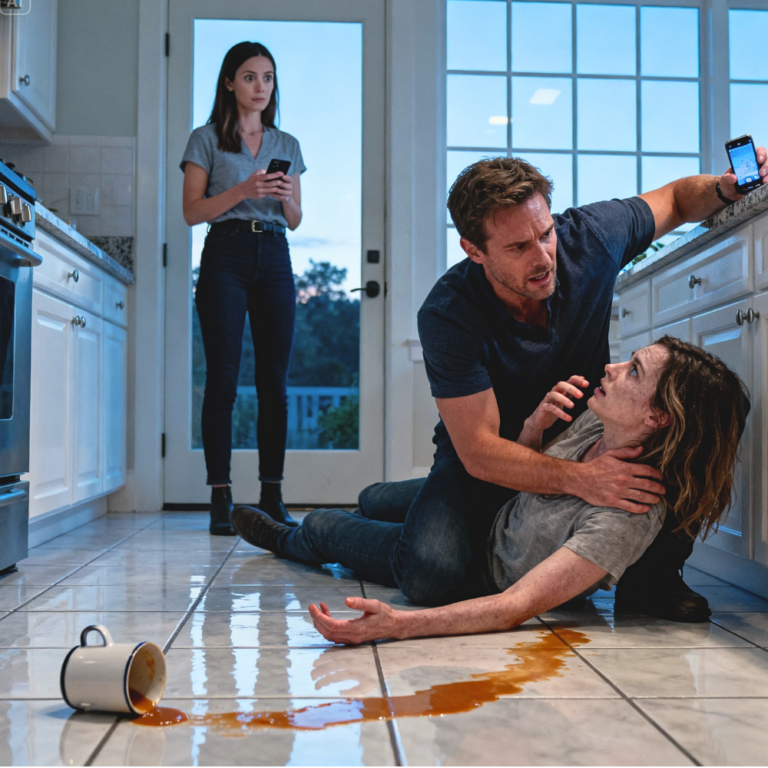
Emily was lying on the floor, face down, her arms bent awkwardly at her sides. Her breathing was ragged, shallow, the kind of gasping sound you never forget once you hear it. For a moment, I froze. Then instinct took over.
I rushed to her side, dropped to my knees, and turned her gently over. Her skin was clammy, her lips pale, her pupils huge and unfocused. She tried to speak, but only a weak, broken noise came out—a sound between a cough and a cry.
“Emily! Hey, stay with me,” I said, patting her cheek. “Em, can you hear me?”
From the corner of my eye, I saw movement. Someone was standing in the kitchen doorway. My sister-in-law, Karen.
Her phone was in her hand, but she wasn’t calling anyone. She was just standing there, biting her lip, looking at me like she’d been caught doing something she shouldn’t.
“When I got here,” she blurted out before I could ask anything, “she was already like this. I swear, I just walked in five minutes ago.”
Her voice trembled—but not in the way someone’s does when they’re scared. It sounded… prepared. Like she’d practiced it.
I looked from her to Emily, whose chest rose in weak, uneven bursts. My mind was spinning.
“You just got here?” I asked.
“Yes,” Karen said too quickly. “I came to check on her, like always. I walked in, and she was already on the floor.”
My hands were shaking as I checked Emily’s pulse—rapid, thready, uneven. “And you didn’t call 911?”
Karen blinked. “I was about to! I just didn’t—”
“When exactly did you get here?” I pressed.
“I said five minutes ago,” she said again, a little louder this time, like volume could make the story true.
“You said you were coming by for lunch earlier,” I reminded her.
She hesitated. “I—well, I did come by earlier. But I left, and then I came back.”
“For what?”
“To check on her again,” she said, her eyes darting to Emily and back to me. “You know how worried I get. She wasn’t answering my texts.”
“Lunch was six hours ago, Karen,” I said, my voice low.
She opened her mouth, then closed it again. “I meant after lunch,” she muttered finally.
Emily made a weak sound then, something between a moan and a word. Her eyes found mine. I saw fear in them—pure, unmistakable fear. She glanced toward Karen for a second, then back to me, her gaze wide and desperate.
That look froze my blood.
“Hang on, sweetheart. I’ve got you,” I said, reaching for my phone.
I called 911. My voice shook as I explained what was happening, while Karen stood in the background, pacing, talking—too much talking. About traffic. About the weather. About how she’d meant to call me but forgot. Her voice filled the air like static, as if she needed noise to hide behind.
The dispatcher kept me focused. “Stay on the line, sir. Help is on the way. Check if she’s responsive.”
“I’m here,” I whispered to Emily, squeezing her hand. “You’re gonna be okay.”
When the paramedics arrived, they moved quickly and efficiently—two of them, Martinez and Chen, both calm, steady, practiced. They took vitals, started an IV, and asked questions while they worked.
“When did you last see your wife?” Martinez asked.
“This morning,” I said. “Around eight. She was fine. Recovering from surgery, but fine.”
“Who’s been with her today?”
I looked at Karen. She stepped forward, her hand fluttering near her chest. “I came by around lunchtime,” she said. “She seemed okay then. I left for a bit and came back just before he got here. That’s when I found her like this.”
Martinez’s gaze lingered on her for a moment longer than normal. Then he nodded at his partner. “Severe dehydration, possible shock,” he murmured. “Let’s get her in the truck.”
As they lifted Emily onto the stretcher, her eyes opened just enough to meet mine again. She didn’t try to speak this time. She just squeezed my fingers faintly before they wheeled her out.
“I’ll come with you,” Karen said suddenly, grabbing her purse.
“No,” I said, sharper than I meant to. “I’ll meet you there.”
She froze, her expression unreadable, then gave a small nod. “Okay,” she said quietly. “Of course.”
Driving behind that ambulance, I couldn’t stop thinking about Emily’s face. That fear when she looked at Karen—it wasn’t confusion. It wasn’t pain. It was something else. Something that made my stomach twist.
At the hospital, they rushed Emily straight into the ER. I sat in the waiting area, hands clasped so tight they ached. My phone buzzed twice—both messages from Karen.
You didn’t have to be rude.
I’m just trying to help.
I didn’t answer.
After what felt like forever, a nurse called my name and led me back to a small curtained room. Emily lay in a hospital bed, hooked to an IV, oxygen flowing gently through a nasal tube. Her color had come back a little, but she looked exhausted—like every breath cost her effort.
I sat beside her and took her hand. “I’m here, Em. You’re okay. You’re safe now.”
A tear rolled down her cheek. Her lips parted slightly, but no sound came out.
Dr. Patricia Wong entered then, her face calm but serious. She introduced herself and went over Emily’s condition: severe dehydration, dangerously low blood pressure, electrolyte imbalance. “That’s treatable,” she said, “but there’s something else.”
“What do you mean?” I asked.
“Her stress hormones are extremely elevated,” Dr. Wong explained. “We’re talking acute psychological shock. When we mentioned contacting family, her vitals spiked. She’s terrified of something—or someone.”
I frowned. “What are you saying?”
The doctor studied me carefully. “Mr. Mitchell, I have to ask: is your wife safe at home?”
“Yes,” I said without hesitation. “Of course.”
“I’m not asking about you,” she clarified gently. “I’m asking about anyone else who has access to your home.”
For a moment, I couldn’t speak. The question hung in the air between us, heavy and sharp, until it settled somewhere deep in my gut.
Because I knew exactly who she meant.
And even before the words left her mouth, I already saw the answer in my head—sitting there in the kitchen, phone in hand, rehearsed story ready to go.
Karen.

Tuesday, November 14th, 2023, 5:47 p.m. I’d just driven home from work. software engineer at Microsoft. Typical Tuesday. Left the Redmond campus at 5:15 like always and walked through the front door expecting dinner smells and Emily asking about my day. Instead, silence. Then I saw her face down, pale, her breathing shallow and weak like someone drowning in air. Emily.
I dropped my laptop bag and ran to her. She tried to speak. Only broken, choking sounds came out. Her eyes were open but unfocused. Pupils dilated. Her lips were cracked. Her hands trembled. My sister-in-law Karen stood by the kitchen door. phone in hand, looking nervous. “No, not nervous. Guilty.
” “When I got here, she was already like this,” Karen said quickly. “Too quickly.” “I don’t know what happened. I just arrived maybe 5 minutes ago and found her on the floor. I was about to call 911.” Something in her voice sounded rehearsed, mechanical, like she’d practiced the words, “What do you mean you just got here?” My hands shook as I checked Emily’s pulse rapid thready.
I came by for lunch like we planned. But when I walked in, she was like this. Lunch was 6 hours ago, Karen. She blinked. I meant I came by after lunch around 5 to check on her. I knelt beside Emily, cradling her head. Honey, what happened? She tried to speak. Her mouth moved, but only a weak moan came out. Her eyes locked onto mine, filled with terror.
She looked at Karen, then back at me, and I saw something I’d never seen in my wife’s face before. Pure fear. I grabbed my phone and dialed 911. Behind me, Karen paced talking, talking non-stop about traffic on I-5, about the weather, about a sale at Nordstrom. Anything but what mattered. Sir, what’s your emergency? My wife. She’s collapsed. Can’t speak.
Breathing’s shallow. Something’s wrong. The dispatcher stayed on the line, asked questions, kept me calm, while Karen’s voice droned on in the background like white noise designed to distract me. The paramedics arrived at 6:03 p.m. Two of them, Martinez and Chen, according to their name patches. They moved fast, professional, checking Emily’s vitals while asking questions.
When did you last see your wife? This morning. I left for work at 8:00. She was fine. Recovering from gallbladder surgery last week, but fine. Who’s been with her today? I looked at Karen. She stepped forward, hand on her chest. I stopped by around lunchtime to check on her. She seemed okay then. I left around 1. When I came back at 5:00, I found her like this.
Martinez glanced at Karen, then back at me. A dark, knowing look passed between him and his partner. They loaded Emily onto a stretcher. Severe dehydration, low blood pressure, signs of extreme stress, possible shock. We’re taking her to Overlake Medical Center. Martinez said, “You can follow us.” I grabbed my keys. Karen touched my arm. “I’ll come with you.” “No.
” The word came out harder than I intended. “I’ll meet you there. Let me tell you about Karen, Emily’s older sister by 3 years, 42 years old, divorced twice, no kids, worked in sales or said she did. Her employment situation was always vague. She’d been between jobs for 8 months. Emily and I had been married for 6 years.
We’d helped Karen through both divorces. Let her stay with us for 3 months after the second one. lent her $8,000 when she needed to get back on her feet. She never paid us back. Emily never asked for it back. “She’s my sister,” Emily would say. Family helps family. Emily was kind, trusting, believed people were fundamentally good. I was more skeptical.
But Karen was Emily’s sister, and Emily loved her. So, I tolerated the boundary violations, the constant need for help, the way she’d show up unannounced and stay for hours. Two weeks ago, Emily had emergency gallbladder surgery, laparoscopic colctomy. She came home the next day but was supposed to rest for 2 weeks. No heavy lifting, no stress, just recovery.
Karen had volunteered to check on her during the day while I was at work. “I’m not doing anything anyway,” she’d said. “Let me help.” Emily was grateful. I was wary, but what could I say? She’s your sister. She wants to help. Now Emily was in an ambulance and Karen’s story didn’t make sense.
At Over Lake Medical Center, they took Emily straight to the ER. I sat in the waiting room, hands shaking, trying to process what I’d seen. Emily’s terror. Karen’s rehearsed explanation. The way Karen had been pacing, talking about nothing, filling the silence with meaningless words. A nurse appeared. Mr. Mitchell, you can see your wife now.
Emily was in a bed, IV in her arm, oxygen canula under her nose. Her eyes were closed, but she squeezed my hand when I touched her. I’m here, sweetheart. I’m here. Tears streamed down her face. Still no words. Dr. Patricia Wong, ER physician, 15 years at Overlake, according to her credentials, came in with a tablet. Mr.
Mitchell, your wife is stable. Severely dehydrated, yes, but that’s treatable. What concerns me is the psychological presentation. What do you mean? She’s in shock. Acute psychological trauma. Her cortisol levels are extremely elevated. Her blood pressure spiked when we mentioned calling family members. This isn’t just physical.
Has something happened at home? I thought about Karen. Her nervous energy, her rushed explanation, the way Emily flinched when Karen came near. I don’t know, I said, but I’m going to find out. Dr. Wong studied me. Mr. Mitchell, I’m required to ask, “Is your wife safe at home?” “Yes, absolutely. I would never. I’m not asking about you.
I’m asking about anyone with access to your home.” The implication hit me like cold water. I went home at 8:34 p.m. Karen’s car, a white Honda Accord, was still in my driveway. She was inside cleaning up,” she said when I walked in. I watched her move through my house like she owned it. Opening drawers in the kitchen, checking papers on the counter, running her hand along the mantle.
“You can go home now,” I told her. I’d rather stay until we know Emily’s okay. She smiled. That fake sweet smile I’d seen a thousand times. I’m worried about her. She’s stable. You can go. Are you sure? I could stay the night. Help out. Her insistence made my skin crawl. No, thank you, but no. She left at 8:52 p.m.
I watched from the window as she drove away. Then I went straight to the garage. We’d installed a security camera system 2 years ago. Ring cameras, four of them. Kitchen, living room, front door, garage, cloud storage, motion activated. I pulled up the app on my phone, selected today’s footage. Everything looked normal until 12:04 p.m. Karen arrived.
She and Emily talked in the kitchen. Emily smiled. They hugged. Then at 12:47 p.m., the kitchen camera showed Emily and Karen sitting at the table. Papers spread out. Emily shaking her head. At 1:23 p.m., the footage jumped. Just jumped. One second, Emily was at the table. The next second, it was 2:01 p.m. and the kitchen was empty. 38 minutes missing.
My blood went cold. I fast forwarded. At 4:47 p.m., Emily appeared on the living room camera on the floor, holding her arm, moving slowly like someone drugged. Karen walked past at 4:53 p.m., fixing her hair, breathing heavily. She looked at Emily, then at the camera. Her expression, I’ll never forget it. Not guilt, not concern, calculation.
She walked out of frame. Someone had deleted 38 minutes of footage. My hands shook so badly I almost dropped the phone. I checked the other cameras. Same thing. missing footage from 1:23 p.m. to 2:01 p.m. on all four cameras, but Karen didn’t know about the backup system. Three years ago, before we installed Ring, I’d set up an old Nest camera in the hallway, hidden behind a plant.
I’d forgotten about it. Emily had forgotten about it, but it was still recording, still uploading to Google’s servers. I logged into the old Nest account, held my breath while the footage loaded. The angle was bad. The hallway pointed toward the kitchen at an angle, but it was there. I watched Karen enter the kitchen at 12:04 p.m.
Watched Emily greet her with a hug. Watched them sit at the table. Then at 12:47 p.m., I watched everything change. Karen pulled out papers, pushed them toward Emily. Emily shook her head, pushed them back. Karen stood, grabbed Emily’s arm hard. Emily tried to pull away. Karen yanked her up, shoved her against the counter.
Emily fell. Karen leaned down, said something I couldn’t hear through the camera. Then she forced Emily’s hand onto the papers on the table, held it there. Emily was crying, shaking her head. Karen released her. Emily slumped into the chair, holding her arm. Karen gathered the papers, straightened her clothes, took out her phone, and started crying, practicing.
Then she wiped her face and composed herself. She looked directly at the Ring camera in the kitchen, took out her phone, did something. The Ring camera’s light went off. She’d used the app to delete the footage. Then she sat on the couch for 3 hours, just sat there, occasionally checking on Emily, watching her deteriorate. At 4:47 p.m.
, she stood, fixed her hair, checked her makeup in her phone camera, and waited. She was waiting for me to come home. I replayed the footage five times, saved it to three different drives, downloaded it to my phone, emailed it to myself, my wife’s sister, the woman we’d trusted, who Emily had helped through two divorces who we’d lent money to.
She’d assaulted Emily, forced her to sign something, then waited for her to get worse before calling for help. No, she hadn’t called for help. I had. I called Marcus Reeves at 9:47 p.m. Our lawyer, estate planning, family law, 23 years practicing in Belleview. I’d used him for our will and house purchase.
Marcus, I need you tomorrow morning early. And I need you to bring someone from the police department. Someone who handles domestic violence cases. What happened? Emily was assaulted. I have video. I need to make sure this is handled correctly. Is Emily okay? She’s in the hospital. She can’t speak. She’s traumatized. Who did this? Her sister.
Silence on the line. Then I’ll make calls tonight. will be there at 8:00 a.m. I didn’t sleep. Sat at the hospital with Emily all night. She drifted in and out of consciousness. Sometimes she’d squeeze my hand. Sometimes she’d cry, but she couldn’t talk. Dr. Wong came by at 2:14 a.m. during her rounds. Any change? No, she’s scared. Can’t speak.
Just broken. Dr. Wong sat down. Mr. Mitchell, I’ve seen this before. This level of trauma, it’s not from a fall or an accident. This is psychological. Someone hurt her. Scared her so badly that her body shut down. I know who did it. Do you have proof? I pulled out my phone, showed her 30 seconds of the nest footage.
Karen grabbing Emily, forcing her hand onto the papers, Dr. Wong’s face went hard. That’s assault. You need to report this. I’m meeting with a detective in the morning. Good, because whatever happened to your wife, it was deliberate, and whoever did it knew exactly what they were doing. Wednesday, Novemb
er 15th, 8:03 a.m. Marcus arrived with Detective Lisa Warren. Domestic violence unit, Seattle PD, 26 years on the force. gray hair, sharp eyes, the look of someone who’d seen every variation of family cruelty. We met in a private room at the hospital. Mr. Mitchell, walk me through everything. I did. Coming home, finding Emily, Karen’s story, the deleted footage, the hidden camera.
Do you have the footage? I handed her a USB drive. 3 hours of continuous recording shows the assault. Shows her deleting the ring footage. Shows her waiting for me to come home. Detective Warren plugged the drive into her laptop, watched in silence. When it finished, she looked at Marcus. This is felony assault, coercion, possibly elder abuse if there’s a vulnerability factor.
Emily just had surgery. I said she’s vulnerable on pain medication. Karen knew that. Then this is aggravated. What were the papers she forced Emily to sign? I don’t know. I haven’t seen them. We need to find out. Mr. Mitchell, do you have access to Emily’s bank accounts? Property records? Yes, we’re joint on everything. Check them now.
I pulled out my phone, logged into our bank account. Our savings account, $47,300 as of Monday, November 13th, now showed $3,200. $44,100 transferred out yesterday, November 14th, 1:47 p.m. to an account registered to Karen Diane Mitchell. She stole $44,000, I whispered. Marcus leaned over. Check the property records.
I logged into King County’s property database. Our house purchased 2018, valued at $680,000, had a new entry dated yesterday. Notice of transfer, partial interest transfer to Karen Diane Mitchell, 25% ownership stake. She took a quarter of our house. Detective Warren’s expression was ice. She forced Emily to sign financial documents.
That’s fraud, coercion, theft, and assault. Mr. Mitchell, I need to speak with your wife. Is she able to communicate? She hasn’t spoken since yesterday. Let’s try. Emily was awake when we entered her room. Groggy but alert. She saw Detective Warren’s badge and started crying. Mrs. Mitchell, Detective Warren said gently. I’m Detective Warren.
I need to ask you some questions. If you can’t speak, just nod or shake your head. Okay. Emily nodded. Did your sister Karen hurt you yesterday? Nod. Did she force you to sign papers? Nod. Tears streaming now. Did she threaten you? Nod. Did she tell you not to tell anyone? Nod. Can you write down what she said? Detective Warren handed Emily a notepad and pen.
Emily’s hands shook. She wrote slowly, letters shaky. She said if I told anyone, she’d say I was crazy from the medication. That nobody would believe me. That I’d lose everything. More writing. She said I owed her. that I’d had everything my whole life and she’d had nothing. That it was my turn to help her.
She grabbed my arm, twisted it, pushed me, made me sign, said if I didn’t sign, she’d hurt me worse. Emily’s hand fell. She was crying too hard to write more. Detective Warren photographed the note. Mrs. Mitchell, this is evidence. You were coerced under duress. Those signatures aren’t valid, and your sister committed multiple felonies. Emily looked at me, mouthed.
I’m sorry. For what? She gestured to the note, wrote. I should have fought back. No. I took her hand. You survived. That’s what matters. Detective Warren made calls. By 10:34 a.m., she had warrants. Arrest warrant for Karen, search warrant for her apartment, seizure order for the stolen funds. Where would your sister be right now? Detective Warren asked.
Probably at her apartment in Kirkland. Or wait, I pulled out my phone, checked Find My Friends. Emily and Karen shared locations. Emily had set it up years ago for safety. Karen’s location showed Emerald Downs, the horse racing track in Auburn. She’s gambling, I said. Detective Warren smiled. Not friendly, predatory. Even better, public place. Witnesses.
Let’s go. We arrived at Emerald Downs at 11:18 a.m. Karen was in the grand stand. VIP section, expensive clothes, champagne, laughing with friends. She saw us coming and her face went white. Karen Mitchell. Detective Warren held up her badge. Seattle PD. I need you to come with me. What? Why? I haven’t done anything.
You’re under arrest for assault, coercion, theft, and fraud. Karen’s champagne glass slipped from her hand, shattered on the ground. This is insane. I haven’t I was helping my sister. You assaulted your sister. Forced her to sign over money and property. We have video. What video? Detective Warren pulled out her phone.
Played 10 seconds of footage. Karen grabbing Emily, forcing her hand onto the papers. Karen’s legs buckled. That’s That’s taken out of context. Context, I said. My voice was cold, unfamiliar. You deleted 38 minutes of footage from our security cameras. You assaulted my wife while she was recovering from surgery. You stole $44,000.
You forged documents to steal our house. I didn’t forge anything. She signed under duress while you were physically restraining her while you threatened her. Karen looked around. Her friends were backing away. People were staring. Wait, this is a misunderstanding. Emily, she’ll tell you. Emily’s in the hospital. She wrote down everything you did, everything you said. Detective Warren stepped forward.
Turn around. Hands behind your back. No, wait. I want to talk to Emily. You don’t get to talk to your victim. The detective cuffed her. You have the right to remain silent. Karen screamed, tried to pull away. People were recording on their phones now. Security guards appeared. This is wrong. I was helping her. She wanted me to have that money.
Then why did you delete the footage? I asked quietly. She froze. Why did you spend 3 hours watching her deteriorate on the floor before I came home? Why did you practice crying on camera? I don’t. I didn’t. We have everything, Karen. The hidden camera you didn’t know about caught everything. Her face crumbled.
You can’t. That’s not legal. It’s my house. My camera. completely legal. Detective Warren led her away. Karen looked back at me one last time, not with anger, with shock, like she couldn’t believe she’d been caught. They found more at Karen’s apartment. The signed documents, power of attorney forms, bank transfer authorizations, property deed amendments, all signed by Emily Mitchell in shaky, uncertain handwriting, a notebook, detailed plans, how to get Emily alone, how to manipulate her medication schedule, how
to delete security footage, how to make it look like Emily had willingly transferred assets, text messages between Karen and someone named Derek, her boyfriend I’d never heard about. Karen got the money. 44K plus the house. Derek, holy She just gave it to you. Karen had to push a little, but she signed.
Derek, what if she tells someone? Karen, she won’t. I made sure. More texts. Derek, how’d you make sure? Karen scared her. Told her nobody would believe her. That the meds would make her look crazy. Derek, you’re scary sometimes. Karen, I’m practical. She’s had everything her whole life. Pretty husband. Nice house.
I deserve some of it. Detective Warren showed me the texts at 4:47 p.m. This is premeditated. She planned this for at least 2 weeks. started researching power of attorney laws on November 1st, the day after Emily’s surgery. Exactly. She saw an opportunity, vulnerable victim, access to the house, and she took it. The charges came down the next day.
Second degree assault, theft in the first degree, over 5,000, fraud, coercion, forgery, elder abuse, Emily’s postsurgical vulnerability counted. Karen’s bail was set at $150,000. She couldn’t make it. Emily slowly regained her voice over the next week. Speech therapist Jennifer Park, 12 years practicing, worked with her daily.
The loss of speech was psychoggenic, Jennifer explained. Trauma induced. Her brain shut down her ability to speak as a defense mechanism. As she processes what happened, it’ll come back. By November 22nd, Emily could speak in whispers. By December 1st, she could talk normally, but the trauma remained. Marcus helped us reverse the fraudulent transactions.
The bank returned the $44,100 within 10 days once they saw the police report and video evidence. The property deed amendment was voided by the county recorder’s office. But the damage wasn’t just financial. Emily stopped trusting people, stopped answering the door, installed more cameras, triple checked locks, jumped at unexpected sounds.
She betrayed me,” Emily said one night, crying in my arms. “My sister, the person I helped my whole life, she hurt me, watched me suffer, and waited for me to get worse. I know. What if you hadn’t come home when you did? But I did. She would have let me die. I didn’t argue because the evidence suggested she was right.
Karen had waited 3 hours watching Emily deteriorate, calculating when I’d arrive, timing her discovery perfectly. If I’d been 30 minutes later, Emily might have died. The trial was February 2024. King County Superior Court. Judge Patricia Chen presiding. 17 years on the bench. Karen’s lawyer, public defender named Michael Torres, 6 years practicing, tried to argue diminished capacity, financial stress, mental health issues.
The prosecutor, Amanda Wong, 10 years in the DA’s office, wasn’t having it. Your honor, the defendant planned this assault for 2 weeks. She researched laws. She identified her sister’s vulnerability. She prepared documents. She deleted security footage. She sent text messages about her plans to her boyfriend. This wasn’t a mental health crisis.
This was premeditated financial exploitation and assault. The jury saw the video, Emily’s testimony, the texts, the notebook. It took them 4 hours to deliberate. Guilty. All counts. Karen was sentenced to 6 years in prison. Required restitution of all legal fees. Permanent restraining order preventing contact with Emily.
She didn’t look at us during sentencing. Just stared at her hands. 8 months later, July 2024. Emily’s doing better. Still has nightmares. Still checks locks obsessively, but she’s laughing again. trusting again. Slowly, we moved. New house, new neighborhood, new security system with backup systems and off-site storage.
Karen’s in Washington Corrections Center for Women in Gig Harbor, minimum 4 years before parole eligibility. Derek, her boyfriend, was also charged as an accessory after prosecutors found he’d helped her research the fraud. He took a plea deal, 2 years probation. Last week, Emily got a letter from Karen. I found it in the trash, unopened.
You didn’t read it? I asked. I don’t need to. Whatever she has to say doesn’t matter anymore. Are you sure? Emily looked at me. She told me nobody would believe me. That I was weak. That I’d lose everything if I told the truth. But but she forgot one thing. What? Emily smiled. Not bitter. Just free. You love me.
And that means I was never alone.

Leave a Reply