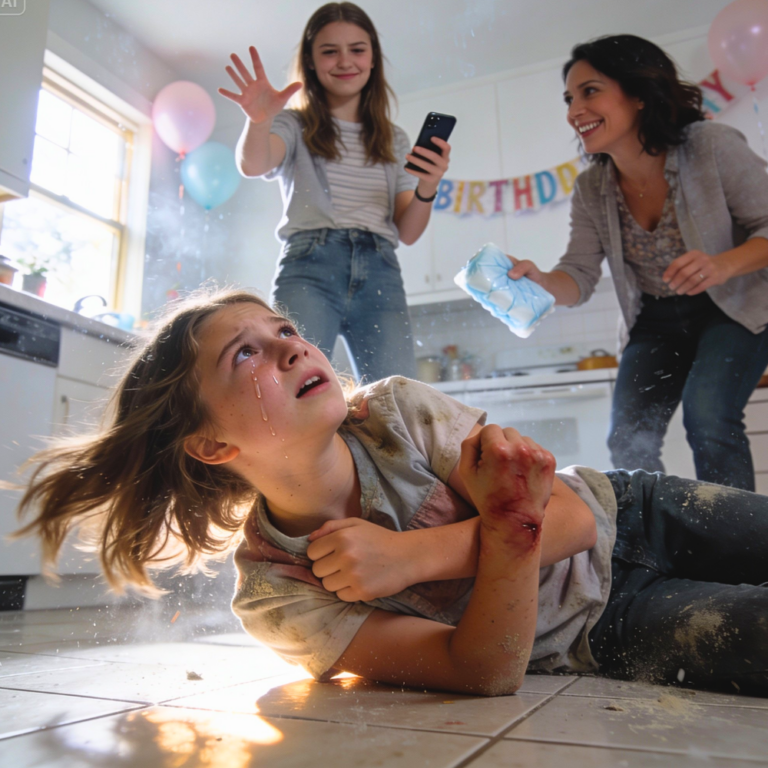
I remember the exact sound my arm made when it broke. It wasn’t a snap like you hear in movies—it was more like a wet crunch, deep and sharp, followed by a rush of silence so heavy it made my heartbeat sound like a drum inside my skull. I was thirteen, lying on the kitchen tile, my bike helmet still crooked on my head and dirt streaked across my knees. My right arm bent at an angle that shouldn’t have been possible.
The pain came in waves, radiating up from my wrist to my shoulder until it felt like my entire body was pulsing with it. I tried to call for my mom, but my throat had closed up. All that came out was a weak sound, halfway between a gasp and a cry.
She came running in from the living room, saw me on the floor, and froze. Her eyes went straight to my arm, and for a second, I thought she was going to help me. She grabbed the freezer handle and pulled out an ice pack, her hands shaking. Then a voice behind her broke through the moment.
“She’s faking it.”
It was my sister, Olivia. Sixteen years old, perfect hair, perfect grades, perfect timing.
Mom turned to her like she’d been waiting for permission. “Are you sure, honey? It looks bad.”
Olivia rolled her eyes. “It’s not bad. She does this every time I have something important.” She crossed her arms, scrolling through her phone with one hand. “You know my college acceptance party is in three hours, right? She’s just trying to get attention.”
The pain was blinding. My vision kept going white around the edges, but I still managed to whisper, “I’m not.”
She didn’t even look at me. “She probably twisted it on purpose. Drama queen.”
Mom exhaled, relieved, as if my sister’s opinion was a medical diagnosis. I’d seen that look before—the mix of exhaustion and gratitude that Olivia had spoken, so now she didn’t have to think for herself. The rule had been in place for years: if I got hurt or sick, Olivia decided whether I needed a doctor.
It started after her thirteenth birthday. I’d eaten a piece of cake with peanuts in it, not knowing. I’d had an allergic reaction right there in front of her friends. My lips swelled, my throat closed up, and I collapsed. The hospital confirmed it was anaphylaxis. But Olivia told everyone afterward that I’d faked it to ruin her party. She said I’d known about the peanuts, that I’d done it for attention. My parents believed her. From that day forward, I wasn’t trusted to know when something was wrong with my own body.
Dad came in from the garage then, holding a wrench. He stopped when he saw me on the floor, my arm limp against my chest. The bone made a small bulge under the skin—subtle, but wrong enough that it made my stomach turn just to look at it.
“Olivia,” he said, his voice flat. “What’s your assessment?”
He said it like he was in a board meeting. Like my sister was some expert witness.
Olivia crouched down near me, but not close enough to touch. She tilted her head, her tone casual. “It’s a sprain. She’s being dramatic because Taylor’s coming tonight.”
My face burned. Taylor was her boyfriend’s best friend. I’d had a small crush on him, and she knew it. Of course she’d use it against me.
“Olivia,” I tried again, my voice breaking. “Please. I need to go to the hospital.”
Mom glanced at Dad. I could see the silent conversation in their eyes—the inconvenience, the cost, the fact that Olivia’s party was that night. An ER visit would ruin everything.
Mom set the ice pack on the counter. “Let’s just wrap it for now, sweetheart. If it’s still bad tomorrow, we’ll take you in.”
Dad nodded in agreement. “Your sister says it’s just a sprain.”
I remember the smell of rubbing alcohol as Mom dug through the first aid kit, the sting of her sighs as she wrapped my arm too tight. I couldn’t feel my fingers after ten minutes. My body was screaming, but I kept my mouth shut. Crying never helped. It only made them look annoyed.
“Upstairs,” she said when she was done. “Rest. Don’t come down during the party.”
Olivia was already walking away, her phone lighting up her face. “Make sure she stays in her room,” she called over her shoulder. “I don’t want her playing for sympathy.”
I made it to my room somehow. I don’t remember walking there, only the sound of laughter starting downstairs as guests arrived early. My arm had started to swell, turning an ugly purple under the bandage. The pain was constant now, throbbing in time with my heartbeat. I tried to lift it once and almost passed out.
I stared at the wall while the music started below, muffled thumps of bass vibrating through the floor. Every cheer, every burst of laughter felt like an insult. I wanted to scream, to break through the noise, to make them see me—but I didn’t. I just sat there, sweating, dizzy, afraid.
My phone buzzed beside me. It was a text from my best friend, Kira.
“Are you coming to the party? Your mom said you’d be there.”
I typed with my left hand. “Can’t. Fell off bike. Arm hurt.”
The reply came fast. “Did you go to the hospital?”
I hesitated before typing, “No. Olivia says it’s a sprain. Have to wait.”
The typing dots appeared, then disappeared. Then my phone lit up with an incoming call.
“What do you mean you didn’t go?” Kira’s voice was sharp with panic. I could hear the sound of traffic in the background. “Harper, your arm is broken, isn’t it?”
Tears welled in my eyes. “They won’t take me. Olivia said—”
“I don’t care what Olivia said,” she cut in. “That’s not how this works. You can’t decide medical care based on your sister’s opinion.” I could hear her talking to someone in the background, then her mom’s voice came through faintly.
“Kira,” I whispered, “if you come here, they’ll lose it. The party—”
“I don’t care about the party,” she said. “You could have nerve damage. We’re two minutes away.”
The line went dead before I could argue.
I sat there, shaking, trying to breathe. Every movement of my arm sent a bolt of pain up my shoulder. I forced myself to stand, to grab my hoodie, to slide it over the wrapped mess of my arm. The sleeve caught on the bandage and I bit my lip so hard I tasted blood.
Downstairs, I could hear the front door opening, voices greeting guests, music growing louder. My parents were laughing, toasting to Olivia’s “big future.”
I tucked my phone into my pocket, picked up my wallet, and walked out of my room.
The stairs creaked beneath me, each step sending a shock through my body. When I reached the bottom, I could see the streamers hanging in the living room, the gold balloons spelling out “CONGRATS OLIVIA.” She stood near the door in a sparkly dress, her hair perfect, her smile wide.
Mom was in the dining room arranging food trays. Dad was adjusting the speakers. No one looked up as I crossed the hallway.
The doorbell rang.
Olivia turned, laughing, already heading toward the door.
I slipped past her before she could notice me.
The cool air outside hit my face like a shock. I spotted Kira’s mom’s car parked at the curb, headlights on, engine running. Kira was in the passenger seat, waving for me to hurry.
My heart pounded as I stepped off the porch, clutching my arm close to my chest.
I didn’t look back.

I was lying on the kitchen floor with my arm bent at an angle that arms should never bend when my older sister Olivia walked in and said I was faking it for attention.
Mom dropped the ice pack she’d been reaching for and turned to Olivia with this desperate relief on her face. Are you sure, honey? It looks pretty bad. Olivia barely glanced at me before pulling out her phone and scrolling through something. She does this every time I have something important. My [clears throat] college acceptance party is in 3 hours.
She probably just twisted it wrong on purpose. The pain shooting through my forearm was making me dizzy, but I knew better than to argue. The rule had been in place since I was 9 after I supposedly ruined Olivia’s 13th birthday by having what she called a fake seizure during her party. It hadn’t been fake. The hospital confirmed I’d had a severe allergic reaction to something in the cake.
But Olivia convinced my parents I’d known about the allergen and eaten it anyway to steal her spotlight. After that, every injury or illness had to be approved by my older sister before I could see a doctor. Dad came in from the garage and saw me on the floor with my arm clearly broken. The bone creating this horrible bulge under the skin that made my stomach turn when I looked at it.
Olivia, what’s your assessment? He asked this in the same tone he used for business decisions, completely clinical and detached. My sister finally looked up from her phone and walked over to examine my arm from about 3 ft away. She crouched down but didn’t touch it, just tilted her head and made this considering sound. It’s probably just a bad sprain.
She’s being dramatic because Taylor’s coming to my party tonight and she has that pathetic crush on him. My face burned with humiliation because the crush was real, but this had nothing to do with that. I’d fallen off my bike trying to avoid hitting Mrs. Peton’s dog when it ran into the street. The fall had been hard and fast, and I’d heard the crack when my arm hit the pavement.
Olivia, please. My voice came out weaker than I wanted. I heard it break. I really need to go to the hospital. Mom exchanged a look with dad and I saw the familiar calculation happening. Taking me to the emergency room meant missing setup time for Olivia’s party. It meant questions from the staff about why they’d waited so long.
It meant Olivia being upset about the attention shifting to me. Let’s just wrap it and see how you feel tomorrow. Mom decided already pulling the first aid kit from the cabinet. If Olivia’s right and it’s just a sprain, we’ll have wasted 4 hours at the ER for nothing. Dad nodded his agreement and they both started gathering supplies while I lay there on the cold tile floor with my arm throbbing in waves that made black spots dance across my vision.
Olivia went back to her phone completely done with the whole situation. She called over her shoulder as she left the kitchen. Make sure she stays in her room during the party. I don’t want her limping around playing for sympathy. They wrapped my arm so tight I couldn’t feel my fingers after 10 minutes.
Then sent me upstairs with two ibuprofen and instructions to rest. I could hear them setting up for the party downstairs hanging decorations and arranging food while I sat on my bed staring at my arm that was already turning purple and swelling so badly the bandage was cutting into my skin. My phone buzzed with a text from my best friend Kira asking if I was coming to the party since my parents had invited half the neighborhood.
I typed back with my left hand that I couldn’t make it. Fell off bike, arm hurt. She responded immediately asking if I’d gone to the hospital. When I said no, she called me instead of texting back. What do you mean you didn’t go to the hospital? Your arm is broken, isn’t it? Her voice was sharp with concern, and I could hear traffic in the background, which meant she was already in her mom’s car somewhere.
Olivia said, “It’s just a sprain, and my parents believed her. I have to wait until tomorrow to see how it feels.” Even saying it out loud made it sound insane, but this was just how things worked in my house. Kira had known me since third grade, and she knew about the rule, had witnessed it in action multiple times over the years. There was a long pause where I could hear her breathing and some muffled conversation with her mom.
We’re coming to get you. My mom says, “You need an X-ray right now. That’s not normal parenting. That’s medical neglect.” I wanted to argue that my parents would be furious if I left. That Olivia would make my life even worse than it already was, but the pain was getting unbearable, and I was scared about the way my arm looked.
The party starts in an hour. Everyone will see you taking me. Olivia will lose it. Kira’s voice got harder. I don’t care about Olivia’s party. You could have a compound fracture or nerve damage. We’re 2 minutes away. She hung up before I could protest anymore. And I sat there feeling this horrible mix of relief and terror about what would happen when my parents found out.
I managed to get a sweatshirt on over my wrapped arm, which sent fresh waves of agony through me that made me bite my lip hard enough to taste blood. I grabbed my wallet and phone with my good hand and made it down the stairs just as the doorbell started ringing with early party guests. Mom was in the dining room arranging a cheese platter and didn’t see me slip out the front door where Kira and her mom were waiting in their car with the engine running.
Mrs. Lanny saw my arm and her face went white. She started to say something but just shook her head and told me to get in. She was taking me straight to the emergency room. The ER doctor took one look at my arm and immediately called for X-rays, her expression getting progressively more concerned as she gently unwrapped the bandages my parents had put on.
How long ago did this happen? She was Filipino, maybe in her 40s, with kind eyes that kept darting between my face and my arm. About 3 hours ago, I fell off my bike. She wrote something on her chart and I saw her jaw tighten. And you’re just getting here now? Who wrapped this arm? I didn’t want to lie, but I didn’t want to get my parents in trouble either.
So, I just said my parents had wrapped it and thought it was a sprain. The doctor looked at Kira’s mom and something passed between them. Some adult understanding that made me feel even more scared. This is a complete fracture of both the radius and ulna. This needed immediate medical attention. The swelling alone could have caused permanent damage.
She started unwrapping my arm more carefully, her hands gentle, but her voice getting sharper. Did your parents see the injury before they wrapped it? Kira spoke up before I could figure out how to answer. Her sister said it wasn’t serious enough for the hospital. Her parents always asked the sister first before taking her to the doctor.
The doctor stopped unwrapping and looked directly at me with this intensity that made me want to cry. Your sister? Not a medical professional. Your sibling makes these decisions. I nodded and she immediately pulled out her phone and stepped away to make a call while a nurse came in to finish removing the bandages. Mrs.
Mrs. Lanny squeezed my good shoulder and told me I’d done the right thing by coming here, that my parents were wrong to leave me in pain for hours. The X-rays confirmed what the doctor already knew. Both bones in my forearm were completely broken, and the way they’d been wrapped had actually made things worse by compressing the fracture sites.
I needed surgery to set the bones properly because waiting 3 hours had let everything shift and swell to the point where a simple cast wouldn’t work. They admitted me immediately and scheduled surgery for that evening. And that’s when two police officers showed up asking to speak with me privately. The older one, officer Diana Vega, had gray streaks in her dark hair and spoke in this calm, professional tone that somehow made everything feel more serious.
We need to understand the situation at home. The hospital is required to report suspected medical neglect, especially involving minors. Can you tell us about this rule where your sister decides your medical care? I was hooked up to an IV for pain medication and feeling fuzzy around the edges.
But I tried to explain how it started after Olivia’s birthday party when I was nine. how she’d convinced our parents I faked illnesses and injuries for attention. So, they made her the gatekeeper for all my medical decisions. Officer Vega wrote everything down in a small notebook while her partner, a younger man named Officer Luis Reyes, took photos of my arm with a camera that had an official looking department seal on it.
How many times has your sister denied you medical care? Officer Vega asked this so matterof factly that I didn’t even think to lie. I started listing incidents, starting with the seizure that had started the whole thing, then moving through six years of denied treatment. The time I had strep throat for two weeks during Olivia’s junior prom because she said I was faking to ruin her dress shopping.
The time I sprained my ankle badly enough that I couldn’t walk during her debate tournament and she insisted I was being dramatic. The time I had food poisoning that lasted 4 days because she had college interviews and didn’t want our parents distracted. Each story made Officer Vega’s expression harder until she finally held up her hand to stop me.
That’s enough for now. We’re going to need you to make an official statement, but first you need surgery. We’ll be contacting your parents and child protective services. The way she said it made it clear this wasn’t optional or negotiable. My phone started ringing around the time they were prepping me for surgery.
My mom’s name flashing on the screen over and over. The nurse asked if I wanted to answer it, and I shook my head, letting it go to voicemail. Mrs. Lanny had stayed with me the whole time, and she told the nurse she’d handle any calls from my parents, that I needed to focus on getting my arm fixed. In the operating room, the anesthesiologist was explaining what would happen when my phone buzzed with a text that Mrs.
Lanny read out loud at my request. It was from Olivia, all caps, saying I’d ruined everything by leaving and making a scene. That the police had shown up at her party asking questions and half the guests had left. That she’d never forgive me for being so selfish and dramatic. Mrs. Lanny’s face went hard as stone when she read it, and she took a screenshot before I could tell her not to. She said quietly, “This is evidence.
Your sister just proved she cares more about her party than your broken bones. I woke up from surgery with my arm in a cast from fingers to above my elbow, metal pins holding everything in place, and this thick bandage wrapped around the whole thing. The surgeon, Dr. Janice Chandlers, came in to explain that the breaks had been worse than the X-rays showed.
Both bones had fractured completely and started to splinter, which meant if I’d waited until tomorrow, as my parents planned, I could have lost permanent use of my hand. She used terms like nerve damage and vascular compromise and permanent disability while my head swam with medication and fear. You got very lucky that your friend brought you in when she did.
Another 6 hours and we’d be talking about much more serious interventions. She looked at the notes on her tablet and her expression shifted to something between anger and sadness. The hospital has already filed a report with CPS. Someone will be by to talk to you in the morning. My parents showed up around midnight.
Both of them dressed in party clothes that looked wrong in the harsh hospital lighting. Mom had been crying, her makeup smeared, and dad’s face was tight with barely controlled anger. They weren’t allowed in my room at first because Officer Vega was still there finishing her report, but I could hear them arguing with the nurses in the hallway.
Mom’s voice kept rising, insisting this was all a misunderstanding, that they’d planned to take me to the doctor in the morning, that Kira’s mom had overreacted and poisoned everyone against them. Dad’s voice was lower, but somehow more threatening, talking about lawyers and false accusations, and how this would destroy his reputation.
Officer Vega finally let them in, but stayed in the room, and the first thing Mom said was, “How could you do this to your sister?” Not asking how I was feeling or if I was okay, just immediately making it about Olivia and how I’d embarrassed them. Dad stood at the foot of my bed with his arms crossed.
We trusted Olivia’s judgment. She’s never been wrong before about your exaggerations. Officer Vega cleared her throat loudly. Mr. and Mrs. Brennan, your daughter had both bones in her forearm completely fractured. She required emergency surgery with pins and plates. There is no universe where that qualifies as exaggeration.
Mom turned on her, voice shaking. You don’t understand. Our older daughter has excellent judgment. She’s premed at Stanford. She knows medical things. We were following her expertise. The officer’s laugh was sharp and humorless. Your daughter is 19 years old and has zero medical training. She’s not qualified to diagnose anything, let alone deny emergency care to her sister.
You’ve been allowing a teenager to play doctor with life-threatening consequences. She gestured to my arm in its heavy cast. This needed immediate treatment. Your daughter was in agony for 3 hours because you prioritized a party over her welfare. The argument went on for another 20 minutes with my parents getting increasingly defensive and officer Vega getting progressively less patient with them.
Finally, she told them they needed to leave because visiting hours were over and I needed rest. She also informed them that CPS would be conducting a full investigation starting tomorrow morning and they should expect home visits and interviews with both daughters. After they left, Mrs.
Lanny came back in and sat beside my bed. She’d been in the waiting room giving her own statement to the police detailing everything she’d witnessed over the years of knowing my family. She pulled out her phone and showed me photos she’d taken of Olivia’s text messages, screenshots of similar messages going back months where Olivia mocked me for being dramatic about injuries. Mrs.
Lanny had been quietly documenting everything, waiting for a moment like this where the evidence might actually matter. Kira stayed with me that night, sleeping in the uncomfortable chair by my bed and waking up every time I made a sound. At one point around 3:00 in the morning, when the pain medication was wearing off and I was waiting for the nurse to bring more, she said something that stuck with me.
You know this isn’t normal, right? Like you know that your parents are abusive and your sister is basically torturing you with their permission. I’d never let myself think of it in those terms before. had always told myself that Olivia was just protective or that my parents were just trusting her judgment. But lying there with pins in my arm from a break that had been ignored for hours, I couldn’t pretend anymore.
“I know,” I whispered, and saying it out loud felt like breaking something open inside my chest that had been locked tight for years. Kira reached over and held my good hand, and we sat there in the dark hospital room while machines beeped and nurses did rounds, and my entire understanding of my family crumbled into something ugly and true.
The CPS case worker arrived at 8 in the morning, a woman named Stephanie Okonquo, who wore professional clothes and carried a leather folder stuffed with papers. She pulled a chair close to my bed and explained that the hospital report combined with the police statements had triggered an emergency investigation. She asked me to walk her through the rule about Olivia and I told her everything about the first time when I was nine and had the allergic reaction.
About the progression of incidents where Olivia denied me care for increasingly serious problems. about how my parents had shifted all medical authority to my sister because they trusted her judgment more than they trusted my reports of my own body. Stephanie wrote everything down in neat handwriting, occasionally asking clarifying questions about specific incidents or timelines.
Her face stayed professionally neutral, but I saw her grip her pen tighter when I described waiting with food poisoning for 4 days. After an hour of questions, Stephanie closed her folder and looked at me directly. I’m placing you in temporary protective custody pending the investigation. You won’t be going home until we determine whether it’s safe.
Do you have any relatives or family friends who could take you in? I immediately thought of Mrs. Lanny and Kira, and Stephanie made notes about contacting them for a placement evaluation. She also told me that Olivia would be interviewed separately, and my parents would be required to attend mandatory counseling sessions about appropriate medical care for minors.
The investigation would take several weeks at minimum, possibly months, depending on what they found. I’d be allowed supervised visits with my parents if I wanted them. But Olivia would not be permitted to have any contact with me until the investigation concluded. The relief I felt at that news was so overwhelming, I started crying, and Stephanie handed me tissues while explaining that my safety was the absolute priority regardless of how my family felt about it. Mrs.
Lanny got approved as my temporary guardian within 48 hours, passing all the background checks and home inspections. She moved me into their guest room, which Kira had already decorated with posters and a reading lamp and a basket of my favorite snacks. The first night there, I couldn’t sleep because I kept expecting my parents to burst in demanding I come home or Olivia to text me about how I’d destroyed everything.
But my phone stayed quiet because Stephanie had instructed my parents not to contact me except through official channels. And Officer Vega had told Olivia that any attempts to reach me would be considered witness tampering. I lay there in the comfortable bed listening to the normal sounds of a house where people weren’t constantly walking on eggshells around one person’s moods, and I felt something tight in my chest start to loosen just slightly.
The next week, I had my first follow-up appointment with Dr. Chandra Seccharin, and she brought another doctor with her. Dr. Neil Kazowski specialized in pediatric orthopedics. And after examining my arm, he started asking questions about my medical history. I told him about the various injuries and illnesses that had gone untreated or undertreated because of Olivia’s decisions.
And he requested copies of all my medical records going back to when I was nine. 3 days later, he called Mrs. Lanny and asked us to come to his office for a consultation. He had printouts spread across his desk showing gaps in my medical care that corresponded with important events in Olivia’s life. A broken finger that healed wrong because I couldn’t see a doctor during her SAT testing week.
Repeated untreated respiratory infections during her college application season that had left scarring on my lungs. A severe burn that got infected because she had homecoming and didn’t want our parents preoccupied with me at urgent care. Dr. Kazowski had compiled everything into a timeline that showed a clear pattern of systematic medical neglect enabled by my parents and orchestrated by my sister.
He’d written a detailed report for CPS documenting each instance, the medical consequences, and his professional opinion that this constituted severe abuse. His hands shook slightly when he showed us the chest X-rays from my respiratory infections, pointing out areas where my lung tissue showed permanent damage from untreated pneumonia that I’d had during Olivia’s freshman year of college.
This should never have happened. A child with pneumonia doesn’t just get to tough it out because her sister has finals. This level of neglect could have killed you multiple times. He slid copies of the report across the desk, one for Mrs. Lanny, one for me and one that he said he’d already sent to Stephanie and the police detective assigned to my case.
Stephanie called the next day to tell me they were adding criminal charges against my parents, not just investigating for CPS purposes. The district attorney wanted to prosecute for child endangerment and medical neglect, and they were considering charges against Olivia as well for her role in denying necessary care.
The evidence from Dr. Kazowski, combined with the police reports and witness statements, painted a picture of systematic abuse over 6 years. Stephanie asked if I’d be willing to testify in court if it came to that, and I said yes without hesitation. I was tired of protecting them, tired of pretending the rule was normal or acceptable, tired of carrying the weight of their dysfunction.
She told me the preliminary hearing was scheduled in 3 weeks, and I should prepare myself for my parents to fight this aggressively. They’d already hired a high-priced lawyer who was claiming the whole thing was a misunderstanding blown out of proportion by an inexperienced CPS worker. My parents requested a supervised visit through official channels and Stephanie arranged it at the CPS office with her present.
They came in looking smaller somehow, less commanding than they’d always seemed. Mom had lost weight and dad’s hair looked grayer. They sat across from me at a conference table and mom immediately started crying, reaching for my hand. I pulled back, keeping both hands in my lap where she couldn’t touch me.
Sweetheart, we never meant for you to get hurt. We thought Olivia knew best. She’s so smart and we trusted her medical knowledge. Dad nodded along, his voice pleading. We were just trying to teach you not to be dramatic about every little thing. We didn’t realize how serious your injuries actually were. I looked at both of them and felt nothing but cold anger.
I told you my arm was broken. I told you I heard it crack. You chose to believe Olivia over me because it was more convenient for her party. Mom’s face crumpled. That’s not fair. We’ve always loved you just as much as your sister. We were just trying to balance both your needs. Stephanie cut in before I could respond. Mrs.
Brennan, medical neglect isn’t about love or balance. It’s about failing to provide necessary care to your child. Your daughter required emergency surgery because you waited 3 hours to seek treatment. She has permanent lung damage from untreated pneumonia. These aren’t small oversightes. These are patterns of serious neglect.
Dad stood up, his voice getting louder. We’re being persecuted for trusting our older daughter’s judgment. Olivia has never steered us wrong before. She got into Stanford for premed. She knows medical things. Stephanie’s voice stayed level but firm. She’s a 19-year-old college freshman. She’s not qualified to diagnose anything.
And even if she were, the appropriate response to a potential fracture is immediate medical evaluation, not wrapping it and hoping for the best. The visit ended early because my parents kept trying to defend themselves instead of acknowledging what they’d done. As they were leaving, mom turned back one more time. Please come home. We miss you. Olivia misses you.
The mention of Olivia made my stomach turn. I told Mom I wasn’t coming home, that I felt safer with Kira and Mrs. Lanny than I’d ever felt in their house. Dad’s face hardened at that and he said something about me being manipulated by outside influences that CPS was poisoning me against my own family. Stephanie ended the visit completely then escorting my parents out while they protested.
After they left, she sat back down with me and asked how I was feeling. I told her the truth that seeing them just made me angry and sad that I didn’t want to fix things with people who still couldn’t admit they’d done anything wrong. The criminal hearing happened on a Friday morning in a courthouse that smelled of old wood and anxiety.
The prosecutor, assistant DA Jerome Wallace, was a black man in his 50s who specialized in child abuse cases. He’d reviewed all the evidence and told me before we went in that he had a strong case, but juries could be unpredictable when it came to parents who seemed otherwise respectable. My parents lawyer was this sharp-suited woman named Vanessa Kohler, who immediately started arguing that this was a private family matter, that CPS had overstepped, that my parents were loving people who’d made an error in judgment. Jerome presented the medical
evidence systematically, starting with the broken arm and working backward through six years of documented neglect. Dr. Kazowski testified about the permanent damage to my lungs and the improperly healed bones from previous untreated fractures. Officer Vega testified about the statements from witnesses and the pattern she’d seen in investigating the case.
Then it was my turn to testify and the defense attorney came at me hard. She asked if I’d ever been dramatic about injuries before. If I’d ever exaggerated symptoms to get attention, if I had a difficult relationship with Olivia that might have made me want to undermine her. I answered every question honestly, admitting that yes, sometimes I’d been worried about minor things that turned out to be nothing.
But I also pointed out that children don’t have medical training, that it’s normal to be uncertain about symptoms, and that’s exactly why parents are supposed to heir on the side of caution. Vanessa tried to trip me up by asking about specific incidents that Olivia had claimed were exaggerated, but Jerome objected every time she tried to use Olivia’s assessments as if they were medical fact.
The judge sustained most of his objections, and eventually the defense attorney sat down looking frustrated. Olivia testified next, and watching her on the stand made me understand how much she’d always controlled everything. She was poised and articulate, explaining how she’d been protecting our parents from my attention-seeking behavior for years.
how I’d learned that getting hurt or sick would get me sympathy and focus. So, I’d started faking or exaggerating symptoms whenever she had something important happening. She talked about the allergic reaction at her 13th birthday, claiming I’d eaten the cake despite knowing it would make me sick just to ruin her party. The prosecutor let her talk herself into a corner, then pulled out medical records showing that I’d had no idea about the allergen, that it was a new allergy I’d never been exposed to before.
He systematically dismantled every example she gave, showing hospital records or doctor’s notes confirming that my injuries and illnesses were real and serious. By the end of his cross-examination, Olivia was crying and insisting she’d only been trying to help, that she’d never meant for me to get seriously hurt. The judge took two weeks to make a decision.
And when we went back for the ruling, the courtroom was packed with people from both sides. My parents’ friends and colleagues supporting them, Mrs. Lanny and Kira supporting me, Stephanie from CPS, Jerome and his team. The judge, an older white man named Douglas McNeel, read from his notes for 10 minutes before delivering his verdict.
He found my parents guilty of child endangerment and medical neglect, sentencing them to two years of probation with mandatory parenting classes and regular CPS monitoring. He also issued a protective order stating that Olivia was not to have any medical decision-making authority over me until I turned 18 and that any future medical decisions would be made by my legal guardian in consultation with actual medical professionals.
My parents would be allowed supervised visitation only and any attempts to violate the protective order would result in immediate jail time. The courtroom erupted in noise, my parents’ friends protesting the sentence while Mrs. Lanny squeezed my shoulder in support. My parents sat frozen at their table, their lawyer already talking about appeals.
Olivia was crying in the front row, her Stanford sweatshirt standing out against the dark clothing everyone else wore. I felt this strange combination of relief and grief. Glad for the protection, but sad that it had taken a broken arm and a court case to get there. Outside the courthouse, reporters tried to ask questions, but Stephanie and Mrs.
Lanny hustled me to the car before I could say anything. Jerome caught up with us in the parking lot and told me I’d been incredibly brave, that cases like this were hard to prove, and my testimony had been crucial. He handed me his card and said if I ever needed anything, I should call him directly. At Life at Mrs.
Lanny’s house, settled into a routine that felt almost normal. I went to school, attended physical therapy for my arm twice a week, and saw a therapist named Dr. Amina Basher, who specialized in trauma from family abuse. She helped me understand that the rule my parents had created wasn’t just neglectful, but was a form of psychological torture.
Teaching me that my body and pain weren’t trustworthy, that someone else’s assessment mattered more than my lived experience. She gave me exercises for recognizing when I was minimizing my own needs, for trusting my instincts about my health, for understanding that I deserved immediate care without having to prove I was sick enough.
The work was hard, and sometimes I left sessions crying. But slowly, I started to feel more solid, less like I was constantly waiting for someone to tell me whether my experiences were real. My arm healed slowly, requiring three more surgeries to remove pins and adjust plates. Each time, Dr. Dr. Chandra Securin documented everything for the ongoing CPS case, noting that the delays in initial treatment had complicated the healing process and would likely result in permanent limited mobility in my wrist.
She wrote letters to my school explaining accommodations I’d need, and worked with physical therapy to maximize what function I could recover. 6 months after the break, I still couldn’t bend my wrist fully, couldn’t grip things as strongly as before, and had constant aching when weather changed. Dr. Chandra Securin told me this was the best outcome we could hope for, given how badly the bones had been damaged.
She said it gently, but I heard the unspoken message that this permanent disability was preventable, that 3 hours of delay had changed my life forever. My parents completed their parenting classes, but didn’t seem to internalize anything they’d learned. At supervised visits, they still defended their decisions, still claimed they’d just been trusting Olivia’s judgment, still acted like victims of an unfair system.
They never apologized for the pain they’d caused or acknowledged that their rule had been abusive. After 6 months of visits where they couldn’t even admit fault, I stopped going. Stephanie asked if I was sure, and I told her I couldn’t keep hoping they’d become different people. She marked it in the case file, and my parents lawyer sent letters threatening to sue for alienation of affection.
Jerome responded with documentation of everything they’d done, and the letters stopped. I was officially done with them, free to build a life that didn’t include people who’d let me suffer for 6 years rather than inconvenience my sister. Olivia tried to contact me repeatedly, sending emails and letters through my old school address. Mrs.
Lanny screened everything and saved it for Stephanie, who documented the contact as protective order violations. The emails were all variations of the same theme. Olivia claiming she’d been trying to protect me from myself, that she’d never meant for things to go this far, that I was destroying our family by refusing to forgive her.
There was never any actual apology, never any acknowledgement that her decisions had caused real harm, just justifications and blameshifting. After the third email, Stephanie reported it to the court, and Olivia got an official warning that any further contact could result in criminal charges. The email stopped after that, but I sometimes saw her posts on social media through mutual friends, always playing the victim, always [clears throat] positioned as the wronged party in a situation she couldn’t control.
I finished high school living with Mrs. Lanny and Kira, who’d become more of a sister to me than Olivia ever was. She helped me with college applications and celebrated when I got accepted to six different schools, all far enough from home that I’d never have to worry about running into my parents or Olivia. I chose a university in another state with a strong pre-law program, deciding I wanted to work in family law, protecting kids from situations similar to what I’d survived.
Mrs. Lanny cried when I told her my plans, proud tears, and said she’d always known I’d turn my pain into purpose. The day I left for college, she gave me a folder containing all the medical records, court documents, and evidence from the case. She said I might need them someday, and having everything organized would make it easier to access if questions ever came up.
College was freedom in ways I’d never experienced. living in a dorm with people who didn’t know my history, who saw me as just another student rather than the girl who’d been neglected by her family. I made friends, joined clubs, discovered I was good at debate and advocacy work. My wrist still bothered me, especially during winter, and I had to take notes on a laptop because handwriting for too long made it ache.
But I adapted, found workarounds, and slowly stopped seeing it as a disability and more as just part of who I was now. In my family law classes, I wrote papers about medical neglect and sibling abuse that my professors said were some of the most insightful work they’d read. I turned my experience into expertise, and it felt powerful rather than painful.
My parents sent one final letter during my sophomore year, forwarded through the university. It was typed in formal saying they completed all the requirements of their probation and wanted to rebuild our relationship. They’d included a check for my college expenses and a handwritten note from my mother saying she missed me.
I stared at the check for a long time, tempted by the money, but knowing that accepting it would mean opening a door I’d worked hard to close. I sent everything back with a brief note saying I appreciated their reaching out, but wasn’t ready for contact. They never tried again after that, and I heard through distant relatives that they’d moved to another state where nobody knew about the case, starting over somewhere fresh.
Olivia graduated from Stanford and went to medical school, which felt like the universe’s crulest joke. I tracked her occasionally through LinkedIn, seeing her post about her clinical rotations and patient care experiences. She’d specialized in emergency medicine, and I wondered if she saw the irony in that choice.
The woman who denied me emergency care for 6 years was now responsible for making life or death medical decisions. I hoped she was better at it with strangers than she’d been with her sister. I also hoped every patient who came in with a broken bone made her think of me, made her remember what she’d done. It was petty and I knew it.
But I couldn’t quite let go of wanting her to feel something, even if it was just guilt. I graduated with honors and got accepted to law school on a full scholarship, writing my personal statement about how lived experience with systemic family abuse had shaped my understanding of justice. My recommenders were professors who’d seen me turn trauma into academic excellence.
And the admissions committee later told me my application stood out for its raw honesty combined with clear professional goals. Mrs. Lanny and Kira came to my graduation, bringing flowers and taking hundreds of photos. That night, Mrs. Lanny told me she’d always seen me as a second daughter, that taking me in had been one of the best decisions of her life.
I cried and thanked her for saving me, not just from that one night with the broken arm, but from years more of abuse I would have suffered if she hadn’t intervened. 10 years after the broken arm, I was working as a family law attorney specializing in medical neglect cases when I got a call from Stephanie, who’d stayed in touch over the years.
She said she had a case that reminded her of mine, a teenage boy whose older brother had been given medical veto power by their parents. Would I be willing to consult? I said yes immediately and spent 3 hours reviewing case files that could have been my story with different names. The pattern was identical, the justifications the same.
The abuse wrapped in the same language of trust and judgment. I helped build the case that eventually removed the boy from his home and resulted in criminal charges against his parents. Afterward, his guardian thanked me and said my expertise had made all the difference. I drove home that night thinking about 15-year-old me lying on a kitchen floor with a broken arm and felt grateful that I’d survived to help others in similar situations.
My wrist still aches when it rains, and I still have scars on my lungs from untreated pneumonia. These physical reminders of what happened never fully go away. But they’ve become part of my story rather than the definition of it. I’m not just the girl whose sister controlled her medical care. I’m the attorney who fights for kids who can’t fight for themselves.
I’m the survivor who turned pain into purpose. And every case I win, every child I help protect feels like taking back power that was stolen from me years ago when my parents decided my sister’s judgment mattered more than my broken bones. Thanks for watching till the end.

Leave a Reply