My name is Mallalerie Reed, and for twelve years, my parents told the world I was dead. Not estranged. Not lost touch. Not “we don’t speak anymore.” Dead. Officially, socially, ceremonially dead. They told our neighbors, our extended family, and every member of the Oakbrook Country Club community that I had perished in a tragic accident shortly after leaving home at nineteen.
They accepted casseroles from sympathetic wives who whispered how young I was. They accepted handwritten condolence cards. They stood stiffly at memorial luncheons and allowed themselves to be hugged. They even wore black for a full month, my mother’s dresses carefully chosen to project dignified grief rather than devastation. I learned later they said it was easier that way. Cleaner.
I didn’t find out right away. I wasn’t notified. No one reached out to confirm I was breathing. I discovered my own death three years later through a forwarded Facebook post from an old high school friend I hadn’t spoken to since graduation. The message was awkwardly worded, apologetic, confused. Is this you? it asked.
Attached was a photo of a printed memorial program. My senior year portrait stared back at me, smiling, hopeful, naive. Below it, in careful serif font: In Loving Memory. The caption said I was twenty-two when I passed. I was twenty-two when I read it, sitting on the floor of a basement apartment in Oakland, eating ramen from a chipped bowl, teaching myself Python on a laptop held together with duct tape and optimism.
I remember staring at that image until my vision blurred, a cold spreading through my chest that never really left. That was the day I stopped thinking of myself as their daughter. That was the day something in me calcified. I didn’t cry. I didn’t scream. I closed the app, shut the laptop, and went back to work. Dead people don’t get second chances. They build something new or stay buried.
Twelve years have passed since the night my father, Reginald Reed, threw my suitcase into the driveway and told me I was a disease on the family reputation. Twelve years since the front door slammed shut behind me and I realized there was no key waiting in my pocket. Twelve years of silence, of absence so complete it felt deliberate.
Today, I stood in my corner office on the forty-second floor of Salesforce Tower in San Francisco. Normally, the view steadies me. Fog rolling in over the Golden Gate. Cars below reduced to moving dots. It reminds me how small everything becomes with distance. But that morning, the view didn’t help.
My phone rested on my glass desk. Sleek. Heavy. Expensive in a way my parents would finally respect. It buzzed once. Just once. That single vibration landed like an earthquake in my chest. I didn’t have to pick it up to know who it was from.
The number was saved in my contacts without a name. Just one word. Past.
I had unblocked it twenty-four hours earlier, not out of nostalgia, but preparation. Still, bile rose in my throat when I read the message.
Come home. Christmas Eve dinner. 7:00 p.m. Emergency family matter.
No greeting. No apology. No acknowledgment of the funeral they staged while I was alive. Just a summons, as if twelve years were a minor inconvenience. As if I were still nineteen, standing in the foyer waiting to be told whether I was allowed to exist.
I didn’t reply right away. I walked to the window and pressed my palm against the cool glass. My reflection stared back. The woman there wasn’t shaking. She wasn’t pleading. She was thirty-one years old. She was the CEO of Ether Logistics, a global AI-driven shipping optimization company. That morning, Forbes had quietly updated their real-time Fortune 500 list.
My name was on it.
That was the reason for the text. Not love. Not regret. Money has a way of resurrecting the dead.
The door to my office opened softly. Donovan stepped in without knocking. Donovan wasn’t just my attorney. He was my strategist, my firewall, the architect of every move that led me here. Forty years old, immaculate charcoal suit, eyes sharp enough to miss nothing and forgive even less. He carried a leather folder like it was an extension of his arm.
“It’s time,” he said calmly. “The jet is fueled. We have a landing slot at O’Hare in four hours.”
I turned from the window. “Did the bank confirm this morning?”
He placed the folder on my desk and opened it with deliberate care. “Vanguard Holdings now holds everything. Mortgage. Business loans. Credit lines. Even your mother’s personal Neiman Marcus card balance. You own it all.”
I ran my thumb along the edge of the leather. Inside wasn’t paperwork. It was leverage. It was gravity. It was proof that ghosts can collect debts.
“Are you sure you want to do this in person?” Donovan asked. “We can mail the notices. Have the sheriff serve them. You don’t need to walk into that house.”
My eyes drifted to the faint white scar on my wrist. A rusted gate latch, the night I left. “No,” I said. “Mail is business. This isn’t business. This is a resurrection. They need to see a ghost.”
I picked up my phone and typed two words. I’m coming.
I packed deliberately. Not a holiday suitcase. A kit. A black dress that fit like armor and cost more than my first year of rent. Diamond studs I bought myself after my first million, not flashy, just undeniable. In a hidden pocket of my purse, the only thing I kept from before: a small silver locket with Grandma Edith’s photo inside.
She was the only one who hadn’t turned away. The only one I couldn’t reach because Reginald monitored her phone and mail like a warden. I didn’t know if she was still alive. I didn’t know if she remembered me. I needed her to.
As I zipped the bag, the memory surfaced, as it always did when the air turned cold. November. Twelve years ago. The foyer smelled of potpourri and judgment. I told them I wasn’t going to business school. I told them I was going west to build something of my own.
Reginald didn’t shout. He never did. He stood by the fireplace, swirling his scotch, disappointment radiating from him like heat. “If you walk out that door,” he said calmly, “you are dead to this family.”
My mother didn’t look up from her magazine. “You’re damaging our brand,” she said flatly.
I was a product. Defective. Disposable.
I didn’t know then they would make it literal. That they would choose a dead daughter over a disobedient one. That they would bury me socially and sleep soundly afterward.
I stood in my penthouse bedroom now, forcing my breathing to slow. I wasn’t that girl anymore. The woman in the mirror had eyes like steel.
“Ready?” Donovan asked from the doorway.
I picked up the folder containing foreclosure notices, debt assignments, and proof that everything they owned was already mine.
“Let’s go,” I said. “I don’t want to be late for my own wake.”
The Gulfstream waited on the tarmac, cream leather and polished walnut replacing the Greyhound bus that once carried me out of Chicago smelling of diesel and despair. As the plane lifted into the clouds, Donovan reviewed the timeline with surgical precision.
My parents were drowning in debt. Insolvent. Propped up by appearances. And now, summoned me home for an “emergency dinner.”
I stared out the window at the jagged Rockies below, snow like exposed bone.
“I don’t want him in prison,” I said quietly when Donovan mentioned fraud. “Prison makes martyrs.”
I closed the folder slowly. “I want him to stand in that dining room and realize the daughter he killed is the one holding the axe.”
Donovan studied me. “They will try to manipulate you. They will cry.”
“I know,” I said. “But guilt only works if you’re guilty.”
They buried me.
I’m just digging myself out.
Continue in C0mment
My name is Mallalerie Reed and for 12 years my parents told the world I was dead. Not figuratively, not metaphorically. They literally told our neighbors, our extended family, and the entire Oakbrook Country Club community that I had perished in a tragic accident shortly after leaving home at 19.
They accepted casserles. They accepted condolences. They even wore black for a month. I found out about my own death three years after the fact through a forwarded Facebook post from an old high school friend I hadn’t spoken to in ages. It was a picture of a memorial service program with my senior year photo on the cover.
In loving memory, it said, “I was 22 then, eating ramen in a basement apartment in Oakland, trying to teach myself Python on a laptop held together by duct tape. I remember staring at that screen, feeling a coldness spread through my chest that never really went away. That was the day I stopped being their daughter. That was the day I became something else, something colder, something harder.
12 years have passed since the night my father, Reginald, threw my suitcase into the driveway and told me I was a cancer to the family reputation. 12 years of silence. Today I stood in my corner office on the 42nd floor of the Salesforce Tower in San Francisco. The view usually calms me. The fog rolling over the Golden Gate Bridge, the tiny cars moving like ants below.
It reminds me of how small everything really is. But today, the view did nothing. My phone, a sleek titanium device that costs more than my first car, sat on the glass desk. It had buzzed once. just once. But that single vibration felt like an earthquake. I looked down at the screen. The number was saved in my contacts, not by name, but simply as the past.
I had unblocked it only 24 hours ago, anticipating this moment, but seeing it still made bile rise in my throat. The text message was short. Come home. Christmas Eve dinner. 700 p.m. Urgent family matter. No, how are you? No, we saw the news. No, I’m sorry we told everyone you were dead. Just a command as if 12 years were 12 minutes.
As if I were still that teenager shivering in a thin coat, waiting for permission to exist. I didn’t reply immediately. I walked over to the floor to ceiling window and pressed my hand against the cool glass. My reflection stared back. I wasn’t that scared girl anymore. I was 31. I was the CEO of Ether Logistics, a company that used artificial intelligence to optimize global shipping routes.
This morning, Forbes had updated their real-time billionaire list. My name was on it. My net worth was public knowledge. That was the trigger. That was the only reason the phone had buzzed. The door to my office opened with a soft click. Donovan walked in. Donovan wasn’t just my lawyer. He was my architect of ruin. He was 40, impeccably dressed in a charcoal suit with eyes that missed nothing and forgave even less.
He held a leather folder in his hand. It’s time, Mallalerie, he said, his voice low and steady. The jet is fueled. We have a slot at O’Hare in 4 hours. I turned away from the window. Did you get the final confirmation from the bank this morning? Donovan replied, placing the folder on my desk. Vanguard Holdings now holds the paper on everything, the mortgage, the business loans, the lines of credit.
even your mother’s personal Neiman Marcus card debt. You own it all. I ran my thumb over the leather of the folder. Inside were the weapons I would use to destroy the people who had buried me while I was still breathing. Are you sure you want to do this in person? Donovan asked, watching me closely. We can mail the notices. We can have the sheriff serve them tomorrow morning.
You don’t have to step foot in that house. I looked at the scar on my wrist, a faint white line from when I had tripped and cut myself on the rusted gate latch the night I left. No, I said, mailing a letter is business. This isn’t business, Donovan. This is a resurrection. They need to see a ghost. I picked up my phone and typed two words. I’m coming.
I packed a bag for the trip. It wasn’t a suitcase full of clothes for a holiday stay. It was a tactical kit. A black dress that cost $5,000. Sharp, intimidating, armor-like. A pair of diamond stud earrings I bought myself after my first million. And in the hidden pocket of my purse, the only thing I had kept from my life before, a small silver locket with a picture of Grandma Edith inside.
Grandma Edith, the only one who hadn’t turned her back, the only one I couldn’t contact for 12 years because Reginald monitored her phone and mail like a prison warden. I prayed she was still alive. I prayed she was still lucid. As I zipped the bag, the memory hit me. It always did when the weather turned cold.
November 12 years ago. The air in the foyer had smelled of popery and judgment. I had just told them I wasn’t going to business school. I told them I wanted to go west to build something of my own in tech. Reginald hadn’t shouted. Shouting would have implied he lost control. My father never lost control.
He had simply stood by the fireplace swirling his scotch and looked at me with a disappointment so profound it felt physical. If you walk out that door, he had said, his voice calm and deadly, you are dead to this family. You are dead to this town. I will not have a daughter who is a dropout and a failure. I’m not a failure, I had pleaded.
I just want to try. There is no trying, my mother, Beatatrice, had chimed in, not looking up from her magazine. There is only maintaining the standard. You are damaging our brand, Mallerie. That was it. I was a product to them. A defective product that needed to be recalled. When I grabbed the handle of the door, Reginald delivered the final blow. Don’t bother calling.
Don’t bother writing. As far as we are concerned, Mallerie Reed died tonight. I thought it was hyperbole. I thought it was just angry talk. I didn’t know they would actually stage a funeral. I found out later that they told people I had gotten involved with drugs in California. A tragic overdose, a closed casket. It was a brilliant lie.
It garnered them sympathy. It explained my absence and it preserved the sanctity of the Reed family name. No one had to know their daughter had rejected them. It was better to have a dead daughter than a disobedient one. I sat on the edge of my bed in my penthouse, forcing my breathing to slow down.
1 2 3 in, out. I wasn’t that victim anymore. I stood up and walked to the mirror. The woman staring back had eyes like steel. I wasn’t going home to beg for forgiveness. I wasn’t going home to show off my money. I was going home to balance the ledger. Ready? Donovan asked from the doorway.
I picked up the leather folder, the folder containing the foreclosure notices, the assignment of debt, and the legal proof that I owned every single thing my parents claimed as theirs. Let’s go, I said. I don’t want to be late for my own wake. The Gulfream G650 waited on the tarmac at SFO, its engines whining with a high-pitched frequency that sounded like anticipation.
The interior was cream leather and polished walnut, a stark contrast to the Greyhound bus I had taken out of Chicago 12 years ago. That bus had smelled of old sandwiches and diesel fumes. This plane smelled of fresh orchids and money. I sat in the window seat, watching the rain streak against the glass. Donovan sat across from me, the dossier spread open on the table between us.
“Let’s review the timeline one last time,” Donovan said, clicking his pen. He was professional, precise, the kind of lawyer who slept 4 hours a night and build 30. He was also the only person in the world I trusted completely. “Go ahead,” I said, taking a sip of sparkling water. I didn’t want alcohol. I needed to be razor sharp.
18 months ago, Donovan began. We identified that Reed manufacturing was overleveraged. Your father refused to adapt to the new supply chain models. He kept borrowing against the assets to maintain appearances. Classic Reginald, I murmured. We set up Vanguard Holdings in Delaware, he continued. A shell company with no direct link to you.
We approached their creditors quietly. The local banks were getting nervous about the debt. They were happy to offload the risk. We bought the primary mortgage on the Oakbrook estate 11 months ago. We bought the business loans 6 months ago and last week we acquired the personal debt packages from the collection agencies. I looked at the spreadsheet.
The numbers were staggering. My parents were drowning in nearly $18 million of debt, yet they were likely still throwing dinner parties and driving leased Mercedes. They are technically insolvent. Donovan said they have been for months. They are robbing Peter to pay Paul. If we hadn’t stepped in, the bank would have foreclosed in January anyway.
We just accelerated the timeline. And the fraud? I asked. Donovan tapped a specific document here to secure the last loan from H Heartland Bank. Your father listed assets he no longer owned. He also failed to disclose the pending lawsuits against the manufacturing arm. That is federal bank fraud. Mallalerie, if you wanted to, you could put him in prison for 5 years.
I looked out the window. The plane was banking over the Rockies. the snowcapped peaks looking like jagged teeth. I don’t want him in prison, I said softly. Prison is too easy. In prison, you can blame the system. You can be a martyr. I want him to stand in that dining room surrounded by his lies and realize that the daughter he killed is the one holding the axe.
It’s going to be brutal, Donovan warned. They will try to manipulate you. They will play the family card. They will cry. Your mother is an expert at weaponizing guilt. I know, I said. But guilt only works if you have a conscience about what you’ve done. I have done nothing wrong. They buried me, Donovan. I’m just digging myself out.
I closed my eyes and tried to rest, but my mind was racing. I thought about the $50 my grandma Edith had slipped into my pocket that night 12 years ago. It was all the money she had on her. That $50 had fed me for 2 weeks. It bought me the time to find a job washing dishes. It was the seed that grew into this empire. I wasn’t doing this for me. Not entirely.
I was doing this for the 19-year-old girl who cried herself to sleep in a bus station. and I was doing it for Grandma Edith. We land in 3 hours, the pilot announced over the intercom. Weather in Chicago is deteriorating. Heavy snow. Brace for a bumpy approach. Fitting, I whispered to myself. It wouldn’t be a homecoming without a storm.
The snow in Chicago wasn’t the romantic dusting of sugar kind you see in movies. It was a heavy, wet, oppressive blanket that muffled sound and turned the roads into treacherous gray slush. It was fitting weather for an execution. We had rented a black Cadillac Escalade, armored with tinted windows. I drove. Donovan sat in the passenger seat, checking his tablet.
The wipers slapped rhythmically against the windshield, a metronome counting down the minutes. As we turned off the highway and into the winding streets of Oakbrook, my stomach tightened. I knew these streets. I knew every curve, every manicured hedge, every oversized mailbox. This was the zip code of old money and hidden secrets. Turn left here.
My memory supplied the direction before the GPS could. We rolled down the familiar culde-sac and there it was, the house. It looked exactly the same and yet completely different. It was a massive brick colonial, imposing and cold. But what struck me was the lights. It was lit up like a department store window in New York City.
Thousands of white fairy lights wrapped around every tree, every pillar, every railing. An enormous wreath hung on the door. In the front yard, a family of wireframe reindeer grazed in the snow. It was a desperate display. It screamed, “Look at us. We are prosperous. We are happy.” It was a facade constructed to hide the rot inside.
I pulled the Escalade up to the curb, parking right behind my father’s sedan. I noticed his car was a model from four years ago, but it had been freshly waxed. He was holding on to the image by his fingernails. “Ready?” Donovan asked. “Give me a minute,” I said. I stepped out of the car into the biting wind.
The cold air hit my face like a slap, instantly grounding me. I took a deep breath, letting the freezing air fill my lungs. Just then, a garage door opened two houses down. A woman in a thick down coat walked out with a golden retriever. She stopped when she saw me. She squinted through the falling snow. It was Mrs. Gable.
She had lived next door to us since I was five. She used to give me cookies over the fence. I locked eyes with her. She froze. Her mouth dropped open. The dog tugged at the leash, but she didn’t move. She looked like she was seeing an apparition. “Malerie,” she whispered. The wind carried her voice to me. “Malerie Reed.” I smiled. It was a cold, sharp smile that didn’t reach my eyes. “Merry Christmas, Mrs.
Gable,” I said clearly. She took a step back, her hand flying to her chest. But but your She couldn’t say it. She couldn’t say dead. I’m feeling much better now. I finished for her. She scrambled back toward her house, dragging the confused dog with her. I watched her go. Good. By tomorrow morning, the phone lines in Oakbrook would be burning up.
The ghost of Mallalerie Reed had returned. The lie was already cracking. That was cruel, Donovan said as he stepped out of the car, buttoning his coat. That was necessary, I replied. They killed me socially, Donovan. I’m just correcting the record. I smoothed down my coat, checked my reflection in the car window one last time, and turned toward the front door.
The path was shoveled perfectly clean. Of course, it was appearances above all else. I walked up the steps, my heels clicking on the stone. I reached out and pressed the doorbell. Even the chime was the same, a deep, resonant dong that echoed from inside. I waited. My heart hammered against my ribs, not from fear, but from a mix of rage and adrenaline.
I was the wolf knocking on the piglet’s door. And I was about to blow the whole house down. The door swung open. Beatatrice Reed stood there. My mother, she was wearing a red velvet dress that I recognized. It was a designer piece from at least five seasons ago. She had had it taken in, probably to account for the weight she had lost from stress.
Her hair was dyed a fierce, unnatural blonde, sprayed into a helmet of perfection. Her makeup was thick, trying to fill in the deep lines around her mouth and eyes. For a second, she just stared at me. Her eyes darted from my face to my coat, then to the massive diamond studs in my ears, and finally to Donovan standing behind me.
I saw the calculation happening in real time. She wasn’t looking at a daughter. She was looking at a lifeline. Mallerie, she shrieked. It was a high-pitched theatrical sound meant for an audience. Oh, my baby, you’re home. She lunged at me, arms open wide. The smell of Chanel number five and stale Jin hit me, a scent I associated with lonely nights and superficial parties.
I didn’t hug her back. I stood stiff as a board, my arms at my sides. It was like hugging a mannequin. She realized I wasn’t reciprocating and pulled back, her smile faltering for a microcond before she plastered it back on. Look at you, she gushed, her hands hovering near my shoulders but not touching.
You look expensive. Doesn’t she look expensive, Reginald? Reginald appeared in the hallway behind her. My father. He looked smaller than I remembered. His posture was still rigid, but his face was gray and his eyes were tired. He wore a smoking jacket that had seen better days. He didn’t smile. He didn’t cry.
He looked at me with a mixture of resentment and relief. You’re late, he said. His voice was grally. Traffic. I almost laughed. 12 years. I had been gone for 12 years, declared dead, erased from the family history, and his first words were a criticism of my punctuality. Something like that, I said coolly. Hello, Reginald. He flinched at the use of his first name. I used to call him daddy or sir.
Not anymore. And who is this? He asked, looking at Donovan with suspicion. This is Donovan, I said. My associate. We said family only, Reginald grumbled, turning his back and walking into the house. Donovan is family. I lied smoothly. He knows more about me than anyone in this room. We stepped inside. The foyer was exactly as I remembered it.
The checkered marble floor, the grand staircase, the crystal chandelier. But upon closer inspection, I saw the cracks. The rug was frayed at the edges. There was a water stain on the ceiling near the molding. The house was decaying just like the people living in it. I looked at the walls. There were photos everywhere. Photos of my brother Paxton, photos of my parents on vacation, photos of their purebred dogs.
There was not a single photo of me. Not one. It was as if I had never existed. They had scrubbed me clean. Come, come, Beatrice said, ushering us toward the living room, her nervous energy vibrating off her. Everyone is dying to see you. We have so much to catch up on. Yes, I said, unbuttoning my coat. We certainly do.
The living room was warm, overheated by a roaring gas fireplace. Standing by the bar was a young man I barely recognized. Paxton, my baby brother. He was 25 now. He wore a cashmere sweater and held a tumbler of whiskey. He had the soft, unearned confidence of a boy who had never been told no, but his eyes were bloodshot and his hands shook slightly.
So, Paxton drawled, not moving from the bar. The prodigal sister returns. Did you Uber here or did you take the bus like last time Paxton? Beatatrice chided weakly. Be nice. I flew private, I said, my voice level. And the car outside is armored. You might want to tell your friends not to key it. Paxton choked on his drink.
He looked out the window, saw the Escalade, and then looked back at me with a new expression. Greed. Pure naked greed. Sitting on the velvet sofa was Aunt Lucinda, my father’s sister. The family gossip. The woman who had likely spread the rumors of my overdose with glee. She was examining my Hermes Birkin bag, which I had set on the chair.
“Is this real?” she asked, looking up at me over her reading glasses. “Or is it one of those Chinatown knockoffs? I hear they’re getting very good. It’s real, Lucinda. I said it cost more than your car. And unlike your car, it’s fully paid for. Lucinda pursed her lips, looking like she had swallowed a lemon. But I didn’t care about them.
My eyes scanned the room until they landed on the corner near the bookshelf. Sitting in a wheelchair, looking frail and small, was Grandma Edith. She was 85. Her hair was white as snow and she was wrapped in a knitted blanket. She was staring at me with wide, watery eyes. I ignored everyone else and walked straight to her.
I knelt beside her chair, disregarding my expensive dress on the floor. “Grandma,” I whispered. She blinked. Her hand, trembling and spotted with age, reached out and touched my cheek. Her skin felt like dry paper. “Malerie,” she rasped. Her voice was weak and used. “It’s me, Grandma. I’m here. I told them,” she whispered, tears spilling over her lashes.
I told them, “You weren’t dead. They said I was scenile. They said I was crazy. They stopped letting me use the phone.” Rage, hot and blinding, flared in my chest. They hadn’t just lied to the world. They had gas-lighted an old woman, isolating her in her own grief. “I know,” I said, holding her hand tight. “I know, but I’m real. I’m here.
” I reached into my pocket and pulled out the silver locket. I opened it and showed her the picture inside. It was me and her taken in her garden when I was 10. She let out a sob that broke my heart. My brave girl. You came back. I came back for you. I promised. Well, isn’t that sweet? Reginald’s voice boomed from the center of the room, shattering the moment.
But let’s not get overly emotional. Dinner is served and we have business to discuss. I stood up. wiping the tears from my face. The softness disappeared. The steel returned. “Yes,” I said, turning to face my father. “Let’s eat.”
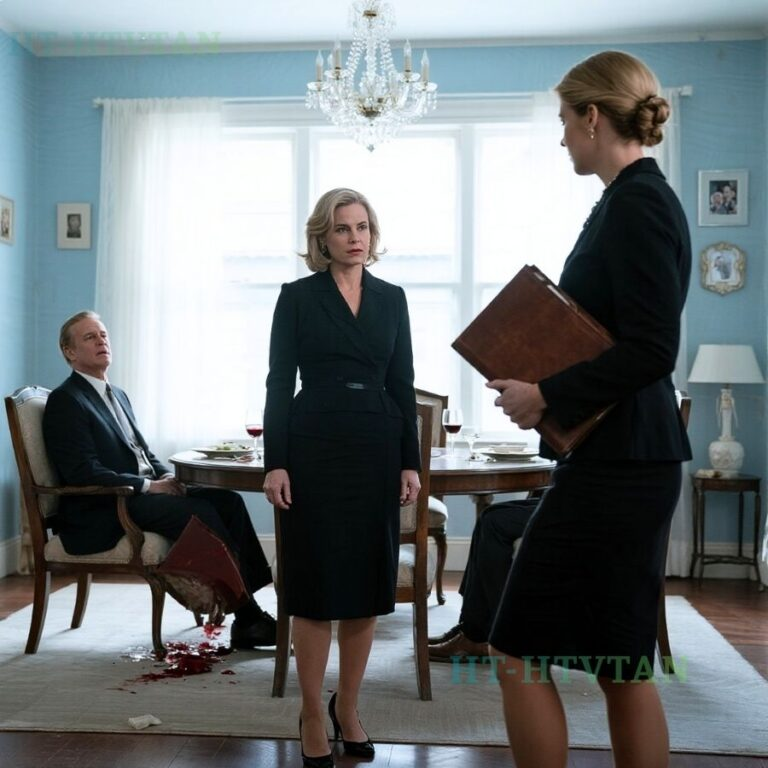
The dining room was set for a royal banquet. Crystal goblets, silver flatear, heavy linen napkins. It was a scene straight out of a magazine designed to impress. But the air in the room was so thick with tension you could cut it with a knife.
I sat on one side of the table, Donovan next to me. My parents sat at the heads. Paxton and Lucinda sat opposite us. Grandma Edith’s wheelchair was pushed up to the corner, barely fitting. A hired server, probably a college student working for cash, brought out the appetizers. Shrimp cocktail. Beatatrice beamed. I had them make your favorite, Mallerie.
Do you remember? You used to love shrimp when you were little. I looked down at the pink crustaceans. I looked up at my mother. I have been allergic to shellfish since I was 10 years old. Mother, I said calmly. I went into anaphylactic shock at cousin Sarah’s wedding. You were the one who drove me to the ER. Beatatric’s smile froze. She blinked rapidly.
Oh, right. Yes. I I must have forgotten. It’s been so long. You forgot that your daughter could die from eating this? Donovan asked. His voice was polite, but the underlying tone was sharp. It was a simple mistake. Reginald snapped. He waved his hand at the server. Take it away. Bring her the salad.
It was a small detail, but it said everything. They didn’t know me. They didn’t remember me. They had replaced the real version of me with a convenient fiction in their heads. As we ate the salad, wilted greens with too much dressing, Reginald began his performance. He cleared his throat and tapped his wine glass with a fork.
I want to propose a toast, he said, standing up. To family, to being whole again. The Reeds have always been pillars of this community. We have faced hard times. Yes, the market changes, the world changes, but we adapt. We survive. And now with Mallalerie back, we are stronger than ever. He raised his glass to the Reed legacy.
To the legacy, Beatatrice and Lucinda echoed. I didn’t touch my glass. I just watched him. You speak of legacy, Reginald, I said, my voice cutting through the murmurss. But what is that legacy exactly? Is it the lies? Or is it the debt? The table went silent? The server froze in the doorway. We don’t talk about money at the dinner table, Aunt Lucinda hissed, clutching her pearls.
Why not? I asked. It’s the only reason I’m here. Let’s not pretend otherwise. You didn’t invite me back because you missed me. You invited me back because you saw my name on a list. That is hurtful. Beatatrice sniffed, dabbing at dry eyes. We invited you because it’s Christmas. Because a mother needs her daughter.
A mother who tells people her daughter is dead doesn’t get to play that card, I said. Reginald slammed his hand on the table. The silver rattled. Enough. We did what we had to do to protect this family. You abandoned us. You ran off to California to play with computers while we stayed here and did the real work.
Real work? I raised an eyebrow. Is that what you call running the company into the ground? I built this company. Reginald roared. I provide for everyone at this table. You provided a lie, I said. And tonight the bill is due. The main course arrived. Filet minan slightly overcooked. The argument had settled into a simmering, hostile silence.
I looked around the room, taking in the details I had missed earlier. The wallpaper was peeling in the corner behind the curtain. The crystal goblet in front of me had a tiny chip on the rim. The server’s uniform was ill-fitting, suggesting they had hired the cheapest catering service available. Everything was a facade, just like them.
I felt a profound sense of loneliness. Not for them, but for the time lost. 12 years. I had spent my 20s building an empire, waking up at 4:00 a.m. fighting for every contract, every line of code. I had missed birthdays, holidays, simple moments of peace. And for what? To come back to this house of strangers who looked at me like a winning lottery ticket. Paxton broke the silence.
He had been drinking steadily since we sat down. So he slurped his wine. You’re big time now, huh? What do you actually do? Tech support, fix printers. He laughed at his own joke. Lucinda tittered along with him. I slowly cut a piece of steak. I own Ether Logistics, Paxton. We design the AI algorithms that control 40% of the global shipping supply chain.
If you order a package from Amazon, my code tells it how to get to your door. If a hospital needs a kidney for a transplant, my system finds the fastest route. I paused, looking him dead in the eye. I also own the digital infrastructure that processes credit transactions for several major banks, including the one that just declined your card at the liquor store this morning.
Paxton’s face turned bright red. He slammed his fork down. You stalked me. I did due diligence. Donovan corrected him. When one considers investing in a distressed asset, one must examine all the liabilities. And you, Paxton, are a significant liability. I am not a liability, Paxton shouted. I’m the vice president of Reed Manufacturing.
VP of a company that hasn’t made a profit in four years, I pointed out. A title with no salary, I assume since daddy pays for your condo and your car. That’s enough, Beatatrice cried out. Stop it. Stop attacking your brother. We are a family. Are we? I asked softly. Because from where I’m sitting, this looks like a hostage situation.
Dishes were cleared. Coffee was served. The moment I knew was coming finally arrived. Reginald signaled for everyone to leave the room except the immediate family. The server scured away. Even Lucinda made an excuse to go powder her nose, sensing the heavy lifting was about to begin. Donovan stayed.
Reginald tried to object, but I simply said, “He stays, and that was that.” Reginald clasped his hands on the table. He took a deep breath, shifting gears from angry patriarch to reasonable businessman. It was a transition I had seen him do a thousand times. Mallerie, he began, his voice softening. I know we have our differences.
I know the past is complicated, but we are blood and blood matters. He paused for effect. The company is going through a temporary liquidity crisis. The banks are being unreasonable. They don’t understand the legacy of Reed Manufacturing. They are threatening to call in our loans. How much? I asked.
I wanted to hear him say the number. We need a bridge loan, Reginald said. Just to get us through the quarter to restructure. How much, Reginald? He looked at Beatatrice then back at me. $5 million. I didn’t blink. 5 million. It was a fortune to most people. To me, it was a tax write off, but the audacity of the request was breathtaking.
5 million, I repeated. And what do I get in return? You get to be a read again, Beatatrice said, leaning forward, her eyes shining with manic hope. We will announce your return. We will put you on the board. You can have your old room back. We can be a family again just like before. You’re selling me my own name, I said, marveling at their delusion.
You’re selling me a seat at a table that is already underwater. It’s an investment. Reginald insisted. The company has assets. The real estate alone. The real estate is leveraged to 120% of its value, Donovan interrupted, reading from his tablet. The factory machinery is outdated. The inventory is unsold. The brand value is negligible.
Who the hell do you think you are? Reginald snarled at Donovan. I’m the guy who did the math, Donovan replied calmly. Mallerie, please. Beatatrice reached across the table trying to grab my hand. I pulled it away. Don’t listen to him. Listen to your heart. We are your parents. We gave you life. Doesn’t that mean anything? It means everything.
I said, “It means I survived you. I stood up. The chair scraped loudly against the floor. You want $5 million to fix your mistakes. You want me to bail you out so you can keep pretending you’re the royalty of Oakbrook. You want me to save the very reputation that you sacrificed me to protect? Yes. Beatatrice sobbed.
Yes. Please, baby, save us. I looked down at them, pitiful, desperate, and completely unrepentant. I have a counter offer, I said. The room went deadly quiet. The only sound was the ticking of the grandfather clock in the hall, a sound that used to haunt my nightmares. A counter offer? Reginald asked, hope flickering in his eyes.
He thought I was going to negotiate terms. He thought I was going to offer 3 million or four. He didn’t understand that I wasn’t here to negotiate. I was here to terminate. Before I give you my offer, I said walking slowly around the table. I have one question, just one. And I want the truth.
For the first time in this house, I want the absolute truth. I stopped behind my mother’s chair. She trembled. Why did you tell everyone I was dead? The question hung in the air like smoke. Reginald looked away. Beatatrice stared at her hands. “Answer me,” I commanded. My voice wasn’t loud, but it carried the weight of 12 years of silence.
“It was complicated,” Reginald muttered. “No, it wasn’t,” I said. “It was a choice. You chose to bury an empty casket rather than admit your daughter had a mind of her own.” “Why?” Reginald slammed his fist on the table again, but this time there was no power in it. Only fear because of the scandal. You left. You dropped out.
The rumors were starting. People were asking questions. Where is Mallerie? Why isn’t she in school? It was embarrassing. Mallerie, we have a standing in this community. So you killed me, I said. To save face at the country club. We didn’t kill you, Beatatrice whispered. We just let you go. You held a memorial service, mother.
I shouted, finally losing my cool. You accepted flowers. You cried over a grave that doesn’t exist. You erased me. We had to protect the family honor. Reginald yelled back. his face turning purple. You were selfish. You left us. I was 19. I screamed. I wanted to live my own life. And for that, you sentenced me to death.
I took a deep breath, studying myself. I looked at Donovan. He gave me a barely perceptible nod. It was time. “You care so much about honor,” I said. my voice dropping to a dangerous whisper. “You care so much about appearances. Let’s talk about the reality.” I pulled out my phone and tapped the screen. You owe Heartland Bank $2.4 million.
You owe City Commercial 1.8 million. You have second and third mortgages on this house totaling 900,000. You owe suppliers 600,000. How do you know that? Reginald whispered. He looked like he was about to have a heart attack. Because I know who owns your debt, I said. I looked at Donovan. Show them. Donovan stood up.
He didn’t look like a dinner guest anymore. He looked like the grim reaper in a tailored suit. He placed the heavy leather folder in the center of the table, right between the centerpiece and the untouched coffee cups. He opened it. Loan number 7842, Donovan read aloud, acquired by Vanguard Holdings on August 14th.
Loan number 3391, acquired by Vanguard Holdings on September 2nd. Promisory note for the renovation of the West Wing. Acquired by Vanguard Holdings last Tuesday. He slid the papers across the table. They fanned out like a winning poker hand. Reginald picked up one of the documents. His hands were shaking so badly the paper rattled. He read the header.
He read the assignment clause. Vanguard Holdings, he muttered. Who is Vanguard Holdings? Beatatrice looked up confused. The bank said we had an extension. They said they sold the debt to a private equity firm. They did? I said. I stepped forward and placed my hands on the table, leaning in so I was inches from my father’s face.
I am Vanguard Holdings. The silence that followed was absolute. It was the silence of a bomb going off the split second before the shockwave hits. Beatatrice gasped. Her hand flew to her mouth. Her wine glass, which she had been clutching, slipped from her fingers. It hit the table, shattered, and red wine bled across the white tablecloth like a fresh wound.
You, Reginald whispered. You bought our debt. I bought all of it, I said. Every cent, every lean, every mortgage. I own this house, Reginald. I own your company. I own your car. I own the chair you are sitting in. Paxton, who had been silent, suddenly stood up. “That’s You can’t own us. Check your email,” Paxton, Donovan said without looking at him. “I just sent you the notification.
Your company credit card has been cancelled.” “And the repo men are scheduled to pick up your Porsche tomorrow morning at 9:00.” Paxton pulled out his phone. He stared at the screen, his face draining of color. He slumped back into his chair, defeated. “This This is impossible,” Beatatrice stammered. “You’re our daughter.
You wouldn’t do this.” “You’re right,” I said. “A daughter wouldn’t do this, but a ghost would.” Reginald looked at the papers, then at me. His eyes were wild. This is blackmail. I’ll sue you. I’ll tell everyone what you did. Tell them what. I laughed. That your dead daughter came back to life to collect on your bad loans.
Go ahead, Reginald. Tell them. It will make a fascinating story for the newspapers. Local businessman commits bank fraud saved by daughter. He faked death of Reginald collapsed back into his chair. He knew I had him. He knew there was no way out. “You are a bad investment, Reginald,” I said, channeling every ounce of cold corporate energy I possessed.
“You have managed this family like you managed your business with arrogance, short-sightedness, and fraud.” I walked over to the fireplace and looked at the family portrait hanging above it. It was painted 5 years ago. Just the three of them. Happy. Perfect. Here are your options, Donovan said, placing a single crisp document on top of the pile of debt.
Option A, we proceed with immediate foreclosure. The sheriff will be here at 8:00 a.m. tomorrow to evict you. We will seize all assets to satisfy the debt. We will also file a formal complaint with the FBI regarding the fraudulent asset statements you submitted to Hartland Bank. Beatatrice let out a low moan. Prison. Oh God. Reginald.
Option B. Donovan continued. You sign this. It is a full surrender of assets and a voluntary release of claims. You sign over the deed to the house, the remaining stock in the company, and rights to the Reed family trademark. And then what? Reginald croked. We live on the street. No, I said. I pulled a check from my purse.
It was already written out. $350,000, I said, placing the check on the table. That’s nothing, Paxton yelled. The house is worth $4 million. The house has 4.2 million in debt against it, you idiot, I snapped. You have zero equity. This check is a gift. It’s charity. I looked at my parents. 350,000. Enough to buy a small condo in Florida.
Enough to buy two used cars. Enough to disappear. Disappear. Beatatrice whispered. You leave Chicago, I said. You leave Oakbrook. You go somewhere where no one knows the name Reed. And you never ever contact me or Grandma Edith again. You’re taking mother?” Reginald asked, looking at the wheelchair in the corner.
“Grandma is coming with me,” I said. “She’s the only asset in this house with any value. And if we don’t sign,” Reginald challenged, trying to find one last scrap of leverage, then I burn it all down. I said, “I ruin you publicly. I put you in jail and I leave you with nothing. Not even a penny. I checked my watch.
You have 5 minutes. The pilot is waiting. The room was silent except for the howling of the wind outside. The snow battered the windows demanding entry. “She means it, Dad.” Paxton whispered. He looked at me with fear. “She really means it.” I stared at Reginald, the man who had thrown me out, the man who had erased me.
I waited for him to break. The grandfather clock chimed the quarter hour. Bong bong bong. Reginald stared at the document. His hand hovered over the Montlank pen Donovan had placed on the table. I could see the war raging inside him. His ego was fighting a losing battle against his survival instinct. He was a proud man, but he was also a coward, and cowards always choose safety.
“I need my purse,” Lucinda suddenly said, breaking the tension. “She stood up, grabbed the pen, and looked at the document.” “Where do I sign to get my name off the guarantee?” “Lucinda” Beatatrice gasped. “How could you?” Oh, shut up, Beatatrice. Lucinda snapped. The ship is sinking. I’m not going down with you. I have my own debts.
Lucinda signed her name with a flourish. She threw the pen down and looked at me. I assume I am free to go. Get out, I said. She grabbed her coat and practically ran out the front door. That broke the dam. Paxton was next. I’m sorry, Dad. He muttered. I can’t go to jail. I’m too pretty for jail. He signed his name. He didn’t look at me.
He just walked out of the room, heading for the liquor cabinet to pour one last drink on the house’s tab. Now it was just my parents. Beatatrice was crying softly. My home, my beautiful home. Where will I put my things? You won’t have things, mother, I said. You’ll have memories. Try to find some honest ones.
She looked at Reginald. Reggie, what do we do? Reginald looked at me. For a moment, I saw a flash of the father he used to be when I was very small. The man who taught me to ride a bike. But that man was gone, buried under layers of greed and narcissism. “You win,” he whispered. “You win, Mallalerie.
Are you happy? Happiness has nothing to do with it,” I said. “Sign.” He picked up the pen. His hand shook. He pressed the nib to the paper. It took him a long time to write his name. Reginald Arthur Reed. When he finished, he dropped the pen as if it were burning hot. He slumped forward, putting his head in his hands. He looked small.
He looked defeated. He looked like exactly what he was, a man who had lost everything because he couldn’t love his daughter for who she was. Donovan snatched the papers up immediately. He checked the signatures, notorized them with his stamp, and slid the check across the table. Transaction complete.
Donovan said, “You have until noon tomorrow to vacate the premises. The locks will be changed at 1201.” “I walked over to Grandma Edith.” “Ready to go, Grandma. Get me out of this hell hole,” she said, her voice surprisingly strong. I grabbed the handles of her wheelchair. I didn’t say goodbye to my parents.
I didn’t look back at the ruined dinner. I simply turned and pushed the wheelchair toward the door. Donovan held the front door open. The wind was howling, a full-blown blizzard now. But as we stepped out onto the porch, the cold felt different. It felt cleansing. I helped Donovan lift Grandma Edith into the back of the Escalade. She was wrapped in blankets, looking like a little bird, but her eyes were bright.
“Are you okay?” I asked her as I buckled her in. “I’m fine,” she said. She reached out and squeezed my hand. “Did you see his face? I haven’t had that much fun in 20 years.” I laughed. It was a real laugh bubbling up from my chest. “You’re terrible, Grandma. I’m old.” She winked. “I’m allowed to be.” I got into the driver’s seat. Donovan sat beside me.
“That went well,” he said dryly. “It went exactly as planned,” I replied. I put the car in gear and pulled away from the curb. In the rear view mirror, I saw the house one last time. As we drove down the street, the timers on the Christmas lights must have hit their limit, or maybe a fuse blew. Suddenly, the thousands of twinkling lights on the Reed house went dark.
The house vanished into the blackness of the storm. Symbolic, Donovan noted. We drove in silence for a while, the only sound the hum of the engine and the heater blasting. What now? Grandma asked from the back seat. Where are we going? I don’t have a passport. We’re going to California, Grandma, I said. I bought a house in Napa. It has a huge garden.
No snow, just sunshine and wine. I like wine, she said contentedly. 6 months have passed since that night. The house in Oakbrook was sold to a developer who tore it down to build two modern mansions. My parents moved to a small condo in Boca Raton. I heard from a lawyer that they divorced two months later. Beatatrice is working as a greeter at a department store.
Reginald spends his days at the dog track. Paxton is working at a car rental agency near the airport. They are alive, but the Reed family is dead. As for me, I’m sitting on the patio of my vineyard in Napa. Grandma Edith is pruning her roses nearby. She’s gained weight. She smiles every day. People tell me I was cold.
They say, “How could you do that to your own flesh and blood?” They say I should have forgiven them. But forgiveness is a luxury for those who haven’t been buried alive. They try to erase me. I just return the favor. I take a sip of wine and look at the sunset. I have my name back. I have my life back. And most importantly, I have the truth.
They called me cold for evicting my own parents. But tell me, would you warm a snake that already bit you once? Thank you for listening.


Leave a Reply