The call came from University Hospital at 9:30 p.m. on a Friday night, the kind of call that rearranges your understanding of time. I was sitting at a long table in a downtown restaurant, half-listening to a senior partner talk about quarterly projections while I pushed a spoon through melting cheesecake. My phone vibrated once. Then again. Then a third time, back to back, numbers I didn’t recognize stacking up like a warning siren I couldn’t mute.
I stepped away from the table, murmuring something about taking a call, and listened to the first voicemail with my back pressed against a hallway wall. A hospital administrator, voice clipped and professional, asking me to come immediately regarding my daughter, Nora. No details. Just urgency. The second voicemail was worse. A police officer, Detective Kyle Brennan, stating there had been a serious incident at my home involving injury. The third was from my neighbor, her voice tight, asking if everything was okay because she’d seen ambulances and police cars outside our house.
My hands were already shaking as I tried to call my wife, Julia. Straight to voicemail. She was working the night shift at her hospital across town, probably scrubbed in, unreachable. I tried our home phone out of instinct, knowing it was useless. Then I grabbed my coat, ignored the curious looks, and walked out into the cold night air like someone leaving the wrong life behind.
The drive to University Hospital took twenty minutes. I remember every red light, every slow driver, the way my heart hammered so hard I could feel it in my throat. I kept telling myself this had to be a misunderstanding. Nora was six. First grade. Tiny for her age. She still slept with three stuffed animals arranged carefully around her head and asked me to check under her bed for monsters every night. Whatever had happened couldn’t possibly be what the detective’s tone suggested. It didn’t fit into the shape of reality.
The emergency room parking lot was half empty when I arrived, sodium lights casting everything in that sickly glow that makes the world feel unreal. I ran inside and gave my name at reception. The woman’s expression changed instantly, professional neutrality giving way to something heavier. Concern, yes, but also preparation. She made a call, and within two minutes Detective Brennan appeared.
He looked about forty, with tired eyes and a face that had learned how to deliver bad news without flinching. He asked me to follow him to a private waiting room, and my stomach dropped. Private rooms were for conversations you didn’t forget.
We walked past the main ER into a family consultation area. Inside were two people already seated, a man and a woman in their late forties, both dressed in business casual clothes that screamed upper-middle-class professionals. The woman’s eyes were red and swollen. The man’s jaw was clenched so tight I could see the muscles twitching.
Detective Brennan introduced them as Gregory and Diane Thornton.
Their seventeen-year-old son, Blake, was in surgery for severe head trauma. Skull fracture. Brain bleed. Critical condition. And my six-year-old daughter had put him there.
The words didn’t land all at once. They hovered, disconnected, refusing to assemble into meaning. Gregory Thornton spoke first, his voice controlled, polished, vibrating with rage barely restrained by decades of courtroom discipline. He said my daughter had violently attacked his son with a weapon while Blake was babysitting at our house. He explained Blake had been hired through a family friend to watch Nora and her three-year-old brother, Finn, while Julia worked her night shift and I attended my work dinner.
He mentioned, almost casually, that he and his wife were corporate attorneys. They knew their rights. They knew the law. He said my daughter’s actions constituted aggravated assault, possibly attempted m@rder given the severity of Blake’s injuries. They would be pressing criminal charges despite Nora’s age. They would be filing a civil lawsuit. Damages, he estimated, would exceed one million dollars once medical bills and long-term care were calculated.
Diane added that Blake had been accepted to Princeton. Full scholarship. His entire future laid out neatly until my daughter had tried to end it for no reason. Her voice cracked on that last part, but her eyes never left my face, as if daring me to contradict her.
I asked where Nora was. Detective Brennan said she was with a victim advocate in another room, being evaluated. I asked what that meant. He explained they provided support for children involved in traumatic incidents, his tone careful, measured.
I said I needed to see my daughter immediately. Gregory stepped forward, his composure fraying. He said I needed to understand the severity of what my child had done. That Blake might not survive the night. That if he did, he might have permanent brain damage. That my daughter had displayed a level of violence suggesting serious psychological issues. That I should be preparing for her to be removed from my custody and placed in juvenile psychiatric care while proceedings moved forward.
His voice rose with each sentence. I felt something hot and blinding surge through me. I told him to back away. Told him I’d listen to the police, not to him. Told him his son was in surgery and mine was being questioned, and I needed to see her before anyone said another word about charges, lawsuits, or custody.
Detective Brennan placed a hand on my shoulder, grounding, firm. He said we could see Nora in a moment, but first I needed to understand what they knew so far.
He pulled out a tablet.
First, Blake Thornton’s student ID. Clean-cut. Handsome. Varsity soccer. Honor roll. The kind of kid people described as having his whole life ahead of him. Then the photos from the scene. Blake on our kitchen floor. Blood pooling around his head. Massive swelling on the right side of his skull. Paramedics kneeling over him, hands blurred with motion. Then another image.
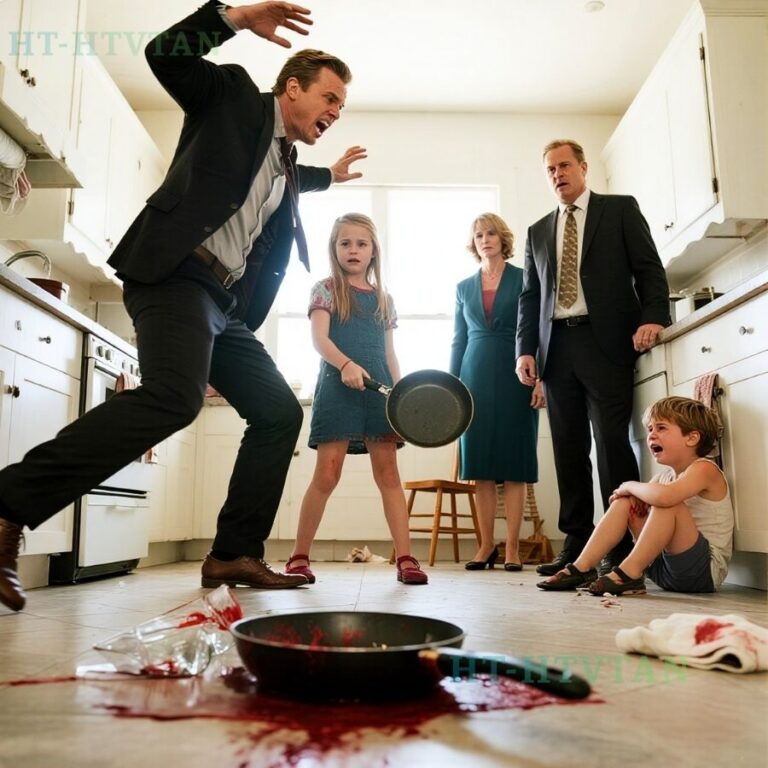
Our cast iron skillet. Twelve inches across, heavy, probably eight pounds. Sitting on the tile, coated with blood and hair.
Detective Brennan explained the preliminary findings. Nora had struck Blake twice. Once to the leg, causing him to fall. Once to the head, causing the fracture. Blake was unconscious when first responders arrived. Nora had been found sitting in the living room with Finn. Both children had blood on their clothes. Nora had refused to speak to officers. She had only asked, over and over, if Finn was okay.
Finn had been taken to the pediatric ward. Injuries consistent with rough handling, but nothing life-threatening. I asked what kind of injuries. The detective hesitated, then said Finn had a dislocated shoulder, bruising on both arms, finger-shaped marks suggesting he’d been grabbed forcefully, and minor whiplash consistent with being shaken. He was sedated now. Stable.
I felt cold spread through my body, like something essential had drained away. I asked if Blake had done that to Finn.
Gregory Thornton said absolutely not. Immediate. Final. Said Blake would never hurt a child. Said any injuries Finn had must have happened before Blake arrived. I pointed out Blake had been at our house for three hours before the call. The timeline didn’t make sense.
Diane accused me of deflecting blame from my violent daughter. Her voice shook, but her conviction was unbreakable. I realized then she genuinely believed her son was the victim, that she could not conceive of him doing anything wrong. In her mind, my six-year-old was a monster.
Detective Brennan asked us to sit. Plastic chairs arranged in a loose circle. He asked if I was aware we had security cameras in our home. I said yes. We’d installed a nanny cam system six months earlier after a neighborhood break-in scare. Four cameras. Living room. Kitchen. Playroom. Hallway. Cloud storage. I’d forgotten about them entirely.
He said officers had accessed the footage using emergency credentials. Said what they found changed everything.
He turned the tablet toward Gregory and Diane and started the video.
Our kitchen appeared on the screen, the familiar angle from above the refrigerator. Timestamp: 8:15 p.m., forty-five minutes before the call. Blake stood in frame, gripping Finn by one arm. My three-year-old son was screaming, his body jerking violently as Blake shook him hard enough that Finn’s head snapped back and forth. Even without sound, the terror on my child’s face was unmistakable.
Blake’s mouth moved. I couldn’t hear the words. But I could read his lips.
The first voicemail was from a hospital administrator asking me to come immediately regarding my daughter, Nora. The second was from a police officer named Detective Kyle Brennan saying there had been an incident at my home involving serious injury. The third was from my neighbor asking if everything was okay because she’d seen ambulances and police cars outside our house.
I excused myself from the table, my hands already shaking as I tried calling my wife Julia, who was working the night shift at her hospital across town. She didn’t answer. I tried our home phone. Nothing. I got in my car and drove 20 minutes to University Hospital with my heart hammering so hard I could feel it in my throat.
My daughter Nora was 6 years old, first grade, tiny for her age, she still slept with three stuffed animals and asked me to check under her bed for monsters every night. Whatever incident involved her couldn’t possibly be what the detective’s tone suggested. The emergency room parking lot was half empty when I arrived.
I ran inside and gave my name at reception. The woman’s expression changed immediately from professional courtesy to something more complex. Concern mixed with weariness. She made a call and within 2 minutes, Detective Brennan appeared. He was maybe 40. Weathered face, tired eyes. He asked me to follow him to a private waiting room and my stomach dropped because private waiting rooms meant serious conversations.
We walked past the main ER into a family consultation area. Inside were two other people, a man and woman in their late 40s, both wearing business casual clothing that screamed upper middlecl class professionals. The woman had been crying. The man’s jaw was clenched so tight I could see the muscles jumping. Detective Brennan introduced them as Gregory and Diane Thornton.
Their 17-year-old son, Blake, was currently in surgery for severe head trauma, skull fracture, brain bleed, critical condition, and my six-year-old daughter had put him there. I couldn’t process the words. Couldn’t make them fit together into meaning. Gregory Thornton spoke first. His voice was controlled, but vibrating with rage barely contained beneath professional courtesy.
He informed me that my daughter had violently attacked his son with a weapon while Blake was babysitting at our house. Blake had been hired through a family friend’s recommendation to watch Nora and her three-year-old brother Finn while Julia worked her night shift and I attended my work dinner. Gregory explained that he and his wife were both attorneys.
Corporate law. They knew their rights. They knew my daughter’s actions constituted aggravated assault, possibly attempted murder given the severity of Blake’s injuries. They would be pressing criminal charges despite Norah’s age, would be filing a civil lawsuit for damages they estimated would exceed $1 million once medical bills and long-term care costs were calculated.
Diane added that Blake had been accepted to Princeton, had a full scholarship, had his entire future ahead of him before my daughter had tried to kill him for no reason. I asked where Nora was. Detective Brennan said she was with a victim advocate in another room being evaluated. I asked what he meant by victim advocate and he said they provided support for children involved in traumatic incidents.
I said I needed to see my daughter immediately. Gregory stepped forward and said, “I needed to understand the severity of what my child had done. That Blake might not survive the night. That if he did survive, he might have permanent brain damage. That my daughter had shown a level of violence that suggested serious psychological problems.
That I should be preparing for my child to be removed from my custody and placed in juvenile psychiatric care while criminal proceedings moved forward.” His voice was getting louder with each sentence, and I felt rage flash through me hot enough to make my vision blur. I told him to back away from me.
Told him I’d listen to the police, but not to him. Told him his son was in surgery and mine was apparently being questioned and I needed to see her before anyone said another word about charges or lawsuits or custody. Detective Brennan put a hand on my shoulder, said we could see Nora in a moment, but first I needed to understand what they knew so far.
He pulled out a tablet and showed me photos. Blake Thornton’s student ID, cleancut kid, handsome varsity soccer, honor roll. Then photos from the scene. Blake on our kitchen floor. Blood pooling around his head. Massive swelling on the right side of his skull. Paramedics working on him. More photos. Our cast iron skillet 12 in across, probably 8 lb, sitting on the kitchen tile covered in blood and hair.
Detective Brennan explained that based on preliminary investigation, Norah had struck Blake twice with the skillet. Once to his leg, causing him to fall. Once to his head, causing the skull fracture. Blake had been unconscious when first responders arrived. Norah had been found sitting with her brother Finn in the living room.
Both children had blood on their clothing. Norah had refused to speak to officers, had only asked repeatedly if Finn was okay. Finn had been taken to the pediatric ward for evaluation. He had injuries consistent with rough handling, but nothing life-threatening. I asked what kind of injuries. Detective Brennan hesitated, then said Finn had a dislocated shoulder, bruising on both arms, finger-shaped marks suggesting he’d been grabbed forcefully, minor whiplash consistent with being shaken.
He was sedated now and stable. I felt cold spread through my entire body. asked if Blake had done that to Finn. Gregory Thornton immediately said absolutely not. Said Blake would never hurt a child. Said whatever injuries Finn had must have occurred before Blake arrived. I said Blake had been at our house for 3 hours before I got this call. The timeline didn’t work.
Diane said I was trying to deflect blame from my violent daughter by accusing their innocent son. Her voice was shaking. On the edge of breaking, I understood suddenly that she genuinely believed Blake was the victim here. that she couldn’t conceive of her Princetonbound son doing anything wrong. That in her mind, my six-year-old was a monster who’d attacked unprovoked.
Detective Brennan asked if we could all sit down, said there were some things we needed to review before making any determinations. We sat in uncomfortable plastic chairs arranged in a circle. The detective pulled up something on his tablet, asked if I was aware we had security cameras in our home.
I felt my heart skip, said yes. We’d installed a nanny cam system 6 months ago after a break-in scare in our neighborhood. Four cameras, living room, kitchen, playroom, hallway, all connected to cloud storage. I’d honestly forgotten about them. Hadn’t checked the footage in months. Detective Brennan said officers had accessed the system with our emergency access codes.
Said what they’d found changed everything. He turned the tablet toward Gregory and Diane, asked them to watch, started playing a video. I could see our kitchen from the camera mounted above the refrigerator. Timestamp showed 8:15 p.m. 45 minutes before I’d gotten the emergency call. The video showed Blake in our kitchen holding Finn by one arm.
My 3-year-old son was crying, screaming. Blake was shaking him, not gently, violently. Hard enough that Finn’s head snapped back and forth. hard enough that even through the silent video, I could see the terror on my baby’s face. Blake was yelling at Finn. I couldn’t hear the words, but I could read his lips. Shut up.
Shut the [ __ ] up. Stop crying, you little [ __ ] Then Blake twisted Finn’s arm deliberately, purposefully. I saw Finn’s face contort in agony. Saw his mouth open in what must have been a scream of pain. Saw his shoulder dislocate, pop out of socket. Blake laughed. Actually laughed. He pulled out his phone with his free hand.
Started filming Finn recording my son’s suffering. The time stamp ran forward. 1 minute, 2 minutes, 5 minutes. Blake kept shaking. Finn, kept recording, kept laughing. At the 8-minute mark, a small figure appeared in the kitchen doorway. Nora, my six-year-old daughter, she was wearing her pajamas, must have heard the screaming from upstairs.
The video showed Nora freeze, process what she was seeing, her small face transforming from confusion to horror to something else, something cold. She yelled at Blake. I could see her mouth forming words. Let him go. Stop hurting him. Blake looked up, said something back. His expression was contemptuous, dismissive, threatening.
He pointed toward the stairs, telling her to go back up. Norah stood there for maybe 3 seconds. Then she turned and ran out of frame. Gregory made a sound almost triumphant said there. She had opportunity to get help. She chose violence instead. Detective Brennan held up a hand. Said, “Keep watching.” 30 seconds later, Nora reappeared.
She was dragging something. The cast iron skillet. It was nearly as big as her torso. She could barely lift it, but she pulled it across the kitchen floor toward Blake. He didn’t see her at first. Too busy tormenting Finn. too busy recording, too busy enjoying himself. When Blake finally noticed Norah, he turned toward her, laughed, said something. Norah didn’t respond.
She lifted the skillet with both hands. It took visible effort, her entire body straining. She swung it at Blake’s leg. The impact made Gregory flinch, even watching silently. Blake’s knee buckled. He dropped Finn, stumbled backward, grabbed the counter for balance. Nora moved fast, impossibly fast for a six-year-old holding an 8-lb skillet.
She got between Blake and Finn. Her brother was on the floor crying and clutching his arm. Blake straightened up, his face contorted with rage. He moved toward Nora, reached for her. She swung the skillet again, this time overhead, this time aimed at his head. The ark was perfect. The timing was perfect.
The skillet connected with the right side of Blake’s skull just above his ear. His head snapped sideways. His eyes rolled back. He dropped. Just collapsed, went down hard, and didn’t move. Norah immediately released the skillet. It clattered to the floor. She ran to Finn, knelt beside him, her small hands gentle as she checked him over. Then she stood and ran out of frame.
15 seconds later, she was back with our cordless phone. She was calling 911. The timestamp showed she called at 8:24 p.m. 9 minutes after Blake had started torturing Finn, 6 minutes before I’d received the first emergency call. The video ended. The room was completely silent. Gregory and Diane sat frozen. Their faces had gone pale.
Dian’s mouth was opening and closing, but no sound came out. Gregory was staring at the blank tablet screen. Detective Brennan spoke quietly, asked if they wanted to see it again. Gregory shook his head, asked in a horse voice if there was audio. The detective said yes, asked if they wanted to hear it. Diane made a choking sound, said no.
Said she’d seen enough. Gregory looked at me, then looked away. The righteous fury had drained completely from his expression. Left behind was horror and shame and the dawning realization that their son was not who they thought he was. Detective Brennan said the audio was worse than the video. Blake’s words were clear, calling Finn names, mocking his speech.
Finn had developmental delays, was in speech therapy. Verbal skills of maybe a 2-year-old. Blake had known that, had targeted that, had filmed it for what the detective suspected was planned posting on social media. They’d found Blake’s phone in his pocket. Found the video still recording when paramedics arrived.
found other videos, older videos, other children, other babysitting jobs. That got my attention fast. I asked what other videos. Detective Brennan said they were still reviewing Blake’s phone, but preliminary examination showed at least six videos of him abusing children he’d been hired to watch. Ages ranging from 2 to 8. Nothing as severe as what he’d done to Finn, but still disturbing.
pushing kids, mocking them, making them cry while he filmed, posting some videos to private social media accounts where his friends could watch and comment. The videos went back 18 months, roughly when Blake had started babysitting regularly, making money from families who trusted him, families who thought they were hiring a responsible high school student, an honor roll kid, a Princetonbound scholar.
Gregory stood up abruptly, said he needed air, walked out of the room. Diane stayed seated. She was crying silently now, tears running down her face. She looked at me and said she was sorry. Said she didn’t know. Said Blake had been different lately, distant, secretive. But she’d attributed it to normal teenage behavior.
She said her son needed help. Serious psychological help. Said if he survived, she’d make sure he got it. Said she wouldn’t fight any charges, wouldn’t file any lawsuit, just wanted her son to live and get treatment. I said I wanted to see Nora. Detective Brennan nodded, led me down a hallway to another private room.
Inside was a woman in her 30s wearing casual clothing and an ID badge identifying her as Amanda Cross, victim advocate with the county services. Sitting next to her on a small couch was my daughter. Norah looked so small, so fragile. Her dark hair was tangled. Her pajamas had blood spatter across the front, dried blood on her hands and arms. Not her blood, Blake’s blood.
She was holding a juice box, but hadn’t drunk any. When she saw me, she dropped it and ran across the room. I caught her, held her. She wrapped her arms around my neck and pressed her face into my shoulder. She was shaking. I could feel her small body trembling against mine. I sat down with her in my lap and asked if she was okay.
She nodded, asked in a small voice if Finn was okay. I said yes. Finn was going to be fine. She started crying then, actually sobbing, all the fear and shock and trauma pouring out. I held her and let her cry and tried to understand how my gentle six-year-old had done what that video showed. Amanda Cross explained that Norah had been very brave, had given a clear statement about what happened, had been worried primarily about her brother, had asked repeatedly if she was in trouble for hitting Blake, had asked if Blake was going to hurt
Finn again. Amanda said Norah was experiencing normal trauma response. Shock, fear, guilt, all completely understandable given what she’d witnessed and done. Detective Brennan asked if I could get Nora to walk through the events one more time for his report. I looked at my daughter, asked if she could tell me what happened.
She nodded, took a shaky breath, started talking in her small voice. She said she’d been in her room reading, heard Finn screaming, knew something was wrong because he sounded scared, not angry. She’d run downstairs and found Blake hurting Finn. Saw Blake shaking Finn and filming him. She’d yelled at Blake to stop.
Blake told her to go away or he’d hurt her, too. She saw Finn’s arm hanging wrong. Knew Blake had broken something. She’d gone back upstairs. I asked why she went upstairs. Nora said she knew she couldn’t fight Blake. He was too big, too strong. She needed a weapon, needed something to make him stop. She’d thought about calling 911 first, but was scared Blake would hear her and hurt Finn worse before help arrived.
She’d remembered the big pan I used for cooking, the heavy one. She’d run back downstairs and grabbed it. It was really heavy, hard to carry, but she managed. She’d walked up behind Blake while he was busy with Finn, swung the pan at his leg because that’s where she could reach. Wanted to make him let go of Finn. He dropped Finn and stumbled.
Norah got between them. Blake got angry, started coming toward her. She knew if he got hold of her, she wouldn’t be able to protect Finn. So, she swung the pan at his head, swung as hard as she could. He fell down and didn’t get up. She checked on Finn, then called 911, then waited. She’d been too scared to move Finn because she remembered me saying, “You shouldn’t move hurt people.
” So, she just stayed with him and tried to keep him calm until help arrived. Detective Brennan asked Norah if she’d been scared. She nodded. He asked if she’d wanted to hurt Blake. Norah thought about it, then said she’d wanted to stop Blake from hurting Finn, wanted to make sure Blake couldn’t hurt anyone. She’d hit him as hard as she could because she’d needed to make sure he stayed down.
The detective made notes, told Norah she’d done the right thing, that protecting her brother was brave and good, that she wasn’t in trouble, that Blake was the one who’d done wrong. Norah asked if Blake was going to jail. Detective Brennan said probably yes. Once Blake recovered enough to leave the hospital, he’d be arrested, charged with multiple counts of child abuse, endangerment, assault.
The videos on his phone showed a pattern of behavior, evidence of planning, and intent. Blake was 17, would likely be charged as an adult given the severity and premeditation. Norah asked if that meant Finn was safe. The detective said yes. Blake wouldn’t be able to hurt anyone for a very long time. I asked if we could see Finn.
A nurse appeared and led us up to the pediatric ward. Third floor, bright hallways decorated with cartoon characters. Finn was in a private room. He looked impossibly small in the hospital bed. His left arm was in a sling. His shoulder had been relocated, but the doctors wanted to monitor him overnight. Make sure there was no nerve damage or complications.
He had IV fluids running, bruises already darkening on his pale skin where Blake had grabbed him. He was asleep, sedated. I stood next to his bed and felt rage so pure and hot, I actually had to grip the bed rail to stay steady. Norah climbed up next to her brother, careful not to jostle him. She took his good hand in both of hers, whispered that she was sorry she hadn’t protected him faster, that she should have known Blake was bad.
I told her none of this was her fault. that she’d saved Finn, that she was the bravest person I knew. She looked up at me with those huge dark eyes and asked if I was disappointed in her for hurting someone. I felt my throat close, pulled her into a hug, told her I was proud of her, told her she’d done exactly what needed to be done. A doctor entered.
Tall man in his 50s wearing surgical scrubs and a white coat. He introduced himself as Dr. Francis Reyes, chief of trauma surgery. He’d just finished operating on Blake Thornton. The surgery had gone well. They’d relieved pressure on Blake’s brain, repaired the skull fracture. Blake would survive, would likely make a full recovery physically, might have some memory issues related to the injury, but nothing catastrophic. Dr.
Reyes said he’d been briefed by police on what had happened, had reviewed the security camera footage. He looked at Nora with an expression I couldn’t quite read, then asked if he could speak with me privately for a moment. We stepped out into the hallway. Dr. Reyes pulled up something on his tablet, showed me CT scan images of Blake’s skull, pointed to the fracture pattern, explained that Blake had been hit at a very specific location, the Tyrion, where four skull bones meet, the thinnest part of the human skull, also
directly over the middle menial artery. The impact had fractured the bones and caused bleeding from that artery. Standard trauma that required surgical intervention. Dr. Reyes zoomed in on the scan, showed me how the fracture radiated from a single point of impact. Perfect placement.
He said in 20 years of trauma surgery, he’d seen professional fighters miss that target, seen trained combatants aim for it and hit surrounding structures instead. The Tyrion was small, maybe 2 in in diameter, located above and behind the eye. Difficult to hit accurately, especially in a dynamic situation, especially with an improvised weapon.
especially by someone who’d never trained in combat or studied anatomy. He asked if Norah had any martial arts background, any self-defense training, any medical education in the family. I said, “No, none.” Nora was six. She’d been in gymnastics for one year. That was it. Dr. Reyes was quiet for a moment, then said what Norah had done was remarkable.
Not just the protective action, but the targeting. Most people swinging a heavy object at someone’s head would aim for the top of the skull. The frontal bone, strong, thick bone that could withstand significant impact. Norah had somehow hit the exact weak point. The one spot guaranteed to cause immediate incapacitation with relatively modest force.
I said, “Maybe it was luck. Random chance.” Dr. Reyes shook his head, said the security footage showed deliberation. Norah had adjusted her stance. adjusted her grip, aimed carefully before swinging. The video showed her eyes tracking Blake’s head, calculating, then striking. The placement was too precise to be accidental.
He asked if I’d consent to Nora being interviewed by researchers studying threat response in children. Said he was working with a team, examining how young children assess and respond to dangerous situations, how they calculate risk and choose actions under extreme stress. Norah’s case was exceptional. A six-year-old recognizing her physical limitations against a larger opponent, choosing a weapon to compensate, using that weapon with precision that suggested intuitive understanding of human anatomy. Dr.
Reyes said there were implications for emergency response training, for understanding how to develop protective instincts in children without teaching violence. He wanted to study Norah’s cognitive process, understand how she’d made the decisions she’d made, learn what could be replicated or taught.
I said I needed to think about it, needed to talk to my wife. Dr. Reyes nodded, gave me his card, said there was no pressure, but the opportunity to study Norah’s case was scientifically valuable, potentially could help other children in similar situations. He added one more thing. said most adults faced with what Norah had witnessed would have frozen, would have panicked, would have called for help and waited.
Norah had assessed the situation, recognized the time constraint, calculated that intervention was necessary, selected an appropriate tool, and executed a plan that saved her brother’s life. That level of tactical thinking was rare in adults. In a six-year-old, it was unprecedented. The trauma center wanted to understand it.
I thanked him and went back to Finn’s room. Found Norah asleep, curled next to her brother on the hospital bed. Both my children in one bed, both injured by someone I’d trusted to protect them. I sat in the chair next to them, and tried to process everything that had happened in the past 3 hours. Julia arrived 30 minutes later. She’d been in surgery when I called, had gotten my messages during her break, came straight to the hospital.
I met her in the hallway and told her everything. showed her the security footage on Detective Brennan’s tablet, watched her face cycle through disbelief, horror, rage, grief. When the video ended, she was shaking. She asked where Blake was, and I had to physically stop her from going to find him. Told her he was in ICU under police guard.
That going after him would only make things worse, that Blake would face justice. Julia went into Finn’s room, spent 20 minutes examining both kids, checking Finn’s shoulder, looking at Norah’s hands where she’d gripped the skillet hard enough to leave marks. Julia was a pediatric nurse, knew what abuse looked like, knew what defensive injuries looked like, knew her children had been failed by the systems meant to protect them.
She asked me how we’d missed this, how we’d hired a monster. I said Blake had been recommended by the Kingston’s family friends whose kids Blake had babysat for years. Had seemed perfect, responsible, trustworthy. We’d done a background check. Nothing showed up. He was 17. Clean record, good grades, no red flags. Julia said the Kingston’s needed to know, needed to check their own children.
I called them from the hospital, explained what happened. They were shocked, horrified. said Blake had watched their two kids maybe 15 times over the past year. Never had problems. Kids never complained. I told them about the videos on Blake’s phone. Suggested they talk to their children. Really talk to them.
Ask specific questions about Blake’s behavior when parents weren’t around. The Kingston said they would called back 2 hours later. Their 8-year-old daughter had broken down crying when asked about Blake. said he’d been mean to her, pushed her, called her names, made her cry, then told her not to tell her parents or he’d tell everyone at school she was a baby.
She’d been too scared and embarrassed to say anything. The Kingston’s were devastated. Said they’d be contacting police to add their report to the investigation. Said they’d failed their daughter by not recognizing the signs. I told them we’d all failed. We’d all trusted the wrong person. Over the next week, the investigation expanded.
Police identified eight families Blake had babysat for regularly. Six agreed to let detectives interview their children with child psychologists present. Five of those six families had children who disclosed abuse, verbal harassment, physical intimidation, recording without permission. Blake had targeted kids too young or too scared to effectively report him.
Had counted on parental trust and his cleancut image to protect him. The videos on his phone corroborated everything. showed a pattern of escalating behavior over 18 months. What had started as minor meanness had progressed to serious abuse. Finn had been the worst case, the most severe injuries. The incident that finally exposed Blake because Norah had been there to witness and act.
Detective Brennan said without that security footage, Blake might have claimed Finn’s injuries were accidental. Might have blamed Norah for attacking him unprovoked. Might have played victim and gotten away with it. The video evidence was irrefutable. Showed clear intent. Showed planned cruelty. Showed Blake was a danger.
Blake woke up 4 days after surgery. Was arrested in his hospital bed. charged as an adult with six counts of child abuse, three counts of assault, multiple counts of harassment, and creating harmful material involving minors. His attorney tried arguing that Blake had diminished capacity due to the head injury, that he couldn’t be expected to participate in his defense. Dr.
Reyes testified that Blake’s cognitive function was intact, that memory issues related to the specific incident didn’t prevent him from understanding charges or assisting counsel. The judge ordered Blake held without bail. Flight risk and danger to community. Blake’s parents hired expensive defense attorneys. Tried negotiating a plea deal.
Prosecutors refused. Said the case would go to trial. Said the community needed to see justice served. The victims needed to see their abuser held accountable. Blake’s attorneys tried another approach. Argued that Norah’s actions were disproportionate. That a six-year-old hitting someone with a heavy weapon showed dangerous tendencies.
that the focus should be on her psychological evaluation, not their client’s prosecution. That strategy backfired spectacularly. The prosecutor released carefully edited portions of the security footage to media. Showed Blake abusing Finn, showed Norah’s protective intervention. Public outrage was immediate and intense. Blake became the face of predatory childare workers.
Norah became a symbol of childhood resilience and protective courage. News outlets requested interviews. I declined all of them. Norah didn’t need that exposure. Didn’t need to be paraded as a hero when she was still processing trauma. But the public attention did serve a purpose. Put pressure on Blake’s defense team.
Made it clear that any attempt to vilify Nora would be met with massive backlash. The defense changed tactics again. tried arguing that Blake himself was a victim, that he’d been bullied at school, had untreated mental health issues, needed help, not punishment. The prosecutor countered with Blake’s social media, posts showing him bragging about his babysitting money, joking with friends about stupid kids and easy work, laughing about parents who paid him to watch kids he considered annoying, no evidence of mental illness, just entitlement and
cruelty. The trial lasted 3 weeks. I attended every day. Julia and I took turns, so one of us was always with Nora and Finn. Our children were healing. Finn’s shoulder recovered fully. His speech therapist said he might have some lingering anxiety, but was resilient. Norah was seeing a child psychologist, working through the trauma.
She had nightmares sometimes, dreams about Blake hurting Finn and her not being fast enough. Her therapist said that was normal. said Norah had done something extraordinary under impossible circumstances and would need time to integrate that experience. The trial featured testimony from six children Blake had abused from their parents, from police, from Dr.
Reyes explaining Blake’s injuries, from child psychologists explaining the impact of Blake’s behavior. The defense put on minimal case. Blake didn’t testify. His attorneys argued for leniency based on his age, his potential, his lack of prior record. The jury deliberated for 4 hours, convicted Blake on every count. Sentencing came 2 weeks later.
Blake’s parents begged for mercy, said their son had made mistakes but deserved a chance to rehabilitate. Said prison would destroy his future. The judge allowed victim impact statements. Julia and I both spoke. Described finding our children bloody and traumatized. Described Norah’s nightmares. Described Finn’s anxiety. Described the betrayal of trusting someone to protect our children only to have that person hurt them deliberately.
Other families spoke. 8-year-old girl whose parents had trusted Blake. 5-year-old boy who still flinched when strangers approached. Each family telling the same story. Trusted Blake. Blake hurt their children. Blake showed no remorse. The judge listened to everything, then delivered sentence. Blake was 17, legally an adult for sentencing purposes.
Maximum security juvenile detention until age 21, then transferred to adult facility. Total sentence 20 years with possibility of parole after 12. The courtroom was silent. Blake’s mother sobbed. His father stared at the floor. Blake showed no reaction, just stood there empty. We left the courthouse and went home, started rebuilding our lives.
Nora went back to school. Her teacher and principal had been briefed on what happened, provided extra support. Other parents had heard about the trial. Some of them approached us, thanked Nora for exposing Blake, said their children had been on Blake’s potential babysitting list. We’d unknowingly protected dozens of families.
Nora didn’t understand why people treated her differently, why adults called her brave. She’d just done what needed to be done, protected her brother. That simplicity was both beautiful and concerning. Her therapist said Norah needed to understand that what she’d done was exceptional but not normal. That most situations didn’t require violence, that asking for help was usually the right choice.
But in that specific moment, with those specific circumstances, she’d made the only choice that saved Finn. Learning to live with that complexity would take time. Dr. Reyes contacted us again 3 months after the trial. said his research team had put together a proposal. Wanted to study Norah’s threat assessment capabilities non-invasively, just cognitive testing, spatial reasoning, pattern recognition, anatomical awareness, understanding how a six-year-old had demonstrated such precise targeting. I discussed it with
Julia and Nora. Our daughter was curious, asked what the doctors wanted to know. I explained they wanted to understand how her brain worked, how she’d made decisions so quickly under stress. Norah thought about it, then said, “Okay.” Said, “If it helped other kids stay safe, it was worth doing.” The testing took place over 6 weeks, 2 hours every Saturday. Dr.
Reyes and his team gave Norah puzzles, showed her anatomy diagrams, asked her to identify weak points on different structures. Norah had no formal training, but scored exceptionally high on spatial reasoning and vulnerability assessment. Could look at an object and identify where force would cause maximum damage. Could calculate angles and impact points intuitively.
The research team was fascinated. Published a paper in a pediatric trauma journal titled intuitive threat response and anatomical targeting in a six-year-old child, a case study in protective violence. used Norah’s case anonymously, but the medical community knew. Dr. Reyes started receiving requests from other researchers, emergency response trainers, self-defense instructors.
Everyone wanted to understand how to replicate or develop the capabilities Norah had demonstrated. Dr. Reyes emphasized that Norah’s actions weren’t something to glorify or teach, but understanding the cognitive process could help identify and protect children who demonstrated similar protective instincts before they were forced to use them, could help develop better ways to empower children to recognize danger without placing responsibility for violence on them.
The research spawned a pilot program teaching children aged 5 to 10 about body autonomy, threat recognition, and when to seek help versus when to act. Nora participated in the program development, helped researchers understand how she’d thought through her choices. Her input was invaluable. 5 years after the incident, Norah was 11, starting middle school.
She’d grown taller, more confident, still gentle with younger kids, still protective of Finn, who was now eight and thriving. Norah had developed an interest in medicine, specifically trauma care. Dr. Reyes had stayed in touch, invited Norah to shadow him occasionally at the hospital, showed her how doctors treated injuries, explained anatomy and physiology.
Nora absorbed everything. Julia joked that we were raising the world’s youngest trauma surgeon. Nora said maybe. Said she wanted to understand how bodies worked, how they broke, and how to fix them. Said knowing how to hurt people meant she should know how to heal them, too. That moral reasoning was sophisticated for an 11year-old.
Her therapist said Norah had integrated the traumatic incident into a coherent self-narrative, had transformed protective violence into motivation for protective healing, was developing healthy coping mechanisms and strong ethical framework. Blake was still in juvenile detention. Would be transferred to adult prison in 6 years.
We didn’t follow his case closely. Didn’t need to. He was contained. Justice had been served. The families he’d hurt were healing. some faster than others. The Kingston’s daughter had struggled, blamed herself for not reporting Blake sooner. Her parents got her into intensive therapy. She was doing better. Learning that Blake’s actions weren’t her responsibility.
That adults had failed to protect her, not the other way around. The other families had similar stories. Each child processing trauma differently. Each family finding their path forward. We stayed connected with some of them. support network of people who understood what we’d experienced, who knew the specific betrayal of hiring someone to protect your children and having them cause harm instead.
That shared understanding helped, made the healing less isolating. 10 years after the incident, Nora was 16, sophomore in high school, straight A student, volunteer at Dr. Reyes’s trauma center. She’d decided on medicine, wanted to specialize in pediatric trauma surgery, wanted to help kids who couldn’t help themselves. Dr.
Reyes had written recommendation letters for her. Said Nora demonstrated exceptional aptitude and rare emotional maturity. Said her understanding of anatomy and protective instinct made her ideal candidate for trauma medicine. Nora applied to competitive summer programs for high school students interested in healthcare.
Got accepted to John’s Hopkins. Spent 6 weeks learning surgical techniques on simulation models. Came home more determined than ever. Told us she’d found her calling. Julia and I watched our daughter grow into someone extraordinary. Someone who’d faced impossible choice at 6 years old and made it. Someone who’d lived with consequences and transformed them into purpose.
Blake was transferred to adult prison when he turned 21. applied for early parole at year 12, was denied, would serve his full 20 years, would be 38 when released, would have to register as sex offender for crimes against children, would have limited employment options, limited housing options, limited life. His parents had divorced.
His father remarried. His mother wrote letters occasionally. Asked how we were doing. Apologized again for Blake. Said she’d failed as a parent. Hadn’t seen the warning signs. Hadn’t stopped him before he’d hurt so many children. We responded politely. Said we hoped she’d found peace. We had.
We’d built good lives despite what Blake had done. Had raised our children to be strong and compassionate. Had found meaning in trauma. That was more than Blake would ever have. Nora graduated medical school at 26, completed residency in trauma surgery at 31, and became the youngest female chief of pediatric trauma at University Hospital at 34, working alongside Dr.
Reyes, who still kept that case study on his shelf and sometimes told new residents about the six-year-old who demonstrated surgical precision with a cast iron skillet before she’d known what surgery was. Thanks for watching till the end.

Leave a Reply