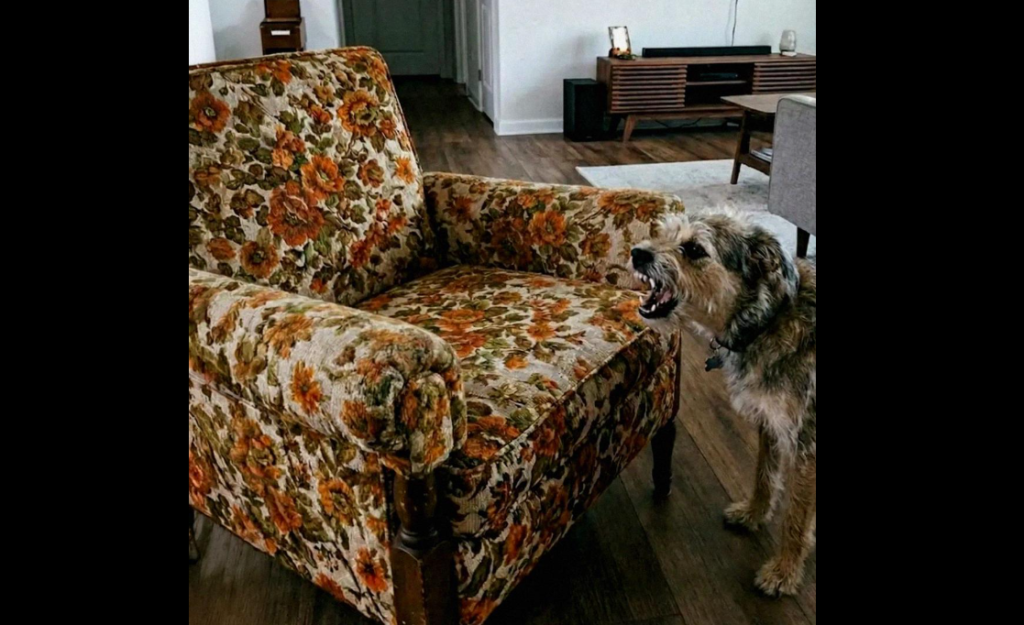
Milo kept barking at the garage sale couch until my mother-in-law saw it, turned pale, and said, “We threw it away for a reason.” Then she looked at my husband and added, “You were four years old the last time it was in our house.”
Jake and I got married two weeks after graduation and moved into a small rented apartment. We had a mattress on the floor, a folding table, and Milo, our rescued puppy. It was a very humble beginning.
“It’s temporary,” Jake would repeat, rubbing my shoulder optimistically. Every Saturday we hunted garage sales, laughed at broken lamps, and haggled like pros.
“It will remind you of your youth.”
I liked the teamwork, the way we could make other people’s junk our own. And, honestly, we found much more interesting things out there than any store could have offered.
In a sale, wedged between plastic toys and a pile of romance novels, was an oversized armchair with faded flowers and thick arms.
Jake ran his hand along the back of the chair and snorted. “No way! My grandma had one like that when I was little.”
I shrugged. “Exactly. It’ll remind you of your youth.”
The seller wanted $20, and the chair smelled dusty, but the frame seemed solid.
Milo, on the other hand, did not like it.
Jake lifted a corner and smiled at me. “Well, it’s a cozy reading chair.”
I imagined winter nights snuggled up to him and handed over the money without thinking twice.
Back home, we vacuumed, mopped, and sprayed the fabric until it no longer smelled like someone’s basement. The armchair, still old but suddenly charming, was illuminated by our work, and we centered the living room around it as if it were a throne.
Milo, on the other hand, didn’t like it. As soon as we put him on the ground, he froze, ears perked up, and then burst into frantic barking.
Milo continued barking all night.
“Milo, it’s just an armchair,” I said, holding his collar. He reached for it, teeth flashing, eyes fixed on the left armrest. Jake tried treats, then scolding him, but Milo kept barking all night.
A week later, we threw a small housewarming party with pizza, cheap beer, and paper plates. Jake’s mother, Diane, arrived last, kissed us on the cheeks, and toured the house to inspect it.
When Diane entered the living room, she stopped. Her eyes fixed on the armchair, and the color drained from her face. Diane approached, circled it twice, and touched a mark on the armrest, gently tracing the dark line in the wood.
“You were four years old the last time that armchair was in our house.”
“Where did they get it from?”
“At a flea market,” I said. “Why?”
Diane swallowed. “We threw it away for a reason.”
Jake stared at her. “Mom, you’re kidding.”
Diane kept looking at him, her lips pressed together.
I lowered my voice. “Diane, what happened?”
She looked at Jake instead of me. “You were four years old the last time that couch was in our house.”
Milo barked and my friends fell silent. Diane grabbed her purse. “Get rid of him tonight,” she whispered and left quickly.
“He recognized him. How?”
Jake stood there, pale, while Milo continued barking at the old armchair.
When the last guest finally left, Jake closed the door and looked at me.
“Okay, tell me you didn’t hear that.”
I sat down on the sofa, facing the armchair. “She recognized him. How?”
Milo prowled in circles, his fur standing on end, barking softly.
Jake called Diane; it went to voicemail. He called again; voicemail.
“Mom, call me,” he yelled into the phone, then threw it on the table. “We’re not going to throw away a couch just because my mom’s acting weird,” he muttered.
“If we find a squirrel skeleton, this will go in the trash.”
I didn’t argue, but I didn’t take my eyes off the chair either.
Around midnight, Milo stood in front of the armchair and refused to move. He stared at the left armrest, growled, and barked once, loud enough to rattle the windows.
“Okay,” I said, grabbing a flashlight. “Show me what you want.”
Jake took a seam ripper from our toolbox. “If we find a squirrel skeleton, this is going in the trash.”
I knelt beside the armrest and slid my fingers under the seam. The thread gave way and something creased on the inside.
Jake’s eyes widened. “That doesn’t look like stuffing,” he whispered. I pulled until a taped bundle came loose.
Inside was a picture of little Jake.
The package was wrapped in murky plastic and sealed with old yellow tape. Milo whimpered, his nose pressed against my elbow. I opened it, and an envelope fell out.
On the front, in shaky handwriting, it said : “For Jacob. When he is old enough.”
“It’s me,” Jake said, looking at the lettering. Inside was a picture of little Jake on a woman’s lap in that same armchair, and a folded letter.
Jake read the first line: “If you’re reading this, the couch is still alive.”
He read the rest in bits and pieces, taking his time with each fragment.
“Grandma disappeared one day.”
The letter said that his grandmother feared she would be “erased,” that Jake’s mother would rewrite the past until it sounded clean.
Then came the line that made Jake’s face go dry: “If you’re reading this, it means the couch made it, and I didn’t.”
She looked at me, blinking rapidly. “Grandma disappeared one day.”
Milo barked again, softer now, as if he agreed.
Jake clutched the letter to his chest. “My mother knows why,” he whispered. “She has to know.”
“Where did he get that armchair?”
The next morning, we drove back to the garage sale house.
The woman who sold it to us opened the door with her hair in curlers and frowned. “Is something wrong?”
Jake held up the envelope. “Where did he get that chair?”
“At a warehouse auction. I look for things like that.”
He rummaged through a drawer and handed me a crumpled receipt with the name of a business and a date on it. Underneath “Tenant” he had scribbled a first name and then a maiden name that I recognized from Jake’s mail.
Jake stared at it. “It’s my mother’s.”
“Don’t investigate.”
In the car, Jake photographed the receipt and texted Diane. Then he sent a picture of the envelope and typed, “Tell me the truth.” The reply came so quickly it felt like he’d been waiting for it: “Give it back. Please. I beg you.”
“What do you mean? Perpetuate the lie?”
Jake called; Diane answered, her voice trembling and panicking.
“Jake, no,” she said. “Don’t pry.”
He stared at the road, his knuckles white. “Let’s go that way.”
Milo whined for a while in the back seat and tried to lick his owner’s face.
“Tell me why you hid this.”
Diane opened the door when we knocked. Her eyes were swollen, and she kept wringing her hands against her sweater.
“Jake, honey,” she began.
Jake held up the letter. “No. No ‘honey’. Not now.”
I stayed one step behind him, but I didn’t look away.
“Tell me why you hid this,” Jake said. Diane looked out at the street.
“Come in,” Diane whispered.
“No. Don’t put it off any longer. Say it here.”
“You have to tell me what happened, Mom.”
Diane started crying: “Jake, your grandmother didn’t want to ignore it. She saw bruises. She said she would call someone. She said they would separate you.”
“Whose?”
“From your father,” Diane whispered.
“I don’t understand. You have to tell me what happened, Mom.”
Diane swallowed hard. “The night he disappeared, she came over and got into a fight with him. He pushed her. She hit her head on the arm of the chair. Mom didn’t get up.”
“So you chose him over Grandma?”
Jake looked at her as if he couldn’t recognize his own mother.
“So you called 911,” he said, without asking.
Diane remained silent.
“You didn’t,” I said, in a quiet voice.
Diane’s chin trembled. “I was scared. She said they would take you away. She said she would ruin us.”
Jake let out a laugh that sounded like pain. “So you chose him over Grandma?”
Diane held out her hand; he stepped back.
Jake didn’t raise his voice; that was what scared him the most.
“Where is it?” Jake asked.
Diane shook her head, tears streaming down her cheeks. “I don’t know. I didn’t ask. I didn’t want to know.”
Milo barked once, angrily.
Jake pulled out his phone, his thumb hovering over the screen. Diane’s eyes widened in pure terror.
“Jake, please. I’m your mother.”
Jake didn’t raise his voice; that was what scared him the most.
“You can’t do something like that and get away with it.”
“And it was my grandmother,” he said, and pressed the call button.
Diane slid against the door frame, crying into her hands.
“We can fix this,” he exclaimed. “Therapy, church, whatever you want.”
Jake shook his head once. “You can’t do something like that and get away with it.”
Minutes later a patrol car arrived. Milo huddled against my leg, trembling. I gripped his neck tighter. Two officers listened as Diane spoke haltingly, wiping her face and losing her composure.
Jake handed them the letter and the receipt.
He sealed everything in bags, labeled it, and marked it as “evidence.”
“We need that armchair,” he said. We drove home with them in the back, Milo whining the whole way. In the living room, Milo barked at the armchair once and hid under the table.
The agent photographed the upholstery, opened the seam with gloves, and removed the plastic bundle. She sealed everything in bags, labeled it, and marked it as “evidence.” Watching the armchair being taken away felt surreal.
After that, the days turned into statements, phone calls, and Jake staring at the ceiling for hours. He barely slept, and when he did, he woke up trembling.
Jake started therapy, and sometimes he would come home quiet.
One night, she whispered, “I thought my childhood had been normal.”
“There’s no such thing as a normal childhood, love. Everyone has some secrets. I’m sorry, yours is just that complicated.”
Diane sent long messages that ranged from apology to self-pity.
Jake once replied, ” You didn’t protect me. You protected yourself .” Then he blocked her.
Milo stopped barking almost completely, and the living room seemed lighter without that armchair.
A few months later, Jake started therapy, and sometimes he would come home quiet.
“Do you want a new reading spot?”
He would sit on the floor with Milo and say, “I am allowed to be angry,” and Milo would smack his tail.
At one point, I looked at the empty space where the couch used to be and decided to fill it with something that wasn’t a constant reminder of the trauma Jake was going through.
I found a plain gray chair in a second-hand shop, bought it, and brought it home as a surprise.
“Do you want a new reading spot?” I asked Jake after bringing the chair up to the apartment.
Jake eyed her suspiciously. “Does she come with secrets?” he joked. Or half-joked, really. I squeezed his hand.
“I keep thinking about my grandmother.”
“This is just a piece of furniture,” I said. “No hidden notes, I promise.” He nodded. We placed it where the old armchair had been. Milo sniffed once, jumped up, and rested his chin on the folded front legs.
That night, Jake sat in the new chair with a book he had been wanting to read for months.
I watched as he became distracted from his reading.
“I keep thinking about my grandmother,” he said.
“I want a house that doesn’t hide things.”
“Me too,” I replied. He just stared at the spot where the old armchair had been.
“I want a house that doesn’t hide things,” she said. “No false stories.”
I slipped my hand between hers. “We’ll make sure to build a home like that.”
Milo climbed onto Jake’s lap and fell asleep while the two of us sat thinking about the future we wanted to build together.

Leave a Reply