My name is Caroline Mitchell, but most people call me Carrie. I’m thirty-two and I live in Portland, Oregon, where the rain comes softly and often, as if the city itself is always trying to calm something down. For most of my adult life, I’ve believed in one thing with absolute certainty: if you love your child enough, you can protect them from anything. I believed love could fill holes. I believed presence could erase pain. I believed that if I just tried harder, stayed kinder, stayed stronger, nothing would ever touch my daughter the way the world had touched me.
After my first divorce, that belief became my survival plan. I brought my little girl home to a small apartment with creaky floors and a view of a brick wall, and I made promises out loud as if saying them would make them unbreakable. I promised I’d never let her feel abandoned. I promised she would always know she was wanted. I promised I would build a life that felt safe enough for her to grow inside it without flinching.
For a while, it was just the two of us. I worked, I cooked, I read bedtime stories, I laughed when I could, I cried when she couldn’t see. Emma was a gentle child—quiet in crowds, bright in small moments, the kind of kid who notices when someone looks sad and offers them her favorite sticker like it’s a cure. She loved drawing animals with oversized eyes and giving them names. She loved being wrapped in blankets on the couch while cartoons played softly in the background. She loved me with the uncomplicated trust only children can give, and I carried that trust like a sacred responsibility.
When Evan came into our lives, I didn’t fall for him in a sudden, cinematic way. It was slower than that. It was built out of ordinary kindness. He was calm and steady and never once made Emma feel like she was “extra baggage.” He didn’t talk about her like she was an obstacle to our relationship. He asked her what she liked. He listened to her answers. He learned her routines without trying to control them. If she wanted to show him a drawing, he didn’t pretend to care—he actually did. He put her artwork on the fridge without being asked. When she was shy, he didn’t force interaction; he let her come to him at her own pace, like you do with a cautious animal that needs proof you won’t harm it.
The first time she called him “Dad,” it wasn’t planned. We were in the kitchen, and Evan was trying to help her make pancakes. He held the whisk awkwardly like someone who didn’t grow up cooking, and flour dusted the counter like snow. Emma laughed and said, “Dad, you’re getting it everywhere.” Then she froze, eyes widening, as if she had said something forbidden.
Evan didn’t make it a big moment. He didn’t stare at me or make her apologize. He just smiled and said, “You’re right. I’m a mess. Can you teach me?” And Emma relaxed again, like her heart had tested the water and found it warm.
I thought that was it. I thought we had made it through storms and into peace. I thought the worst parts of my life were behind me. I thought my daughter and I had finally found what we deserved.
But children carry things quietly. They carry them like stones in small pockets, hidden until the weight starts to change the way they walk.
Emma turned seven this year. She had trouble sleeping since she was little, even before Evan. She would wake up crying in the middle of the night, sometimes wetting the bed, sometimes screaming as if she’d been pulled out of a nightmare she couldn’t explain. I thought it was growing pains or sensitive nerves or the leftover instability of a childhood split between two homes. I told myself she would outgrow it. I told myself a stable father figure would help.
When Evan moved in, I hoped things would get better.
But they didn’t.
Emma still cried in her sleep. Some nights she would sit up with her eyes open but not really seeing anything, staring into space with a look that made my skin prickle. Sometimes she would tell me in the morning that she didn’t remember anything, that she just felt tired, like she had been running in dreams all night. Sometimes she didn’t say anything at all and just moved through the day like a child who was trying to keep herself together.
Last month, I started noticing something strange.
Every night, around midnight, Evan would quietly leave our bedroom.
At first I thought he was just restless. Then I thought maybe he couldn’t sleep. Then I started hearing the soft creak of the hallway floorboards—the kind of sound you don’t notice unless you’re already half awake and already worried.
When I asked him about it, he answered calmly, almost casually.
“My back hurts, honey,” he said. “The couch in the living room feels better.”
I believed him because I wanted to believe him. Trust is a choice you make every day in a marriage, and I didn’t want to be the woman whose past made her suspicious of everything. I didn’t want to project my fears onto a man who had never given me a reason to doubt him.
But a few nights later, I got up for water and realized he wasn’t on the couch.
The living room was dark, the couch empty, the throw blanket neatly folded the way I always left it. The house felt too quiet, the kind of quiet that makes you aware of your own breathing. I stood there for a second and listened, holding my glass, trying to tell myself I was imagining things.
Then I saw a faint line of orange light spilling into the hallway.
Emma’s nightlight.
Her door was slightly open.
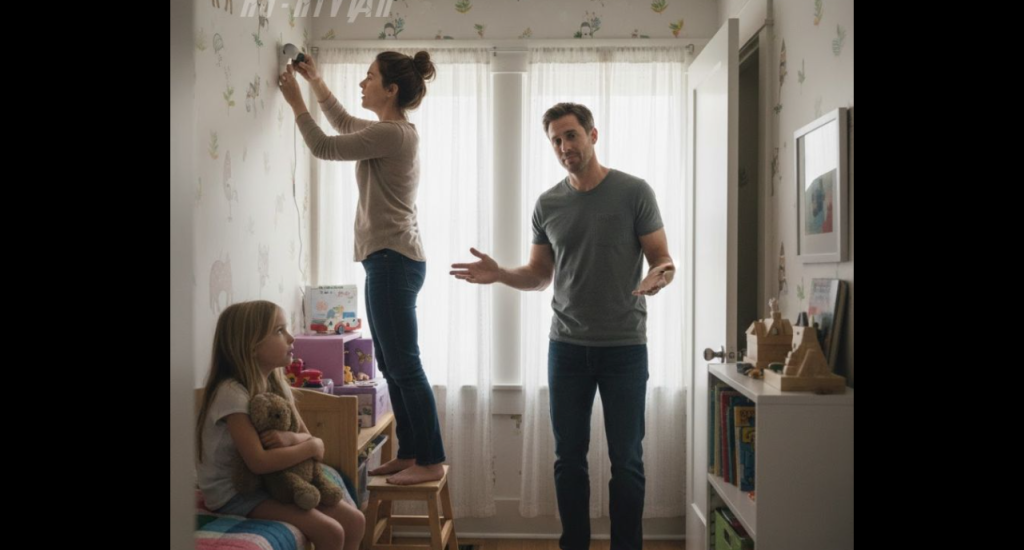
I moved toward it with my heart pounding, each step feeling too loud. When I looked through the gap, I saw Evan lying on the bed beside her, his arm gently around her shoulders.
I froze.
My stomach dropped so hard it felt like gravity had doubled.
Everything in me wanted to believe this was harmless. Everything in me also knew that the worst things in the world often arrive disguised as harmless.
“Evan,” I whispered sharply, voice shaking despite my attempt to control it. “Why are you sleeping here?”
He lifted his head, eyes tired but calm. He didn’t jump. He didn’t look guilty. He looked like someone interrupted in the middle of something routine.
“She was crying again,” he said quietly. “I went in to comfort her and must’ve fallen asleep.”
It sounded reasonable. It even sounded kind.
But something inside me wouldn’t rest. A heavy, uneasy feeling settled in my chest, like the warm still air before a summer storm. I stood there a moment longer, watching his face, trying to find a crack. Trying to find evidence of deception. And the terrifying truth was that I couldn’t. He didn’t look like a man hiding something. He looked like a man doing something he thought was necessary.
I went back to bed, but sleep didn’t come. My mind played tug-of-war with itself.
He loves her. He’s kind. He’s helping.
But why didn’t he tell me? Why does he leave at midnight? Why is he in her bed?
My thoughts spiraled into places I hated myself for visiting. I hated that I could even think such things about my husband. I hated that fear had the power to twist love into suspicion. But I also knew what every mother knows: if the worst thing is possible, you don’t get to ignore it just because it would be painful to face.
So I did what scared, desperate parents do when they don’t know the truth and their imagination is louder than reason.
I bought a small camera.
I told Evan I wanted to check our home security, that I’d heard about break-ins in the neighborhood, that it would make me feel better. He nodded and didn’t question it. That alone made me feel worse, because guilty people usually have excuses ready. Evan just accepted my explanation like it was normal.
I hid the camera in the corner of Emma’s room, tucked among stuffed animals on a shelf where it could see her bed and the door. My hands were clammy as I positioned it. I kept telling myself I was being responsible, that I was protecting my child. But underneath that was another truth: I was afraid of what I might find.
That night, I barely spoke at dinner. I watched Evan laugh at something Emma said, watched the way he refilled her water without thinking, watched the way he asked her about school and listened to her answer like it mattered. I felt like I was living in two realities at once: the one where he was the safe, steady man I loved, and the one where he might be something else entirely.
When everyone was asleep, I lay in bed staring at the ceiling, waiting. At midnight, Evan shifted, quietly slipped out, and the mattress barely moved. My body went rigid.
I waited a few minutes. Then I opened the app on my phone and pulled up the footage.
At around 2 a.m., Emma sat up in bed.
Her eyes were open but blank. Not focused. Not awake the way awake looks. She moved slowly, like she was underwater. She climbed out of bed and began walking around the room with small, unsteady steps. She bumped her head softly against the wall once, twice, like she didn’t understand the wall was there. Then she stood completely still, shoulders drooping, head tilted slightly, as if her body had paused in the middle of a command.
My heart stopped.
I covered my mouth with my hand to keep from making a sound even though no one could hear me. My fingers shook so hard I nearly dropped the phone.
A few minutes later, the door opened.
Evan walked in.
He didn’t panic. He didn’t shout her name. He didn’t rush at her like she was doing something wrong. He simply walked over, wrapped his arms gently around her, and whispered something close to her ear. The camera couldn’t catch the words, but I could see the way his body softened, the way his hand moved slowly between her shoulder blades like a calm rhythm.
Emma relaxed in his arms. Her muscles loosened. She turned like she was following a familiar path and climbed back into bed. Evan tucked the blanket around her, adjusted her pillow, and sat at the edge of the mattress with his hand resting lightly on the comforter near her arm, like he was guarding a fragile peace.
He stayed there a long time.
He didn’t touch her in any way that looked wrong. He didn’t linger in a way that felt secretive. He looked… tired. Like someone who had been doing this alone for a while.
I stayed awake until morning, unable to close my eyes. My fear didn’t vanish. It shifted shape. It became confusion and shame and a strange ache I couldn’t name.
The next day, I took the video to a children’s hospital downtown and asked to speak to a pediatrician. I didn’t tell anyone I was going. I told Evan I had errands. My hands shook the whole drive.
The pediatrician watched the footage twice. He didn’t look shocked. He looked thoughtful. Then he turned to me with careful professionalism.
“Your daughter has sleepwalking episodes,” he said. “It’s a type of sleep disorder that often shows up in children with deep fears or emotional stress.”
Then he asked a question that made my throat tighten.
“Has she ever been separated from you for a long time when she was younger?”
I froze.
Memories flooded back—the first divorce, the scramble to survive, the exhaustion and fear of being a single mother with no steady support. I remembered the month I left Emma with my mom so I could work out of town and get back on my feet. I’d told myself it was necessary. I’d told myself she was safe. I’d told myself one month wouldn’t matter.
But I remembered coming back and seeing her look at me like I was a stranger. I remembered her hiding behind my mother’s leg, scared and confused, eyes wide with betrayal she couldn’t explain. I remembered forcing a bright smile and telling myself, she’ll get used to me again.
I didn’t realize I had left a crack in her little heart—one that hadn’t healed. I didn’t realize that children can forgive and still carry fear. That they can love you and still panic when your footsteps disappear.
The doctor explained that sleepwalking can be triggered by stress and that the goal was safety and reassurance, not punishment. He told me to keep Emma’s sleep environment predictable, to reduce stimulation before bed, to make sure she couldn’t hurt herself during episodes, and to gently guide her back without waking her harshly.
I nodded through tears I didn’t want to show.
On the drive home, my hands clenched the steering wheel like it was the only solid thing in the world. My mind replayed the footage again and again—Emma walking like a ghost, Evan guiding her like he’d done it a hundred times. And slowly, painfully, the truth settled in.
Evan wasn’t sneaking into her room for himself.
He was going there for her.
That night, after Emma fell asleep, I sat on the couch with Evan and told him everything—about the camera, about my fear, about the way I had felt my body go cold when I saw him in her bed. My voice broke on the words because shame makes even honest sentences sound ugly.
Evan listened without interrupting. His face tightened once, not with anger, but with hurt. He exhaled slowly and looked down at his hands.
“I didn’t know how to tell you,” he admitted. “I didn’t want you to think you’d done something wrong. And I didn’t want Emma to feel like she was a problem.”
My throat ached. “How long?”
He rubbed his forehead like he was suddenly exhausted all over again. “A while,” he said. “I started noticing she would sit up at the same time, like clockwork. Sometimes she’d get out of bed. Once she almost walked into the hallway and down the stairs. I caught her before she got hurt.”
My stomach twisted. “You’ve been staying up every night?”
Evan nodded. “I set an alarm,” he said quietly. “Midnight. I go sit by her bed. Sometimes she doesn’t do anything. Sometimes she starts walking. I just guide her back. She settles faster if someone’s there. If I wake her, she gets terrified.”
I stared at him, and my eyes filled. The man I had secretly watched, the one I had doubted, had been sacrificing his sleep—his peace—night after night to protect my child. And he hadn’t told me because he didn’t want to make me feel guilty.
I cried then, not out of fear, but shame. The kind of shame that burns clean, the kind that forces you to face yourself. I had set up a camera to catch him doing something wrong, and what I found was proof of a love so quiet it almost hid itself.
I went into Emma’s room afterward and sat beside her bed, watching her breathe. Her face was relaxed in sleep, eyelashes resting on her cheeks. I brushed hair from her forehead and felt something inside me crumble and rebuild at the same time.
In the morning, I took the camera down. I didn’t hide it. I didn’t sneak it away like a secret. I removed it like you remove a splinter you no longer need.
Emma woke up and rubbed her eyes, then looked at me with that soft seriousness she has when she’s about to ask something important.
“Mom,” she said, voice small, “is Dad coming tonight?”
The word Dad still startled me sometimes, not because it was wrong, but because it carried so much meaning. Tears filled my eyes.
“Yes, sweetheart,” I said. “He’s always here.”
After that, we changed the routine. Not because the doctor demanded it, but because I couldn’t keep pretending that I alone carried everything. We moved a small mattress into Emma’s room for a while. Some nights I lay beside her until she fell asleep. Some nights Evan sat in the chair by the bed with a book, keeping watch quietly like a lighthouse in the dark.
Emma’s episodes didn’t disappear overnight. Healing rarely does. But something shifted. She began to settle faster. She began to wake up less panicked. The bedwetting decreased. The crying softened into occasional whimpers instead of screams. And on mornings after a calm night, she would wake up lighter, like her body wasn’t exhausted from fighting invisible storms.
I also started doing the work I should have done earlier—not to punish myself, but to repair what could be repaired. I talked to Emma gently about the past, in age-appropriate ways. I told her that when she was little, I had to go away for work, and it might have scared her. I told her that I was sorry. I told her that even when I’m not in the same room, I’m still her mom and I’m still coming back. I made sure my promises were backed by actions: consistent bedtime, consistent morning, consistent presence.
And Evan—Evan didn’t act like a martyr. He didn’t hold my fear over my head. He didn’t demand gratitude like payment. He simply kept showing up, the way he always had.
Some evenings, after Emma fell asleep, I’d find him in the kitchen washing dishes quietly, and I’d think about how easily I could have destroyed this peace with suspicion if the footage had looked different. I’d think about how fear can make you ready to strike before you’ve even confirmed you’re under attack. I’d think about how love sometimes looks ordinary: a man setting an alarm, moving softly through a hallway, sitting in a dark room to keep a little girl safe.
One night, weeks later, Emma had an episode. She sat up, eyes blank, then swung her legs over the side of the bed. I was there this time. I put my hands on her shoulders gently and whispered her name the way Evan had. I told her she was safe. I guided her back under the blanket. She sighed and settled like her body recognized the path back to rest.
When it was over, I sat on the edge of the bed, trembling with the leftover adrenaline of fear, and I realized something: Evan had been doing this alone. Quietly. Night after night. Carrying it so I didn’t have to panic. Carrying it so Emma could sleep.
I found him in the hallway afterward, and I didn’t say thank you like it was a small thing. I hugged him. Hard. Like I was trying to make my body communicate what words couldn’t.
He hugged me back and kissed the top of my head, and he didn’t say, See? I’m not a monster. He didn’t say, You doubted me. He just said, “We’ve got her.”
We.
That word mattered. It was the word I had been craving since my first divorce—the idea that I wasn’t alone in protecting my child.
Over time, our home began to feel different. The nights no longer felt heavy with dread. They felt like a team effort. Some nights Emma slept through. Some nights she stirred. But the terror that used to wrap around my chest like wire loosened with each calm night.
One afternoon, Emma came home from school with a drawing. It was a picture of our family—three stick figures holding hands. She had colored Evan’s shirt blue and mine green and gave herself a yellow dress with a huge smile. Above our heads she drew a moon and three stars. Then she wrote, in careful child handwriting, SAFE.
I stared at it for a long time.
Evan taped it to the fridge like it belonged there, like it was the most important document in the house.
That was when I understood what I had been learning in slow, painful steps. Some people don’t come into your life to replace someone. They come to repair what was broken. They come to hold steady the parts of you that are still shaking. They come to show your child, through consistent actions, that love can be calm, that care can be patient, that safety can be built.
I had set up that camera to catch my husband doing something wrong.
What I found instead was proof of true love.
The man I once doubted was the one who chose to carry our pain with tenderness. He didn’t need biology to make him family. He didn’t need DNA to make him protective. He didn’t need recognition to keep showing up in the dark.
People say a real father isn’t the one who gives you life, but the one who’s there when you need a hug. Before, that sounded like something you put on a mug. Now it feels like something I’ve watched unfold in real time, night after night, quietly, without applause.
And now, when Emma asks, “Is Dad coming tonight?” I can answer without fear.
“Yes,” I tell her. “He’s here.”
Because after all the storms, we didn’t just find peace.
We built it.

Leave a Reply